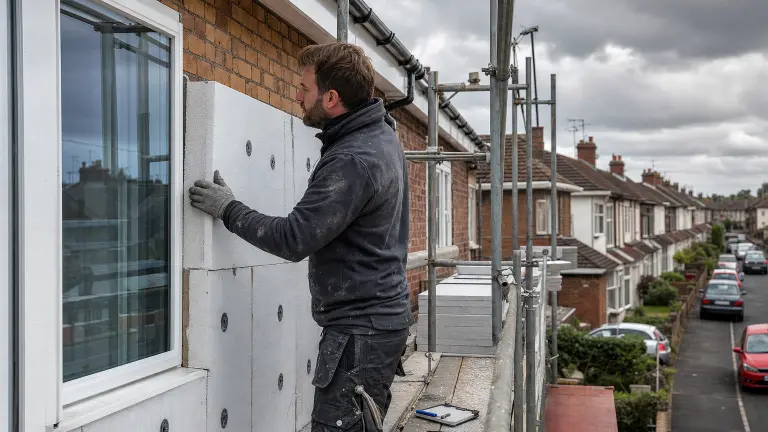
What is PAS 2030? It's the British standard for installing energy efficiency measures in existing homes, and it's the certificate that lets you install government-funded retrofit work. PAS 2035 sits above it and covers the whole retrofit project, from the assessment to the handover. Installers need PAS 2030. The project needs PAS 2035.
That's the short answer. The longer one is about who actually pays for this work, how many buyers ask for it, and whether a small firm should bother. Because here's the part people hate hearing: the certificate on its own wins you nothing. Somebody in the funding chain has to want you.
What PAS 2030 covers in plain terms
PAS 2030 sets out how a business installs measures like insulation, heating controls, ventilation and windows in homes people already live in. It isn't a trade qualification. Your lads still need their own trade competence.
What PAS 2030 checks is the business. How you survey, how you install, how you prove it was done right, how you deal with complaints. You get certified by a UKAS-accredited certification body, one measure at a time, and you get audited every year.
The 2023 edition is the live one
BSI published PAS 2030:2023 in September 2023. Certification bodies stopped taking new applicants on the 2019 version in April 2024, and the transition for finishing 2019 projects ended in March 2025. TrustMark has written the transition rules into its Framework Operating Requirements.
So if anyone sells you a 2019 certificate in 2026, walk away. Any new certification should be against 2023.
PAS 2035 is the project, PAS 2030 is the install
People mix these up all the time. Simple way to remember it: PAS 2035 is the brain, PAS 2030 is the hands.
PAS 2035 is the framework for running a retrofit project properly. It brings in named roles, and the main ones are:
- The Retrofit Assessor surveys the property and how it's used.
- The Retrofit Coordinator owns the project, manages risk and signs it off.
- The Retrofit Designer specifies the measures.
- The installer puts the measures in, certified to PAS 2030.
The Retrofit Coordinator is appointed before the installer starts, and you work to their specification. If you're a small installer, you mostly won't hold PAS 2035 roles yourself. A managing agent or prime contractor usually brings the coordinator, and you bring the PAS 2030 install.
How the retrofit funding chain works
This is where the money is, so learn the chain before you spend a penny on certification.
- Government sets the scheme and the rules.
- The money flows through an energy supplier obligation or a council grant.
- A managing agent or prime contractor wins the programme and needs installers.
- The installer, certified to PAS 2030 and registered with TrustMark, does the measure.
- The work gets lodged with TrustMark, and the funding pays out down the chain.
You can't join TrustMark directly. You go through an approved scheme provider, and for funded retrofit work you need TrustMark and PAS 2030 together. I covered that layer in What Is TrustMark?. If you're doing heat pumps or solar, MCS is a separate gate again.
The chain is changing, so check the dates
ECO4 was extended by nine months and now runs to 31 December 2026, according to Ofgem. The Great British Insulation Scheme was not extended. Government has said there's no ECO5 to replace the supplier obligation. The work moves to grant-funded routes, like Warm Homes: Local Grant through councils.
What this means for you: don't buy PAS 2030 to chase ECO4 jobs in November 2026. That's dead. Buy it because a managing agent or council programme you can actually reach needs installers next year. Check the Ofgem ECO page and TrustMark before you commit.
How many buyers actually ask for PAS 2030
We track UK work sources: housing associations, councils, managing agents, primes, portals and schemes. Each one has its own sign-up requirements.
At least 5 of the 557 UK work sources we tracked as of October 2026 state PAS 2030 (or PAS 2030 with TrustMark) as a requirement for funded retrofit work. About 7 more expect it from installers but we couldn't confirm it on their own pages. Another 3 hold PAS 2030 themselves and don't publish what they ask of their subcontractors.
The shape matters more than the number. Every one of them is retrofit: ECO and grant managing agents, insulation installer networks, decarbonisation primes, and the TrustMark side of things. None of the general housing association repair portals we tracked ask for it.
So PAS 2030 is a narrow key. It opens one door, a real one, and nothing else.
Do you need PAS 2030?
| Your business | Do you need it? |
|---|---|
| Insulation installer (loft, cavity, solid wall) wanting funded jobs | Yes, for each measure you install |
| Heating engineer doing funded boiler or controls work | Yes, plus your gas or oil registration |
| Heat pump or solar installer | Usually MCS first; PAS 2030 if the scheme funds it as a retrofit measure |
| Window or door fitter on funded retrofit programmes | Yes, if windows are in the funded scope |
| Retrofit Coordinator or assessor | No, you need the PAS 2035 role qualification instead |
| Subbie working under a certified installer's system | Check the contract. Often the certified business carries it |
| General builder, responsive repairs, voids, refurbs | No |
| Private-paying insulation or heating customers only | No, it's not a legal requirement for private work |
I ran a property maintenance company in London for housing associations and letting agents, all through subbies. The rule I lived by: never buy a badge before you've got a buyer who asks for it. Get the conversation with the managing agent first. Then certify.
What PAS 2030 costs and how long it takes
All figures here are as of October 2026, ex VAT, and they move. Check the operator's own page before you budget.
- PAS 2030 certification: priced by measure and usually quoted individually. One certification body, NetRet, publishes a starting price of £2,400 for one measure. Budget low to mid four figures for year one, more for each extra measure, plus annual surveillance.
- TrustMark: a central fee of £40 a year, plus your scheme provider's own fee on top.
- Your time: NetRet puts the process at roughly 3 to 6 months. You need a quality management system written to PAS 2030, an office audit, then a live install inspected for each measure.
One thing that caught people out: NICEIC stopped offering PAS 2030 certification from 31 March 2026. If your old notes say "go through NICEIC", they're out of date. OFTEC certifies heating installers, and there are other UKAS-accredited bodies.
The honest bar for a small firm: if you've got one van and no managing agent lined up, this isn't worth it yet. If you've got a crew, a buyer and the admin discipline to keep evidence on every job, it can be.
Running retrofit jobs without losing the evidence
PAS 2030 lives or dies on paperwork. Photos, surveys, specs, sign-offs, per job, per measure. Miss them and you fail the audit.
This is how I'd run it in Plan@Job. Plan@Job is project and operations management for the Operator, which means the contractor business running the clients, the jobs, the subbies and the in-house team.
Illustrative example: an external wall insulation job for a managing agent. You split it into internal stages: pre-install survey, prep and scaffolding, insulation, render, handover. Each stage gets its scope, dates, status and costs, and you mark which stages your own operatives do and which go to a subcontractor. The client sees the agreed overall scope and price plus the evidence you choose to share. Your stage costs and your subbie's identity stay internal.
Daniel Reed, our AI Operations Manager, can share eligible stages with your existing vetted network and follow up on quotes and proposed dates. He doesn't award work. You do. And for funded measures that decision includes checking that whoever installs is covered by a valid PAS 2030 certificate for that measure. Plan@Job doesn't certify anyone or lodge anything with TrustMark. That's still on you and your certification body.
The verdict
PAS 2030 is a door, not a business plan. Find the buyer, check the funding is still there next year, then certify against 2023. If that's you, set up your retrofit jobs properly from the first one. Start with Plan@Job for contractors.
FAQ
Is PAS 2030 a legal requirement?
Not for private work. Nobody needs PAS 2030 to insulate a loft a homeowner pays for. It becomes a gate when the job is government-funded, because the schemes require the installer to be PAS 2030 certified and TrustMark registered.
Can a sole trader get PAS 2030?
Yes, the standard doesn't care about size. But you carry the same quality system, audits and per-measure inspections as a bigger firm, so the cost per job is heavier. Many sole traders work under a certified installer instead.
Is PAS 2030:2019 still valid?
No for new certification. Certification bodies stopped taking new 2019 applicants in April 2024 and the transition for 2019 projects closed in March 2025. Anything you buy now should be PAS 2030:2023.