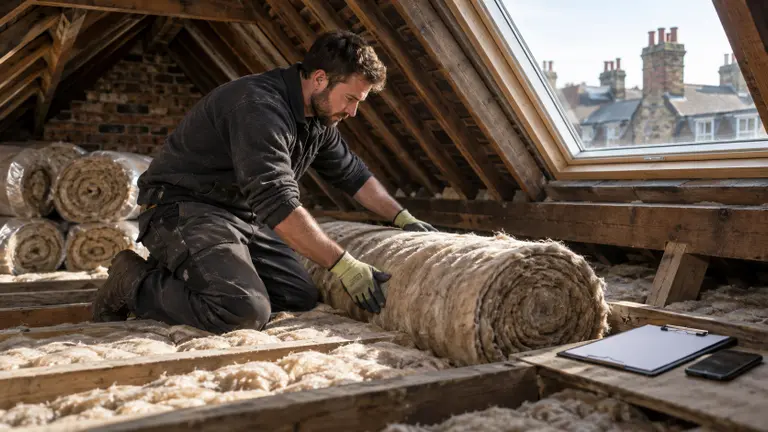
What is TrustMark? It's the UK's government-endorsed quality scheme for work in and around people's homes. You can't join it directly. You register through an approved scheme provider, and you agree to its Code of Conduct. For most trades it's optional. For government-funded retrofit, you can't get in without it.
That's the short answer. The bit people get wrong is assuming every client wants it. Most don't ask for it. A small group can't use you without it.
What TrustMark is, and what it isn't
TrustMark isn't a qualification. It doesn't prove you can fit a boiler. Gas Safe does that. NICEIC or NAPIT do that for electrics.
TrustMark sits on top of those. It says a licensed scheme provider has checked your business, you've signed up to a code of conduct on how you treat homeowners, and the customer has somewhere to go if the job goes wrong. It's about consumer trust, not technical competence.
Here's the route in, in order:
- Pick a scheme provider that covers your trade. TrustMark says there are over 40, a mix of trade associations and certification bodies.
- Pass that provider's own assessment and pay their membership.
- If you do PAS 2030 or MCS work, get certified by the relevant certification body first. TrustMark won't register you for those trades until you are.
- The scheme provider registers you with TrustMark and bills the TrustMark fee.
Everything official sits on trustmark.org.uk. Read it before anyone sells you a package.
Where TrustMark is the gate: funded retrofit
This is where it actually matters. TrustMark lists the government schemes it's tied to, including the Energy Company Obligation (ECO4), the Great British Insulation Scheme, Warm Homes: Local Grant and Warm Homes: Social Housing Fund.
On funded work, the installer of each measure needs TrustMark registration and PAS 2030 certification for that measure. The job also gets lodged in the TrustMark Data Warehouse. That lodgement is what the funding chain checks. Skip it and you've done the work without the paperwork that gets it paid.
PAS 2030 or PAS 2035?
PAS 2030 covers installing energy efficiency measures, like insulation, ventilation and heating. PAS 2035 covers the whole-house retrofit process around them: the assessor, the coordinator, the designer.
The current installer standard is PAS 2030:2023. The 2019 edition is still around under TrustMark's transitional arrangements. If you're buying certification now, buy it against 2023, and ask your certification body what the current transition rules mean for you.
Heat pumps and solar
Different gate. For heat pumps and solar, MCS is the badge clients and funders check. Plenty of installer networks also want a consumer code like RECC or HIES. TrustMark often comes bundled through the same provider, but MCS is the one that opens the door. Our MCS and PAS 2030 explainers are on the way.
How many clients actually ask for TrustMark
We track the UK places contractors get work from: housing association portals, councils, frameworks, main contractors, lead platforms and manufacturer installer networks. Recounted in October 2026, at least 5 of the 557 UK work sources we tracked state TrustMark as a requirement (on its own or as "PAS 2030/TrustMark").
The shape is clear. All five are retrofit: retrofit primes and cooperatives, an insulation installer network, an ECO managing agent, and one manufacturer's certified installer programme.
Around 8 more, mostly ECO and Warm Homes managing agents and retrofit primes, expect it for funded measures but don't say so on any page we could read. A handful hold TrustMark themselves without saying what they ask of subbies. And about 7 entries are scheme bodies offering a route into TrustMark through membership.
Now the other side. The standard housing association portal field set we mapped asks for insurance, CIS, Gas Safe, Constructionline and ISO. No TrustMark field.
So it's a narrow gate. It's critical in one lane and barely shows up anywhere else.
Do you need TrustMark? Check your trade
| Your work | TrustMark? | What clients check first |
|---|---|---|
| Insulation, ventilation or heating measures on ECO4, GBIS or Warm Homes | Yes | PAS 2030 for each measure, Data Warehouse lodgement |
| Retrofit assessor, coordinator or designer | Yes, for the PAS 2035 roles | Retrofit role qualifications |
| Heat pumps and solar (incl. Boiler Upgrade Scheme) | Often bundled, rarely the gate | MCS, plus RECC or HIES |
| Electrician on private homes | Optional | NICEIC or NAPIT, Part P |
| Gas engineer | Optional | Gas Safe |
| Windows, doors, roof windows | Optional, some manufacturer programmes ask | FENSA or Certass |
| Landscaping | Optional, through APL membership | Trade body membership |
| Housing association responsive repairs subbie | Not asked | Insurance, CIS, Gas Safe, SSIP |
| Commercial fit-out or main contractor packages | No | CSCS, SSIP, RAMS, insurance |
If you're an Operator (the contractor business that holds the client and runs the subbies) on funded work, the installer of each measure needs to be covered. Check with the managing agent and your scheme provider whose registration the lodgement goes under before you price anything.
What TrustMark costs (checked 16 October 2026)
There are two layers, plus the certification underneath.
- TrustMark's own fee is £40 a year according to TrustMark's FAQ, billed through your scheme provider.
- The scheme provider's TrustMark charge, on the published pages we checked, runs from roughly £50 to £145 + VAT a year. Some add an application fee of a similar size. NICEIC's TrustMark page, for example, lists £145 + VAT to apply and £145 + VAT a year.
- PAS 2030 certification is quoted per measure, not as a flat price. One certification body's fee sheet in our July 2026 data had an application fee, an office assessment and a per-measure assessment, each from tens to hundreds of pounds. Plan on four figures for the first measure before you've lodged a single job.
Your trade membership comes on top of all that. Prices move, so get a written quote from the provider before you commit.
Is TrustMark worth it if nobody's asking?
Honest answer: not yet.
On private homeowner work it helps a bit. Some homeowners look for the logo, and the code of conduct gives them comfort. But it won't fill your diary, and it won't get you onto a housing association portal or a main contractor's supply chain.
When I was running jobs for housing associations and letting agents in London, I had one rule for badges. Buy the one the client's paperwork asks for, not the one a salesman tells you that you need. Read the tender, the portal form, the managing agent's installer pack. If TrustMark is on it, get it. If it isn't, spend that money on the thing that is.
The exception is a deliberate move into funded retrofit. That market is real, and it runs on paperwork. Go in with PAS 2030, TrustMark and a clean lodgement process, or don't go in. If you want to talk it through with people building the same kind of business, that's what Contractor Club is for.
Running funded retrofit jobs without losing the plot
Funded work punishes messy jobs. You'll have several measures per property, each with its own installer, sign-off and evidence. Here's how it runs in Plan@Job.
Illustrative scenario, not a real job: an Operator takes on a batch of insulation measures for a managing agent. In the project plan they split each property into internal stages: survey, each install measure, and handover evidence. Every stage carries its own scope, dates, status and costs, and is marked as subcontracted or in-house.
The client sees the agreed overall scope and price, plus the evidence you choose to share. Your stage costs and which subbie did which measure stay internal.
Daniel Reed, the AI Operations Manager, can share eligible stages with your existing vetted network and chase quotes and proposed dates. He doesn't award work. You do. Before you award a measure, you check that installer's PAS 2030 and TrustMark cover that exact measure. That decision stays with a person, and it should.
Your next move
If funded retrofit is on your plan, or you already run subbies across staged jobs, have a look at how Plan@Job works for contractors in the UK. If you're a sparky doing private rewires and nobody has asked for TrustMark, don't buy it this week. Sort the registration that does get asked for first, starting with NICEIC, and check the rest in our UK compliance A-Z.
TrustMark FAQ
Is TrustMark a legal requirement in the UK?
No. No law makes every trade register with TrustMark. It becomes compulsory in practice when the work is funded through schemes like ECO4, the Great British Insulation Scheme or Warm Homes, because the funding rules require registered installers and lodged work.
Can I register with TrustMark directly?
No. TrustMark only registers businesses through its licensed scheme providers, which are trade associations and certification bodies. Pick the provider that already covers your trade, because you'll often pay less when TrustMark is added to a membership you already hold.
Does TrustMark replace Gas Safe, NICEIC or MCS?
No. Those prove you're competent and legal to do the technical work. TrustMark sits on top of them as a consumer standard. If you're doing gas work, you need Gas Safe either way.