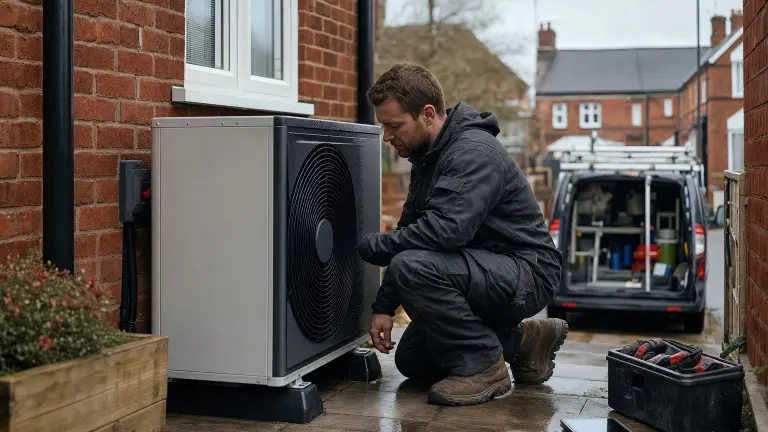
What is MCS certification? It's the Microgeneration Certification Scheme, the UK standard for businesses that install heat pumps, solar PV, battery storage and other small-scale renewables. If your customer wants a Boiler Upgrade Scheme grant, the installer needs it. That's the gate. Everything else is detail.
Here's the part people get wrong. MCS isn't a course you pass on a Friday. It certifies your business: your processes, your technical supervisor and your installs. And you keep proving it every year.
What MCS actually checks
MCS writes the standards. It doesn't certify you directly. You apply through an MCS-approved certification body, and NICEIC and NAPIT are the names most trades already know. The official MCS site lists the current certification bodies and standards.
Roughly, the certification body wants to see:
- a named technical supervisor who is competent in each technology you want certified
- a quality management system covering how you survey, design, quote, install, commission and hand over
- membership of an approved consumer code, usually RECC or HIES
- every finished install registered on the MCS Installations Database
- a site assessment of real work, then surveillance every year after
You're certified per technology. Heat pumps and solar PV are separate scopes, and you pay for each one.
Why MCS decides who gets funded work
The Boiler Upgrade Scheme in England and Wales is the big one. Checked on GOV.UK on 21 October 2026, it lists £7,500 towards an air source or ground source heat pump, £5,000 for a biomass boiler and £2,500 for an air-to-air heat pump. Until March 2027 there's an extra £1,500 for an air or ground source heat pump in some off-gas homes heated by oil or LPG.
The detail that matters to you: GOV.UK says the installer applies for the grant on the customer's behalf through Ofgem, and tells homeowners to get quotes from MCS certified installers. So the application runs through the installer. Without MCS you're quoting against someone who can take £7,500 off the bill. That quote is dead before you send it.
Solar works the same way in a different shape. Customers who want export payments under the Smart Export Guarantee generally need an MCS certified installation, so they ask about MCS before they ask about price.
Every country builds its own gate. In Canada, tradespeople argue about whether the Red Seal is worth the effort. In the UK renewables market, MCS is the gate with grant money behind it.
How many UK work sources ask for MCS
We track the registration requirements of UK work sources: housing association portals, procurement platforms, lead sites, energy networks and manufacturer installer programmes. At least 6 of the 557 UK work sources we tracked as of October 2026 state MCS as a requirement outright.
Six sounds small. Look at where they sit:
- solar group-buying schemes and solar marketplaces
- heat pump and solar lead platforms that only pass grant-eligible leads to certified installers
- an energy supplier's installer referral network
- a ground source manufacturer's installer pathway
About 7 more expect it without saying so on their public pages. They're mostly retrofit managing agents, renewables lead sites and manufacturer networks. Another 7 energy companies and prime contractors hold MCS themselves, which tells you where subcontracted renewables work sits.
Three manufacturer programmes run an MCS umbrella route. That lets an installer work under the manufacturer's certification while building towards their own. Read the terms before you rely on one, because not all of them are published.
What you won't see in our data: housing association portals asking for MCS at sign-up. Their gates are Gas Safe, insurance and safety schemes. MCS is a specialist gate, not a general one.
Do you need MCS? Check your business against this table
In Plan@Job, an Operator is the contractor business that wins the client, manages delivery and runs the subcontractors and in-house operatives. Most Operators reading this don't need MCS. Some definitely do.
| Your business | Need MCS? | What to do |
|---|---|---|
| Heat pump installer chasing grant-funded jobs | Yes | Certify per technology, or start under a manufacturer umbrella route |
| Solar PV or battery installer selling to homeowners | Yes, in practice | Platforms and customers ask for it before price |
| Gas or oil boiler engineer, no renewables | No | Gas Safe or OFTEC is your gate |
| EV charger installs only | No | Chargers aren't microgeneration, so networks ask for other approvals |
| Maintenance operator or main contractor asked for the odd heat pump | Usually no | Subcontract to an MCS installer and keep their paperwork on file |
| Subbie fitting for an MCS company | Not personally | The certified company carries it, so ask what competence evidence they need from you |
| Retrofit under ECO or Warm Homes | Yes, for renewable measures | Expect PAS 2030 and TrustMark on top |
What MCS costs in 2026
Fees are set by each certification body, not by MCS. Checked on 21 October 2026, NICEIC's published MCS fees for 2026/27 work out like this:
- In year one it's £855 ex VAT for one technology, covering application, certification and licence. Four technologies come to £1,920 ex VAT.
- From year two it's £695 ex VAT for one technology, up to £1,755 ex VAT for four.
Then budget for the rest. There's a fee for each install registered on the MCS Installations Database. There's your consumer code membership, training for your technical supervisor, and the hours it takes to write a quality system you can actually follow. Third-party guides put year one at roughly £1,000 to £3,000 all in. Get quotes from at least two certification bodies before you commit, because prices move.
The bit people hate hearing
Paying for MCS doesn't get you work. It gets you permission to quote for it.
Heat pumps are design work. Heat loss, emitter sizes and what the customer expects to pay to run the thing. Get the design wrong and you own that callout every winter.
When I ran a maintenance company in London for housing associations and letting agents, the rule was simple. If a client asked for something we weren't certified for, a certified subbie did it and their paperwork went on the file. You certify when the volume justifies it, not for one job.
My verdict: if heat pumps or solar are a regular ask, get certified and price it as a proper line of business. If it's twice a year, subcontract it and keep the margin.
Running funded renewable jobs as an operator
Illustrative example: a maintenance operator is asked to swap an oil boiler for an air source heat pump in a rented house. They're not MCS certified. In the Plan@Job project plan they split the job into internal stages: survey, the heat pump install subcontracted to an MCS installer, electrical work by their own operative, then making good. Each stage carries its own scope, dates, status and costs.
The landlord sees the overall agreed scope and price, plus the evidence you choose to share, like commissioning photos. Your stage costs and the name of the subbie who did the install stay internal. Your margin stays your business.
In the background, Sophie Bennett, the AI Enquiries Coordinator, checks the job brief for missing information, like the fuel type or property details, and asks for it. Daniel Reed, the AI Operations Manager, follows up quotes and proposed dates with your existing vetted network. More on what they do on the AI staff page.
What stays with you: who gets the work, at what price, and whether that installer's MCS certificate covers the technology on the job. Check it yourself before you award. That's a person's decision, not software's.
FAQ
Is MCS the same as TrustMark?
No. MCS certifies you to install renewables. TrustMark is the government-endorsed quality scheme for work in and around the home, and it comes up constantly on funded retrofit. Some certification bodies offer both, and our guide to which work requires TrustMark covers the other half.
Can I fit a heat pump without MCS?
You can install one if you're competent and follow Building Regulations and the refrigerant rules that apply to the unit. But your customer won't get the Boiler Upgrade Scheme grant, and most of them will walk when they find out. Without MCS you're competing on the full price.
How long does MCS certification take?
It depends on your certification body and how ready you are. The slow part is usually writing the quality system and lining up an install for the assessment, not the application form. Ask the certification body for its current timescale before you promise a customer a date.
If you run the client, the subbies and the margin in between, that's who Plan@Job is built for. See how it works for UK contractors, or set up your operator account and put your next heat pump job in as stages.