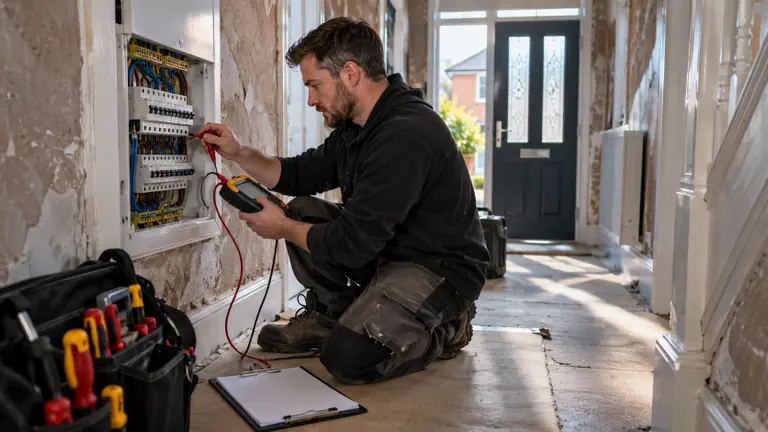
NICEIC registration means your electrical business has been assessed by NICEIC, the best-known UK certification body for electricians. On its domestic schemes it lets you self-certify notifiable electrical work in homes under Part P of the Building Regulations. Put simply, an assessor has been out, checked your work and your paperwork, and signed you off.
It unlocks two things. You can sign off your own domestic electrics without going to building control every job. And you get through the door with buyers who won't put an electrician on their list without it.
Here's the part people get wrong. It's not a qualification. Your qualifications get you through the assessment. Registration is your business being assessed.
What NICEIC registration actually covers
NICEIC runs certification schemes for electrical contractors. You register the business, and you name a Qualified Supervisor who is responsible for the standard of the work.
There are two schemes most trades hear about. Domestic Installer is for electricians working in homes, and it's built around Part P. Approved Contractor is the broader one, covering domestic, commercial and industrial work, and it's the one bigger clients tend to recognise. NICEIC lists the full scheme range on its official site.
Where Part P comes in
In England and Wales, some electrical work in homes is notifiable under Part P. Think new circuits, consumer unit replacements and certain work in bathrooms. There are two legal routes.
- You're registered with a government-authorised competent person scheme. You self-certify, and the scheme notifies building control for you.
- You're not registered. You tell local authority building control before you start, and you pay their fee.
NICEIC is one of those competent person schemes. NAPIT is another, and there are others. GOV.UK keeps the list of competent person schemes. Scotland runs its own building standards system, so if you work up there, check the Scottish rules separately.
Who actually asks for NICEIC
We track 557 UK work sources. That covers councils, housing associations, tier-1 contractors, installer networks, frameworks and trade platforms. As of October 2026, at least 11 of the 557 UK work sources we tracked name NICEIC, or NICEIC alongside an equivalent electrical registration, as a requirement outright. Around 20 more point to it per lot or per discipline without spelling it out at sign-up.
The shape matters more than the number:
- Councils and housing associations put it on the M&E and repairs lots, not on the front door.
- Energy, EV charger and heat installer networks expect a Part P scheme from anyone touching the electrics.
- The retrofit funding chain runs through TrustMark, and TrustMark needs you on a recognised scheme for your trade.
- Kitchen and bathroom installer networks ask for your registration, or your subbie electrician's details.
Eleven isn't a big number. It's not supposed to be. NICEIC is a trade credential, not a company badge like CHAS. The buyers who ask for it are the ones with electrical work behind them. That's exactly where an electrician wants to be.
Do you need it? Depends what you do
| You are | Do you need NICEIC or a similar scheme? | Why |
|---|---|---|
| Electrician (sole trader or Ltd) doing notifiable domestic work | Yes, or another competent person scheme | Without one, every notifiable job goes through building control |
| Electrical contractor going after council, housing association or commercial work | In practice, yes | The buyers who ask for it put it in writing. Read each tender's exact wording |
| Electrician doing commercial or industrial work only | Not for Part P, which covers homes | Buyers will still ask for it |
| Builder or kitchen and bathroom fitter whose electrics go to a subbie | No | Your electrician needs to be registered and issues the certificate |
| Builder with a qualified operative doing regular electrics in-house | Maybe | Domestic Installer can pay for itself if the volume is there |
| Like-for-like swaps that aren't notifiable | No legal need | The work still has to be safe and done to the wiring regs |
| Plasterer, decorator, roofer, groundworker | No | Not your trade. Don't pay for a badge you'll never use |
Builders: your electrician's certificate, not your registration
This is where general builders get caught. You don't need NICEIC to deliver a kitchen with new circuits in it. You need an electrician who is registered, who does or supervises the work, and who issues the certificates in their name.
When I ran my maintenance company in London, working for housing associations and letting agents, the electrics always went to a registered subbie. Not because I couldn't find someone cheaper. Because the certificate is the job. No cert, no handover.
So before you award the electrical stage:
- Check the electrician on the scheme's public register. Don't take a logo on a van as proof.
- Agree up front who issues the Electrical Installation Certificate and who handles notification.
- Get the certificates before you hand over, not "next week".
Your registration doesn't cover their work, and theirs doesn't cover yours. Simple.
What it costs and how long it takes
I checked NICEIC's own scheme pages on 13 October 2026. These are its published 2026/27 fees, before VAT.
- Year one: roughly £700 to £1,300 to join, depending on the scheme. Domestic Installer sits at the bottom of that range and Approved Contractor at the top. That figure is the application fee plus 12 months' certification.
- Year two onwards: around £575 to £615 a year, depending on the scheme and how you pay.
- Extras: an optional pre-assessment, any additional assessments, and a small per-job charge for building regulations notifications.
Fees change. Check the Domestic Installer scheme page and the current Approved Contractor fee sheet before you budget.
On timing, it comes down to assessor availability and how ready you are. Plan in weeks, not days. Don't price a job that needs registration until you've got it.
How to get registered, step by step
- Sort the Qualified Supervisor. That's you or someone in the business. They need the qualifications and experience NICEIC lists for your chosen scheme.
- Pick the scheme. Domestic Installer if you're in homes. Approved Contractor if you're chasing commercial work or bigger buyers.
- Apply and pay the application fee.
- Get ready. Calibrated test kit, the current wiring regs, and completed certificates from your own recent jobs.
- Have your assessment. The assessor looks at real work and your paperwork. If something's wrong, fix it and don't argue.
- Stay on it. You're reassessed every year. Your registration is only as good as your last visit.
Running the electrical stage in Plan@Job
If you're the Operator, the contractor business managing the client, the delivery, your subbies and your own operatives, the Plan@Job project plan lets you split a job into internal stages. Electrical first fix and second fix can each be a stage with its own scope, dates, status and costs, marked as subcontracted or in-house.
Your client sees the overall agreed scope and price and the evidence you choose to share. They don't see your subbie's identity or your internal stage costs. That's your margin, and it stays yours.
Daniel Reed, the AI Operations Manager, can share eligible work with your existing vetted network and follow up on quotes and proposed dates. In supported workflows a subbie can price before they're fully vetted. Checking their scheme registration and deciding who gets the electrical stage is your call. No AI awards the job.
The next move
NICEIC makes sense for you if you're an electrician doing notifiable work in homes, or if you want the council, housing association and installer network work that sits behind it. If you're a builder with no electrician on the books, you don't need the badge. You need a registered subbie and the discipline to get the certificate before handover.
Either way, the job only runs as well as your plan. If you run the client, the subbies and the handover yourself, set up Plan@Job as a contractor and put your next job into stages.
NICEIC questions people actually ask
Is NICEIC registration a legal requirement?
No. The law says notifiable domestic electrical work in England and Wales has to meet Part P and be notified. Registering with a competent person scheme is one way to do that, and NICEIC is one of those schemes. The other route is building control, job by job.
Can I do electrical work without being NICEIC registered?
Yes. Non-notifiable work doesn't need a scheme, and notifiable work can go through building control instead. It still has to be safe and to the wiring regs. What you lose is the ability to self-certify, plus access to the buyers who ask for registration.
Does my NICEIC registration cover my subcontractors?
No. It covers work your business does under your Qualified Supervisor. Don't put your name on a certificate for work you didn't do or supervise. If a subbie does the electrics, they need their own registration and issue their own certificates.