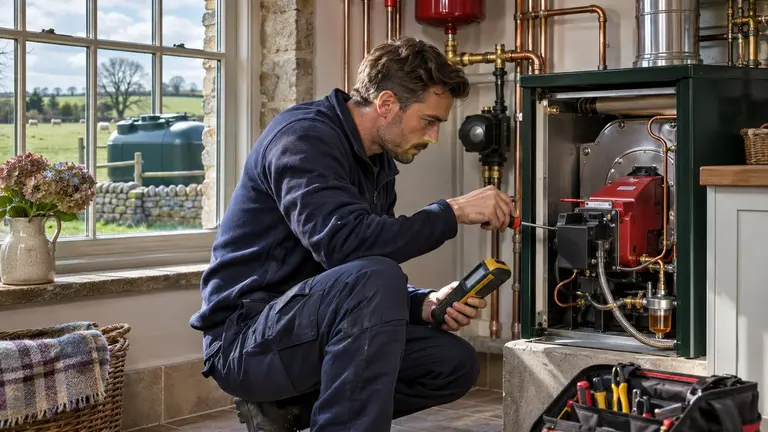
What is OFTEC registration? It is membership of the competent person scheme run by OFTEC, the Oil Firing Technical Association. It shows that a business and its technicians have been assessed as competent for oil heating work, and it lets them self-certify notifiable installations under Building Regulations in England and Wales instead of notifying building control each time.
If you install, replace or commission oil boilers or oil storage tanks, registration is the normal route to doing that work cleanly. If you only service oil boilers, or never touch oil at all, you may not need it. This guide sets out who it applies to, how it differs from Gas Safe, and how to decide whether it is worth adding to your business.
What OFTEC registration covers
OFTEC is the trade association and registration body for the oil heating industry. It also covers some solid fuel and renewable heating work, but oil is where most contractors meet it.
Registration has two layers.
Technician competence
Individual technicians train and pass assessments for specific categories of work. Typical categories include servicing and commissioning oil appliances, installing oil appliances and installing oil storage tanks. Being assessed in one category does not cover the others. A technician registered for servicing is not automatically covered for tank installation.
Business registration
The business registers with OFTEC and names its registered technicians. That is what allows the business to self-certify notifiable work. When the job is finished, the business notifies the work through OFTEC, and the customer receives a certificate showing it complies with Building Regulations.
This matters later. Buyers, surveyors and insurers often ask for that certificate when a house is sold or a claim is made.
Do you need OFTEC registration?
The short answer: you need it if you want to self-certify notifiable oil heating work in England or Wales. Installing or replacing an oil boiler and installing an oil tank are the common examples. Without registration, that work has to be notified to the local building control body before it starts, which adds fees, inspections and delay.
Use this table as a starting point.
| Your business | Typical oil work | Do you need OFTEC registration? |
|---|---|---|
| Heating engineer covering rural or off-gas-grid areas | Boiler installs, replacements, commissioning | Usually yes, for self-certification |
| Specialist tank installer | New and replacement oil tanks | Usually yes, for the tank installation category |
| Servicing-only engineer | Annual services, breakdowns | Not always required, but customers and insurers often expect it |
| General builder or renovation contractor | Kitchen or extension work near an existing boiler | No, if you subcontract the heating work to a registered firm |
| Plumber working only on gas properties | Gas boilers, no oil appliances | No, Gas Safe is what applies |
| Main contractor commissioning heating work | Oversight only, heating subcontracted | No, but check your subcontractor is registered for the right category |
| Electrician | Wiring to a boiler or controls | No for the electrical work, which falls under electrical competent person schemes |
Scotland and Northern Ireland run their own building standards and building control systems. Oil heating is common in both, so check the local requirements before quoting there.
OFTEC vs Gas Safe: the key difference
Contractors often treat these as the same thing for different fuels. They are not.
- Gas Safe registration is a legal requirement. Anyone working on gas appliances and fittings for payment must be on the Gas Safe Register. Working on gas without it is a criminal offence.
- OFTEC registration is the competent person route for oil. There is no equivalent legal register that every oil technician must join. The legal hook is Building Regulations: notifiable work must be either self-certified through a scheme or notified to building control.
- Competence still matters either way. Oil appliances carry real risks, including carbon monoxide, fire and fuel spills. Unregistered does not mean unaccountable.
- Many engineers hold both. In mixed areas, being able to quote for gas and oil jobs keeps your diary fuller across seasons.
You can check the official details on the OFTEC website and the Gas Safe Register.
If you work for landlords, remember that current smoke and carbon monoxide alarm rules in England cover rooms with fixed combustion appliances, which include oil boilers. Check the current regulations before advising a client on what applies to their property.
How much demand is there for oil heating work?
Oil heating is a niche. Most UK homes are on mains gas, so the volume of oil work is smaller. It is concentrated in rural areas, off-gas-grid villages and parts of the UK where mains gas never arrived.
That cuts both ways:
- Fewer jobs overall. You will not fill a large team on oil work alone in most regions.
- Fewer competitors. In off-gas-grid areas, customers often struggle to find a registered engineer, especially at short notice in winter.
- Travel matters. Jobs are spread out. Price your travel and time honestly rather than absorbing it.
- Repeat work. Annual servicing and tank checks give you a predictable base if you look after customers.
Before committing to training, look at your own patch. How many enquiries for oil work have you turned away this year? Who else nearby is registered? If the answer is very few, the niche may be worth it.
How to get OFTEC registered
The route is fairly consistent, but check OFTEC's current guidance before booking anything.
- Decide your categories. Servicing only, installation, tank installation, or a mix. Match this to the work you actually want to win.
- Book training and assessment. Use an OFTEC-approved training centre. Experienced engineers may only need assessment; newer ones usually need the full course.
- Pass the assessments. Each category has its own assessment. Plan for the time off the tools.
- Register the business. Apply to OFTEC with your registered technicians, insurance details and company information.
- Set up your notification process. Know who in the business notifies completed work and how certificates reach the customer.
- Keep it current. Registration and technician competence need renewing. Diary the dates.
What it costs
OFTEC publishes its current registration and assessment fees, and training centres set their own course prices. These change, so check the official sources rather than relying on any figure in a blog post. When you budget, include:
- Training and assessment for each technician and category
- Annual business registration and per-job notification fees
- Tools, including a suitable combustion analyser
- Insurance that covers oil heating work
- Days lost to training
Running oil heating jobs through Plan@Job
Plan@Job is AI-powered project and operations management for construction and property businesses. In Plan@Job, the Operator is the contractor business that manages clients, project delivery, subcontractors and in-house operatives. Here is how an oil heating job can run through it.
Illustrative example: a renovation contractor wins a farmhouse refurbishment that includes replacing an old oil boiler and tank. Their own team handles the building work. The heating goes to an OFTEC-registered subcontractor.
Split the job into stages
Using project management, the contractor splits the job into internal stages: strip-out, tank base and tank installation, boiler replacement, commissioning and making good. Each stage has its own scope, dates, status and costs. Some stages are in-house, others subcontracted.
The client sees the overall agreed scope, the price and any evidence you choose to share. Internal stage costs and the subcontractor's identity stay internal.
Let the AI staff handle the chasing
Plan@Job's AI staff work in the background:
- Sophie Bennett, AI Enquiries Coordinator, checks existing job briefs for missing information, such as tank location or the age of the current boiler, and asks for clarification. If two attempts do not get an answer, she hands it back to you.
- Daniel Reed, AI Operations Manager, supports sharing eligible work with your existing vetted network, follows up quotes and proposed dates, and sends you a morning brief.
- Maya Collins, AI Finance Coordinator, prepares deposit requests and overdue payment actions for your approval.
What still needs your decision
The AI staff do not award work, set prices or move money. You decide:
- Which subcontractor gets the heating work
- Whether their OFTEC categories match the job, including tank installation if needed
- The price you agree with the client
- When deposits and payment chasers go out
Subcontractors can sometimes price before vetting is complete in supported workflows. Checking registration and approving them for the job is still your call at the right stage.
Is oil heating work right for your business?
If you are already a heating engineer in an off-gas-grid area and keep turning down oil enquiries, OFTEC registration is likely worth the training time. If you are a builder or main contractor, you probably do not need it yourself. You need a reliable registered subcontractor and a clean way to manage the job around them. For more on growing a contracting business, the community at Contractor Club is a useful place to compare notes with other UK contractors.
If you run jobs with a mix of in-house and subcontracted trades, see how Plan@Job works for UK contractors.
FAQ
Is it illegal to work on an oil boiler without OFTEC registration?
No, there is no legal register for oil work equivalent to Gas Safe. However, notifiable work such as installing a new oil boiler or tank must comply with Building Regulations. Without registration you would normally have to notify building control before starting. You must also be competent to do the work safely.
Can a Gas Safe engineer work on oil boilers?
Gas Safe registration covers gas work only. A Gas Safe engineer needs separate oil training, and OFTEC registration if they want to self-certify notifiable oil installations. Many engineers in rural areas hold both.
Does OFTEC registration cover oil tank installation?
Only if the technician has been assessed for the tank installation category. Boiler servicing and installation categories do not automatically include tanks. Check the categories on a subcontractor's registration before assigning them tank work.