
Subcontractor margin in construction comes down to one rule: price the client first, then work out what you can offer the sub. Not the other way round. If you take the subbie's number and stick your bit on top, you're not running a margin. You're running hope. Decide what the job is worth to the client, decide what you need to keep, and the gap between the two is your ceiling for the sub.
I learned that on the tools, then learned it again running a property maintenance company in London where most of the work went out to subcontractors. The jobs that hurt were never the ones where the sub was expensive. They were the ones where I didn't know my number before I picked up the phone.
This guide is for operators. On Plan@Job, an Operator is the contractor business that manages the client, the delivery and the people doing the work, whether that's subcontractors or your own operatives. Here's how to set the offer, step by step, and which parts Plan@Job handles versus which parts are your call.
Margin or markup: get this straight first
Margin is what you keep as a share of the client price. Markup is what you add on top of your cost. They are not the same number, and mixing them up is the quietest way operators give money away.
Illustrative arithmetic, not a market rate: a sub prices a job at £8,000 and you add 25% markup. The client pays £10,000. You keep £2,000. That's a 20% margin, not 25%.
Pick one and use it everywhere. I work in margin, because margin is what's actually left when the client pays.
What your margin has to cover
Your margin isn't profit. Before you set a target, be honest about what comes out of it on a normal job:
- site visits and quoting, including the jobs you don't win
- your time managing the sub, the client and the handover
- the snag list and any callback after the sub has left
- materials, if you supply them rather than the sub
- the gap between paying the sub and the client paying you
- the van, insurance, software and the phone that rings at 9pm
Then there's tax admin. If the work falls under the Construction Industry Scheme, you've got deductions and returns to handle as a contractor. Check HMRC's current guidance or ask your accountant. I'm not quoting rates here.
Here's the part people hate hearing: if your margin only covers the cost of running the job, you're working for free with extra steps.
Step 1: Price the job to the client in Jobs
Start in Jobs, not in your phone contacts. Build the quote from the scope: what's being done, where, by when, and what's included. Use your own experience of what the work is worth and what the client will pay.
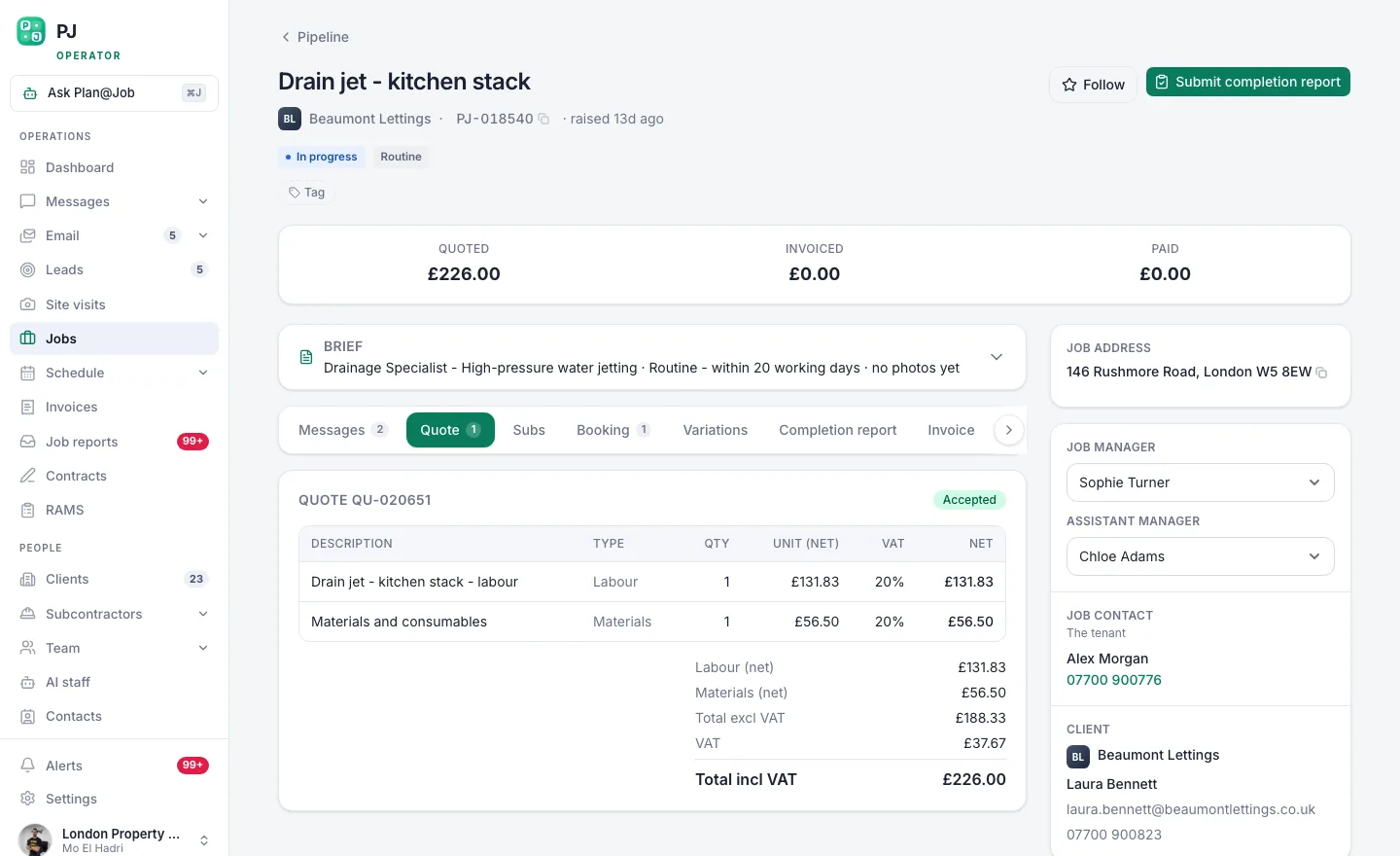 The client sees one scope and one price. Your stage costs stay behind it.
This step is a person's decision, full stop. Plan@Job doesn't set your prices and it doesn't decide what the client should pay. It gives you one place to hold the scope and the number.
Step 2: Split the job into stages with internal costs
Open the project plan and split the job into internal stages. Each stage gets its own scope, dates, status and costs, and each can be subcontracted or done in-house by your own operatives.
This is where the margin lives. The client sees the overall agreed scope and price, plus any evidence you share with them. Your internal stage costs and the identity of your subcontractor stay internal. That's how a middleman should run. The client buys the result from you, not a list of who you hired.
You can read more on how stages work on the project management page.
Step 3: Work out your ceiling for each stage
Now do the sum before anyone quotes you. For each stage:
- Take the part of the client price that belongs to that stage.
- Multiply it by one minus your target margin.
- Take off anything you're carrying yourself on that stage, like materials or skip hire.
- What's left is the most you can pay the sub.
Illustrative example, labelled as such: a stage is worth £4,000 to the client and you want a 25% margin. That leaves £3,000 of cost. You're supplying £400 of materials. Your ceiling for the sub is £2,600.
Your ceiling is not your opening offer. It's the line you don't cross. Write it against the stage so you're not doing maths in your head on a call. This step is yours too. The platform holds the numbers, you set them.
Step 4: Find the right subbies in the Directory
Go to the Directory and search by the trade the stage needs. Start with your own Subcontractors list if you already have people you trust for that work.
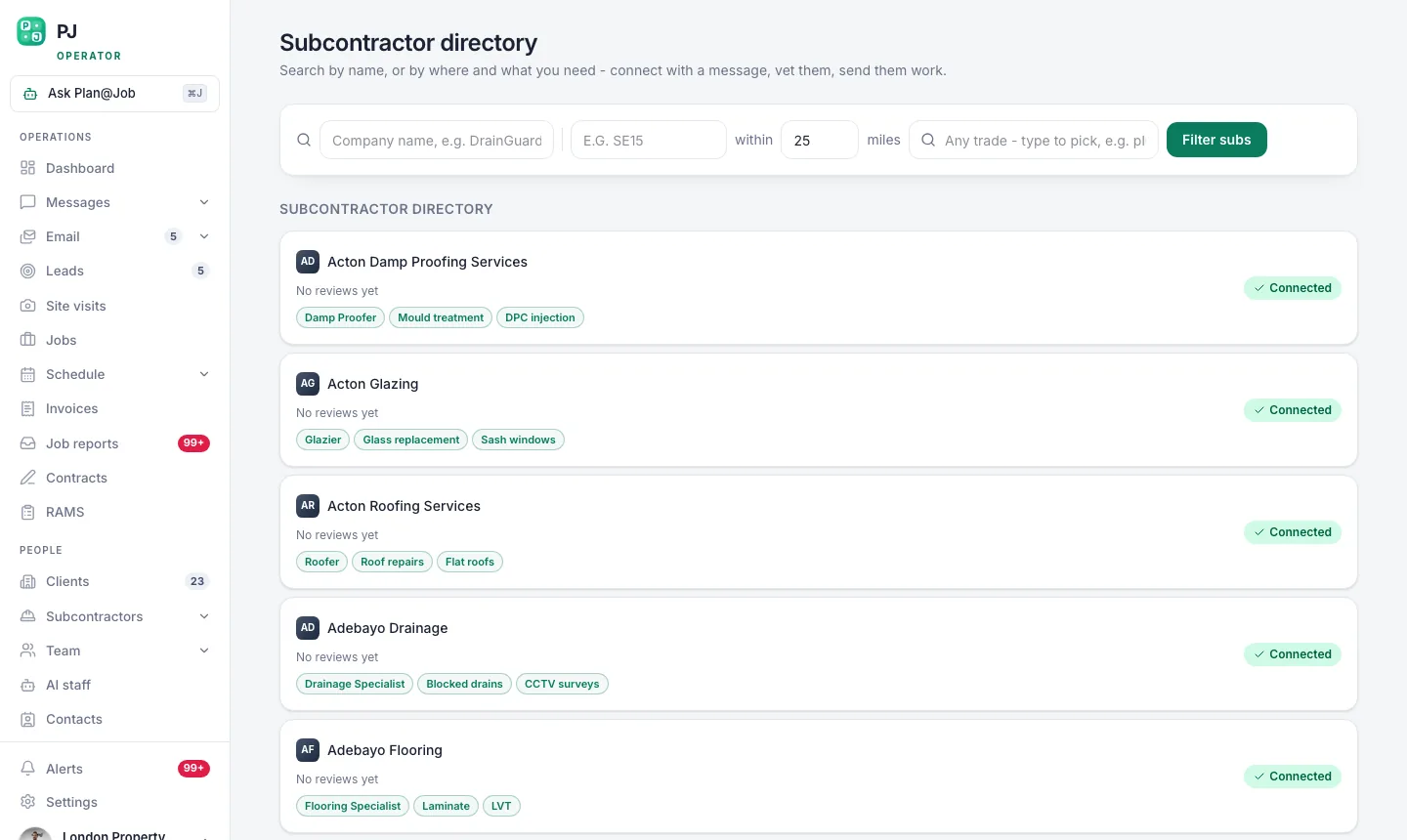 The subcontractor directory ranks by trade first, then by how close they are to the job.
Distance matters more than people think. A sub driving an hour each way builds that travel into their price, or they stop turning up halfway through the job. Local is usually cheaper and usually more reliable.
Step 5: Send one brief out from the Subcontracting desk
From the Subcontracting desk, send the same brief to several subbies at once. Their prices come back into one place, so you're comparing like with like instead of scrolling through WhatsApp.
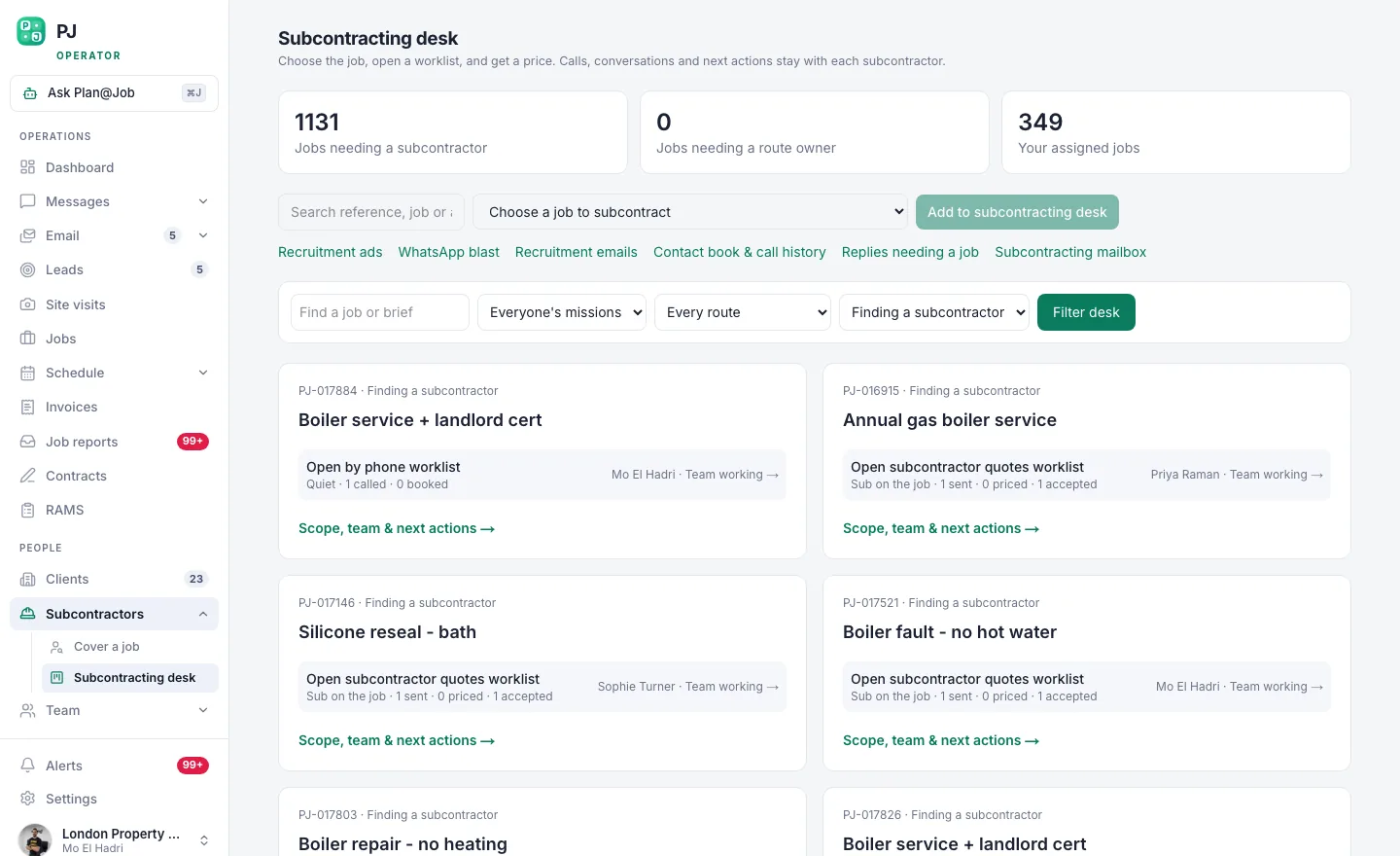 The subcontracting desk: one brief out to many, and every price back in one place.
The brief decides the price. A vague brief gets a padded price, because the sub is pricing the risk of what you didn't tell them. Spell out the scope, access, dates, who supplies materials, waste removal and making good.
In supported workflows, subcontractors can price before they've been fully vetted. That's fine for getting numbers in. Do your checks and approval before you award the work, not after.
Chasing prices is where most operators lose a day. Daniel Reed, our AI Operations Manager, can support follow-ups on quotes and proposed dates so it's not sitting on you. He doesn't set prices and he doesn't award work. More on how that works on the AI staff page.
Step 6: Compare against your ceiling, then decide
Compare every price to your ceiling first, and to each other second. Check inclusions line by line. The cheapest number often has the shortest list of what's included.
If every price comes in over your ceiling, the market is telling you something. Either your scope is wrong, your client price is wrong, or the job isn't worth doing at your margin. Go back to the client, change the spec, or walk away. Walking away is a decision too.
Award the work yourself. Plan@Job doesn't award jobs automatically, and it shouldn't. You're the one whose name is on the job.
Step 7: Lock it in before anyone starts
Once you've agreed a price, put it in writing. Use Contracts for the agreement, collect RAMS where the work needs them, and keep the conversation in Messages so there's a record when someone remembers it differently later.
Put the agreed cost against the stage and set the dates in the Schedule. Now your margin is a real number you can track, not a feeling.
What usually goes wrong
Same mistakes, every time:
- getting the sub's price before you've priced the client
- agreeing a day rate on a job you sold at a fixed price
- the client asks for extras, the sub charges you, and you never charge the client
- squeezing a sub so hard they walk mid-job or cut corners
- forgetting callbacks, so the margin you thought you made goes on a return visit
Variations are the big one. Price every change on both sides before the work happens, not after.
And don't grind the sub to the bone. A sub working at a loss doesn't do your job well, and the client doesn't care whose fault it was. It's not the price - it's the service.
The next move
Price the client. Set your ceiling. Then go to market. That order is the whole game.
If you want the quote, the stages, the subcontracting desk and the follow-ups in one place, have a look at Plan@Job for contractors. And if you want to talk margin with people running the same kind of business, that's what Contractor Club is for.
FAQ
What margin should I keep on subcontracted work?
There's no single right number, and anyone who gives you one without seeing your costs is guessing. Start from what your margin has to cover: quoting, managing, snagging, callbacks and cash flow. If the number left over doesn't pay you properly, the margin is too thin, whatever the industry average says.
Should I tell the subcontractor what the client is paying?
No. The client price is your business, and so is the gap. In Plan@Job the client sees the agreed scope and price, while your stage costs and who's doing the work stay internal. Be straight with the sub about the scope and the dates. That's what they need.
Can a subcontractor quote before they're vetted?
In supported workflows, yes. Subcontractors can submit a price before vetting is complete. Do your checks and approval before you award the work, so a good price never gets you a sub you haven't looked at properly.