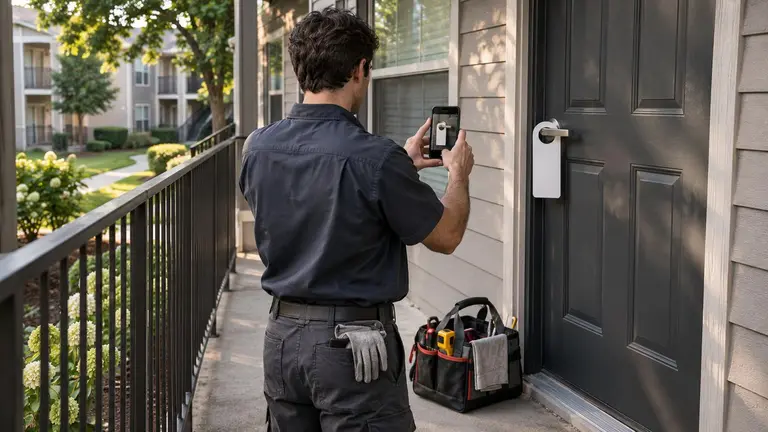
Good maintenance no access documentation records five things: who went, when they arrived, what they did to try to get in, what they saw from outside, and what happens next. Write those down at the door, add timestamped photos, and send the note to the property manager the same day.
That short record does a lot of work. It shows the tenant was given a fair chance. It supports any trip charge the contractor bills. It tells the next technician what to expect. And if the repair gets worse while everyone waits, it shows who knew what and when.
What counts as a no-access visit
A no-access visit is any scheduled visit where the technician arrives and cannot start the work. The reason matters, because each one leads to a different next step. Record which of these applies:
- Nobody answered and there was no permission to enter
- The tenant was home and refused entry
- The key, lockbox or gate code did not work
- The unit was unsafe to enter, for example a loose dog
- Only a minor was home
- The address or unit number on the work order was wrong
Do not write a bare no access and leave it there. A tenant who refused is a different problem from a lockbox with the wrong code. The manager needs to know which one they are dealing with.
What to record at the door
Write the note before you leave the property. Details fade fast once you are on the next job.
- Work order number, property address and unit number.
- Technician name and company.
- The scheduled window and your actual arrival time.
- Every attempt to make contact: knocks, doorbell, calls and texts, each with a time. Note which number you called and whether you left a voicemail.
- How long you waited.
- The reason for no access, in plain words.
- Anything visible or audible from outside that relates to the job, such as water under the door or an alarm sounding.
- Whether you had a key or code, and whether you used it. If you did not enter, say so clearly.
- What notice you left and where you left it.
- Your departure time.
Keep it factual. Times, actions and observations. Nothing else.
Photos that help
Take a few photos with the timestamp switched on:
- The unit door showing the unit number
- The door tag or notice in place
- The lockbox or gate keypad, if that was the problem
- Your call log showing the attempts, if your company allows it
- Any visible issue outside the unit that relates to the work order
Do not photograph through windows. Do not photograph people, children or license plates. The photos prove you were there and what you left. They are not a search of the tenant's home.
What to leave out
Leave out opinions and guesses. Do not write that the tenant is avoiding you or is always difficult. Write that there was no answer after two knocks and one call. If the record is ever read by an owner, an insurer or a court, plain facts hold up. Commentary does not.
Leave out private details too. The reason for the repair does not belong on a tag hanging on a door where neighbors can read it.
What to leave for the tenant
A door tag or folded note should tell the tenant four things:
- The date and time someone came
- The company name and that it was a scheduled maintenance visit
- The work order reference, without describing the problem
- Who to call to reschedule, and by when
If the manager uses email or text for tenant messages, the same information should go out that way on the same day. The tag alone is easy to lose. Two records are better than one.
What the property manager does with the report
The technician's note is only half of the record. The manager completes it.
First, attach the note and photos to the original work order. Do not start a new one. The history should read in order: request, notice given, visit attempted, outcome.
Second, check what notice the tenant actually received before the visit. Find the message, the date it went out and how it was sent. If the notice was late, vague or sent to an old number, the missed visit is not the tenant's failure. That changes what you do next.
Third, contact the tenant and record the contact. Note the date, the method and what was agreed.
Fourth, set the next date and write down who confirmed it.
The decisions that need a person
A no-access record feeds several decisions. None of them should happen by default.
- Entering with a key. Entry rules in the United States are set by state and sometimes local law, plus the lease. Notice requirements and emergency exceptions differ from one state to the next. The manager decides whether entry is allowed, not the technician at the door. If you are unsure, check your state's landlord-tenant statute or ask a local attorney.
- Urgency. A dripping faucet can wait for a new appointment. An active leak into the unit below cannot. Someone has to read the report and judge the risk to the building and the people in it.
- Trip charges. Whether the contractor bills for the wasted visit depends on the agreement between manager and contractor. Whether any of that cost can be passed to the tenant depends on the lease and state law. A person reviews the record and decides.
- Repeated refusals. After a second or third failed visit, the manager decides whether to escalate, and how. That may mean a formal written notice or legal advice. It is not a call for the maintenance team.
One safety point for technicians. If you smell gas or see signs of fire or serious flooding, do not treat it as a routine no-access. Move away from the unit, call 911 or the utility's emergency line, then call the manager.
An illustrative no-access note
This example is fictional. It shows the level of detail to aim for.
Work order 2291. Unit 4B, kitchen sink leak. Scheduled window 10 am to 12 pm Tuesday. Arrived 10:40 am. Knocked at 10:41 and 10:44, no answer. Called the tenant number on the work order at 10:45, left voicemail. Texted at 10:46. Waited until 10:58. No sound from inside, no water visible at the door. Had no key and did not enter. Left door tag on handle with office number. Photos attached: door with unit number, tag in place. Departed 11:00 am.
It takes two minutes to write. Anyone who picks up the job next week can read it and know exactly where things stand.
How to prevent the next no-access
Most failed visits trace back to the work order, not the tenant. Before a technician is sent, the job should state:
- The best contact number and a backup
- Whether the tenant has given permission to enter if they are out
- Gate codes, lockbox location and parking instructions
- Pets in the unit
- The agreed window, confirmed the day before
If any of that is missing, fix it before the truck rolls.
Where Plan@Job fits
Plan@Job is AI-powered project and operations management for construction and property businesses. Property maintenance is one of its main uses.
Two parts of it relate to this problem. Sophie Bennett, the AI Enquiries Coordinator, checks existing job briefs for missing information and asks for clarification. If two attempts do not get an answer, she hands the job to a person. That is the stage where missing access details are cheapest to catch. You can read how the AI staff work and what they leave for your approval.
On larger jobs, the project plan splits work into internal stages with scope, dates, status and costs. The client sees the overall agreed scope and price, plus the evidence you choose to share. Internal stage costs stay internal.
None of this decides entry, charges or escalation for you. Those stay with your team.
The UK is the live market for Plan@Job today. If you manage property in the United States, see the US property managers page for current availability and to reserve your place.
FAQ
Can a technician enter with a key if the tenant is not home?
Only if the manager has confirmed it is allowed for that visit. Entry rules come from state and local law and the lease, and they vary. The technician should never make that call alone at the door. If entry is authorized, record who authorized it and when.
Can we charge the tenant for a missed maintenance appointment?
It depends on the lease and your state's rules on tenant charges. Check both before you bill anything. Whatever the answer, you will need the record: the notice given, the attempts made and the time on site.
How long should we keep no-access records?
Keep them with the work order for as long as you keep the rest of the property file. Retention periods vary by state and by the type of record, so follow your company policy or ask your attorney. Do not delete a no-access note just because the repair was later completed.