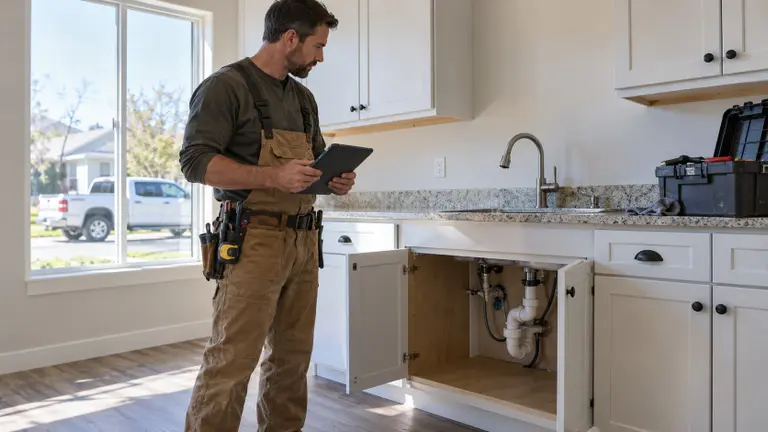
Here's the short answer on how to price handyman jobs for property managers. Use a flat rate for anything you've done enough times to know where it goes wrong. Use time and materials for anything behind a wall, under a floor, or described on the work order as 'just take a look.' Most contractors get this backwards. They flat-rate the scary jobs to win them, then lose the margin the moment they open the drywall.
Property managers don't really care which model you pick. They care that the number doesn't move without warning, that the invoice matches what they approved, and that the unit is ready for the next tenant. Price around that and you keep the account.
Why property managers buy differently from homeowners
A homeowner is spending their own money. A property manager is spending an owner's money and answering for every dollar of it.
That changes everything. A lot of work orders arrive with a not-to-exceed amount already on them. Anything over that and the manager has to go back to the owner, wait, then come back to you. Meanwhile the unit sits empty and somebody is annoyed. Usually it's them, and they remember it was your job.
When I ran my maintenance company in London, most of our work came from letting agents and housing associations. Different country, same client. They always had someone above them to answer to. The rule I ran the business on was simple: the agent never gets surprised by an invoice. Price matters. Surprises lose accounts faster.
So the real question isn't 'flat rate or hourly.' It's 'which one lets me give this manager a number they can stand behind?'
When flat rate is the right call
Flat rate works when the scope is clear and you've seen the job enough times that the unknowns are small. The manager gets a number to send to the owner. You get paid for being fast and good, not punished for it.
Jobs that usually suit a flat rate
- Replacing a faucet, toilet, garbage disposal or light fixture like for like
- Swapping door hardware, rekeying locks, hanging blinds
- Patching and painting small, visible drywall damage
- Smoke detector and filter swaps across a building
- Standard make-ready items on a turnover you've walked yourself
Notice the pattern. You can see the whole job before you price it.
How to build a flat rate that doesn't bite you
This is the order I'd work it out in:
- Count the real hours. Not wrench time. Drive time, parking, the trip to the supply house, waiting for the tenant to open the door, cleanup and photos.
- Multiply by your loaded rate. That's what an hour actually costs you once you add wages or your own pay, insurance, the truck, tools, admin and the hours nobody pays for.
- Add materials at cost plus your markup. Markup on materials is normal. You're sourcing, carrying and warrantying them.
- Add a buffer for the thing that always happens. Seized shutoff valve. Wrong part. Tenant's dog.
- Write the scope in one line, with what's not included.
That last step matters more than the number. 'Replace kitchen faucet with owner-supplied unit. Excludes shutoff valve replacement or supply line repair if found faulty.' Now if the valve snaps, you're not arguing. You're sending a change order the manager already saw coming.
When time and materials is the honest answer
Some jobs you can't price properly until you're inside them. Water damage. A leak nobody can find. Rot under a tub. An electrical fault that 'only happens sometimes.'
Flat-rate those and one of two things happens. You price high to cover the unknowns and lose the job, or you price low to win it and work three days for free. Both are bad business.
Time and materials is the fair way to handle real unknowns. But property managers get nervous about an open meter, and they're right to. So you make it safe for them.
Make time and materials easy to approve
Put all of this on the quote:
- Your hourly rate, and whether it changes after hours or on weekends
- Your materials markup
- A not-to-exceed figure for the first stage of work
- A check-in point where you stop, send photos and report before going further
- What you'll hand over at the end, like itemized hours, receipts and before and after photos
The not-to-exceed is the key. It turns 'open-ended' into 'capped, with a phone call if it needs more.' And you have to mean it. If you hit the cap, you stop and call. That's how you build trust with a manager who's been burned before.
The hybrid most good contractors end up using
In practice, the best maintenance outfits I've seen don't pick one model. They split the job.
First, a flat-rate diagnostic visit. You go out, open what needs opening, find the cause and take photos. Then you come back with a flat price for the fix, because now you know what the fix is.
The manager gets two small decisions instead of one big scary one. You get paid for the investigation instead of giving it away to win the repair. And the owner sees a clear story: here's what we found, here's what it costs.
The other hybrid is a flat rate with tight exclusions and a written change order process. Same idea. You price what you can see, and you agree upfront how you'll handle what you can't.
What to get straight before you quote US work
A few things vary by state, and you need to check them yourself rather than take anyone's word for it.
- Licensing. Many states let handymen do small jobs without a contractor's license but set limits on job size or type of work. Plumbing, electrical and HVAC are often licensed trades regardless. Check with your state's contractor licensing board before you take on bigger work.
- Sales tax. Whether labor, materials or both are taxable depends on the state. Ask your accountant, and price it in.
- Paperwork. Expect most property managers to ask for a W-9 and a certificate of insurance before your first job. Have them ready.
- Payment terms. Agree on them upfront and put them on every quote. Don't find out at invoice time that the manager pays on a cycle you didn't expect.
None of this is glamorous. It's also exactly where small contractors get caught out.
How Plan@Job fits into the pricing workflow
Plan@Job is AI-powered project and operations management for construction and property businesses. In Plan@Job, you're the Operator: the contractor business managing the clients, the delivery, your subs and your in-house team.
Here's where it helps with pricing.
Bad pricing usually starts with a bad brief. Sophie Bennett, the AI Enquiries Coordinator, checks existing job briefs for missing information and asks for clarification before you price. If two attempts don't get an answer, she hands it back to you. So you're not quoting off 'bathroom leak, pls fix.'
On bigger jobs, the project plan lets you split the work into internal stages, each with its own scope, dates, status and costs, delivered by subs or your own team. That's how you run the hybrid model properly: diagnostic as one stage, the fix as another. The client sees the overall agreed scope and price plus the evidence you share. Your internal stage costs and your subs' identities stay internal. That's your margin, and it stays yours.
Daniel Reed, the AI Operations Manager, follows up on quotes and proposed dates so approvals don't go quiet. Maya Collins, the AI Finance Coordinator, prepares deposit requests and overdue payment actions for your approval. More on all three on the AI staff page.
What none of them does is set your price. That's your call, and it should be.
One honest point on benchmarks. The best pricing data you'll ever have is your own. Every job you close, compare what you quoted against what each stage actually cost you. After a few months you'll know exactly which jobs are safe to flat-rate and which ones always run over. Market averages won't tell you that about your business.
If you want more on the margin side of contracting, Construction Arbitrage goes deeper on how the spread between client price and sub cost really works.
FAQ
Should I charge property managers a trip fee?
Yes, or build it into your minimum charge. Every visit costs you drive time and fuel, even if the tenant isn't home and you can't get in. Put your no-access policy on the quote so nobody argues about it later.
What hourly rate should a handyman charge?
Build it from your own costs first, not from what the guy down the road charges. Work out your loaded hourly cost, add the margin you need, then check it against what local managers are actually paying. If the market won't pay it, fix your costs or your client list. Don't just drop the rate.
Do I need a license to do handyman work in the US?
It depends on your state and the work. Many states allow small jobs without a contractor's license but set limits, and trades like plumbing and electrical usually need their own license. Check your state's licensing board before quoting anything that's close to the line.
Here's my verdict. Flat rate where you can see the job, time and materials with a cap where you can't, and a written scope either way. Plan@Job is live in the UK first. If you run maintenance work in the US, reserve your spot on the US contractors page and you'll hear when it opens in your market.