The short answer to how to get property maintenance contracts is unglamorous. You build a named list of the letting agents, managing agents and block managers inside a radius you can genuinely service, you get in front of them before they have an emergency, and you make it easy for them to justify your invoice to a landlord or a leaseholder. There is no list you can buy that skips those three steps. Property managers rarely choose on price alone; they choose the contractor whose paperwork never comes back to bite them. This guide is for operators, the contractor business managing its own clients, project delivery, subcontractors and in-house operatives, and it names the Plan@Job screen behind each step.
1. Decide which property managers you actually want
Three buyers share the job title and buy in completely different ways.
- Letting and managing agents. Reactive repairs on tenanted homes. High volume, modest value per job, and tenant access is the hard part. The agent is measured on how fast a tenant complaint closes.
- Block managers. Communal areas, roofs, drainage, plant, fire doors and lighting. Budgets are set a year ahead, and major works in a leasehold block trigger a statutory leaseholder consultation, so those jobs are never awarded off a phone call.
- Housing providers, build-to-rent and student accommodation. Formal onboarding, compliance evidence, out-of-hours expectations, payment to agreed terms.
Before you build any list, settle three things yourself:
- The radius you can reach inside whatever response time you are prepared to promise.
- The trades and job values you want, and the ones you will decline.
- How many new jobs a week you can absorb without letting down existing clients.
That is your decision, not the software's. Get it wrong and you win work you cannot deliver, which is worse than winning nothing.
2. Build the list in Contacts
The names come from ordinary places, all of them free:
- Lettings listings on the major portals, filtered to your postcodes. The managing agent is on every advert.
- Signage in communal entrances and bin stores. Blocks carry a "managed by" notice with a phone number.
- Your council's HMO and selective licensing registers where published, which name the licence holder and often the agent.
- Companies House, to see whether you are approaching an independent or part of a group with central procurement.
- Member directories of the property trade bodies, for block and letting agents.
- Loss adjusters and insurance repair networks, if you handle escape of water or fire damage.
In Plan@Job, open Contacts and add one record per company with a named human attached: role, direct email, direct phone, the owner from your Team who is responsible for chasing, a status and the date you last spoke. One rule worth holding: never leave a prospect on a generic info@ address. Get the maintenance coordinator's name, because that is the person who allocates jobs.
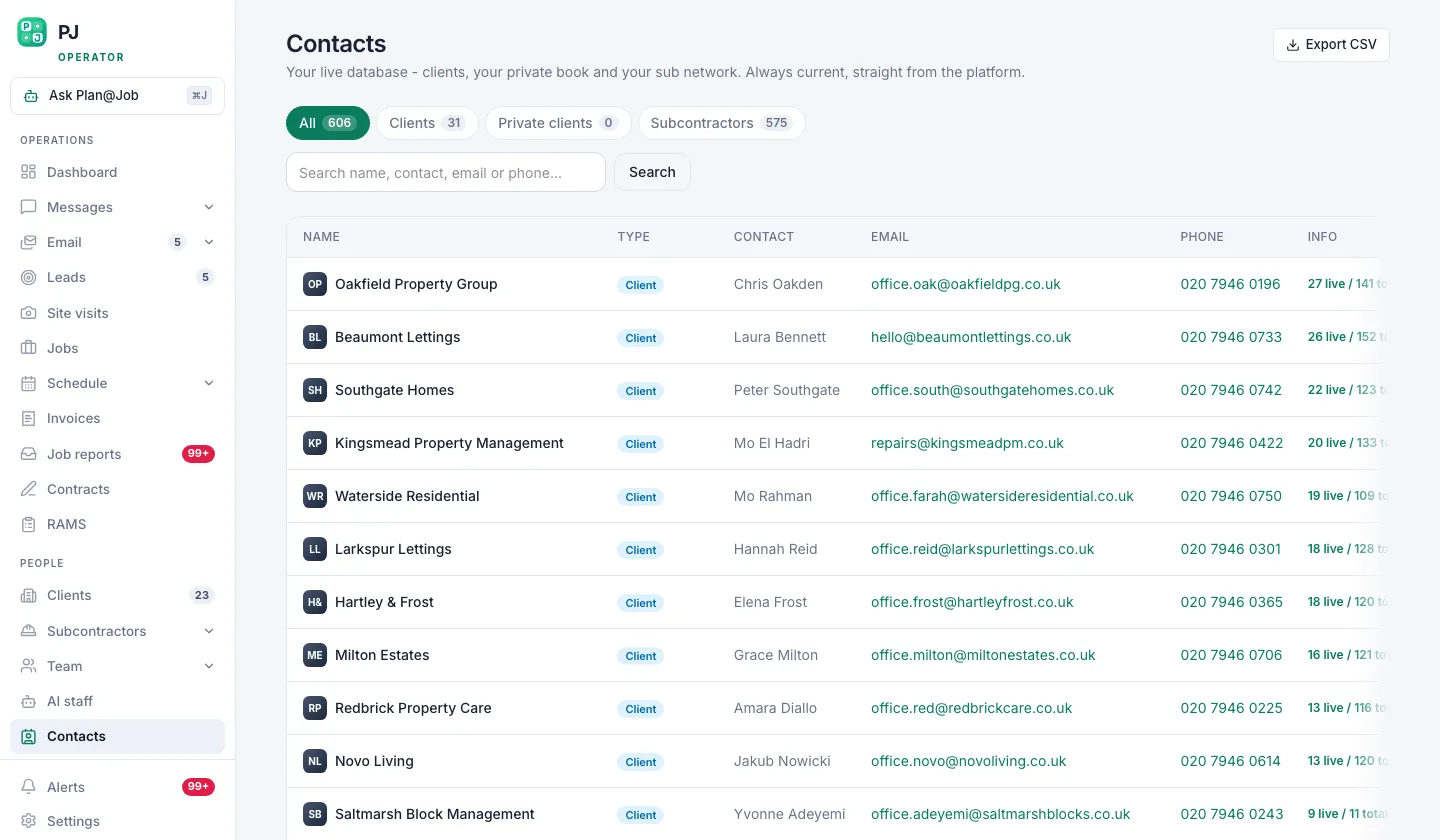 Contacts is the list you build before any campaign goes out.
The platform keeps owner and last contact visible so a prospect cannot go quiet unnoticed. Deciding who deserves a second call is yours.
3. Assemble the evidence pack before you make contact
Property managers are not really buying labour, they are buying defensibility. Every pound is justified to a landlord, a leaseholder or an asset manager, and the contractor who supplies that justification unprompted becomes the easy choice.
Have this ready before the first email:
- In-date public liability and employers' liability certificates.
- Trade registrations relevant to the work: Gas Safe registration for gas, a recognised competent person scheme for electrical work, asbestos awareness where you disturb older fabric.
- Method statements and risk assessments per job type, held in RAMS.
- Your terms and rate schedule, stored in Contracts.
- Two or three sample Job reports: before photos, what was done, parts used, after photos.
- A plain statement of what you do and do not cover out of hours.
The sample job report earns more than everything else on that list, because it is the one document an agent can forward to a landlord without rewriting it.
4. Make first contact yourself
- Email the named person from the Email screen so the thread sits against their contact record rather than in a personal inbox. Four lines: your patch, your trades, your response time, an offer of a sample job report.
- Phone two working days later and ask one question: do you keep an approved contractor list, and who maintains it?
- If you are local, call in with a reason, such as dropping off certificates.
- Offer a deliberately low-risk first job. Most agents test you on something small and annoying before trusting you with a roof.
Be clear about what the platform will not do. Plan@Job does not run cold outreach for you and the AI staff do not prospect; first client contact normally needs your approval. What they do handle starts once an enquiry arrives. Sophie Bennett, the AI Enquiries Coordinator, checks existing job briefs for missing information and asks for clarification, with a two-attempt handoff to a person if it stays unanswered. That is the difference between a workable job and "leak in flat 3, tenant has the key".
Illustrative example, not a customer: a two-van damp specialist lists 40 agents within 25 miles in Contacts and offers each a pre-let damp inspection. Two accept, one becomes repeat work, the rest go quiet. That ratio is why the list has 40 names on it and not four.
5. Convert interest into a site visit and a priced job
Book the survey on Site visits, assign the operative, and capture photos while you are there. Price from what you saw.
Then build the job on Jobs as a project plan split into internal stages, each with scope, dates, status and costs, covering subcontracted and in-house delivery. The split matters commercially: the client sees the overall agreed scope, the agreed price and the evidence you share through the Client portal, while internal stage costs and subcontractor identity stay internal. You can subcontract the scaffold without the agent learning who to ring next time. There is more on how stages work on the project management page.
Daniel Reed, the AI Operations Manager, handles quote and proposed-date follow-ups and sends a morning brief, so a quote sitting unanswered for a fortnight gets chased. Nothing is priced, awarded or promised without you. What each colleague does and does not do is set out on the AI staff page.
6. Treat the first job as the audition
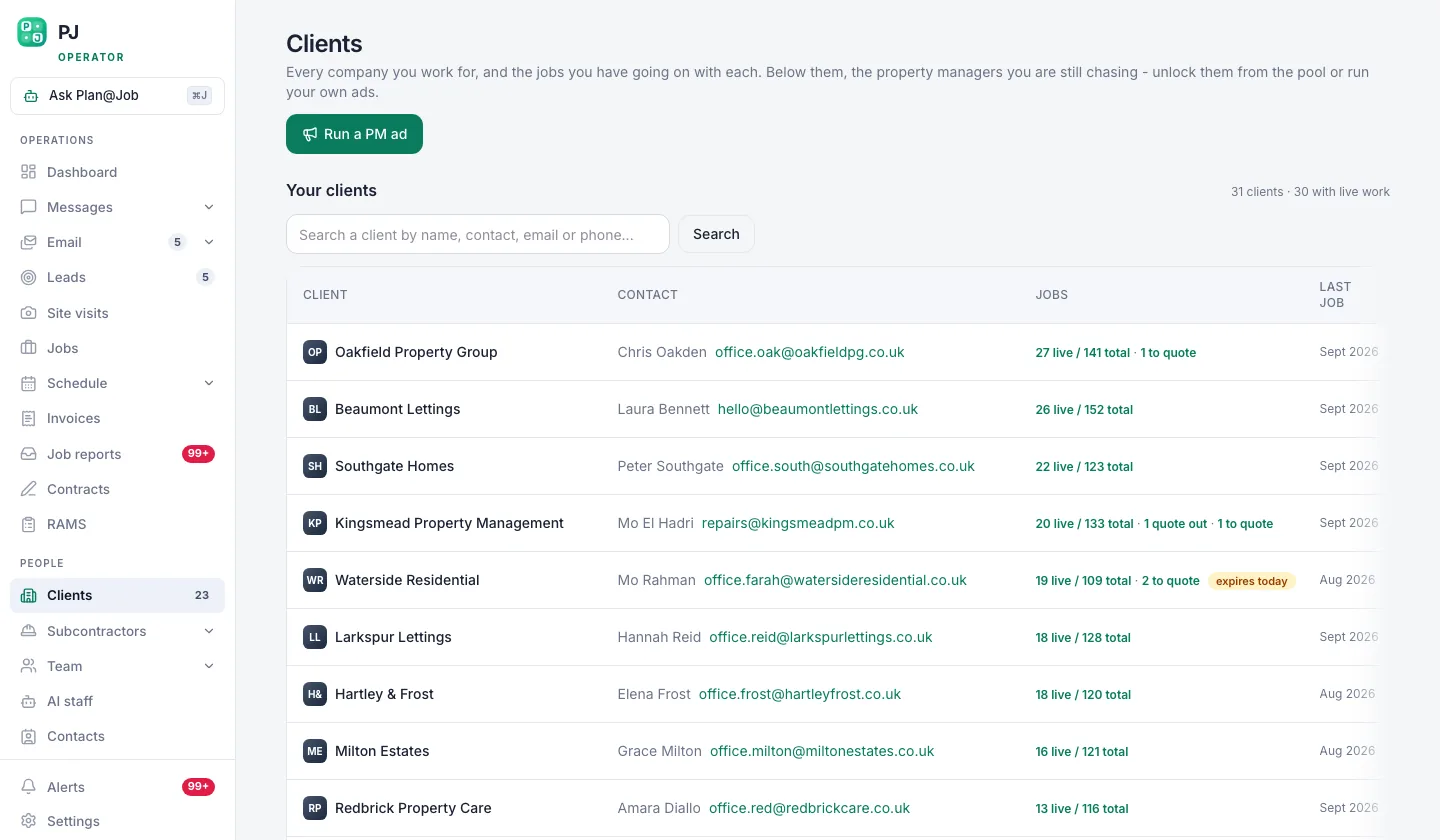 A prospect becomes a client here, with every job and invoice under their name.
- Close out the same day with a Job report: what was found, what was done, photographed.
- Invoice within two working days from Invoices, quoting the purchase order reference the agent gave you. Agents cannot pay what they cannot code.
- Let Maya Collins, the AI Finance Coordinator, prepare deposits and overdue payment actions for your approval. Finance runs on fixed workflows and approval stays with a person.
- Ask for the next job while the report is still in their inbox. Most contractors waste that moment.
Only ask to join an out-of-hours rota when you can genuinely answer the phone at 11pm. One missed emergency undoes six good jobs.
7. Find out which channel actually pays
 Work sources answers the question most contractors cannot: which channel actually pays.
Work sources records where each job came from, so after a quarter you stop guessing. Review it monthly, drop the channel producing nothing, and move that time to the one producing jobs. If a main contractor has saved or requested your business, links appear under Invites and Tenders through membership-based access. Treat that as one channel among several, not a pipeline.
What usually goes wrong
- Starting with the biggest agent. Large groups have central procurement and slow onboarding. An independent managing a few hundred units decides on one call.
- Generic addresses. info@ reaches whoever is least busy. Always get a name.
- No owner on the contact. If nobody in Team owns the record, nobody chases it, and the list dies in three weeks.
- Promising cover you cannot staff. Better to say 7am to 6pm and mean it.
- Pricing off a photo. The variation conversation afterwards costs you the relationship.
- One contact per agent. Coordinators move often, so keep two named people.
Next step: if you are an operator building a maintenance client base, see how this fits together on the Plan@Job page for UK contractors. To compare notes with other UK contractors on which agents locally are worth approaching, our own community at Contractor Club is a reasonable place to ask.
FAQ
How long does winning a first maintenance contract take?
It varies by agent, and nobody can promise you a timeline. The normal pattern is a small test job first, then a second, then steady allocation once the coordinator trusts your reporting. Plan for a first job rather than a contract.
Do I need to be fully vetted before I can quote?
An agent's onboarding policy is theirs, and most want insurances and registrations up front. Inside Plan@Job, supported workflows let a subcontractor price work before vetting is complete, with checks and approval handled at the appropriate stage, so pricing is not blocked while paperwork catches up.
What paperwork do agents ask for most often?
Insurances, trade registrations for the work involved, method statements and risk assessments, and a sample of your completion evidence. Keep them in RAMS and Contracts so you can send the whole pack in minutes rather than hunting through a van glovebox.