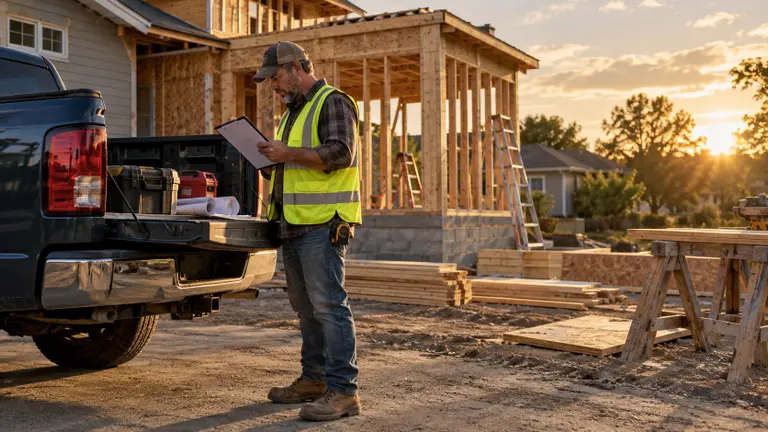
Contractor license requirements by state come down to one rule. The state where the job sits decides, not the state where you live. Some states license general contractors statewide. Some leave it to the city or county. Nearly all of them license the trades in some form. So before you bid, you check the state, the local jurisdiction and the trade. Get one wrong and you can finish the job and still end up fighting to get paid.
Last reviewed: October 3, 2026. Licensing rules change. Always confirm on the official board's website before you bid.
Why the state decides, not you
There's no federal general contractor license in the US. Licensing is state law, and in a lot of places it's local law on top of that.
So a license in one state means nothing in the next one. Cross a state line for a job and you start again. Some states have reciprocity deals that let you skip an exam. You still have to apply.
One federal rule does follow you everywhere. If you're renovating, repairing or painting in homes or child-occupied facilities built before 1978, the EPA's Lead Renovation, Repair and Painting (RRP) rule applies. The firm needs certification and the job needs a certified renovator. People forget this one more than any state license.
How the states split up
There are roughly four patterns. Work out which one your state follows before you do anything else.
States with a statewide contractor license
California (Contractors State License Board), Florida (Construction Industry Licensing Board), Arizona (Registrar of Contractors), Nevada (State Contractors Board), Utah (Division of Professional Licensing), North Carolina and Louisiana all license contractors at state level.
These usually come with license classifications, an exam, proof of experience, and bond or insurance requirements. Many also set a dollar threshold for small jobs that don't need a license. Look the threshold up on the board's site. Don't rely on a number a buddy gave you three years ago.
States where the city or county does the licensing
Texas has no statewide general contractor license. New York doesn't either. In those states the city or county may license you instead. New York City, for example, licenses home improvement contractors through its Department of Consumer and Worker Protection.
This is where people get caught. They hear "no state license" and stop looking. The county still wants you on the list.
States that register instead of license
Some states make you register rather than pass an exam, usually for residential work. Pennsylvania has Home Improvement Contractor registration through the Attorney General's office. Massachusetts has its own Home Improvement Contractor registration, plus a separate Construction Supervisor License for certain building work.
Registration is easier than licensing. It's still the law. Skip it and you're unregistered, which is the same headache.
Trades are their own thing
Electricians, plumbers and HVAC techs are licensed separately in most states, even where general contracting isn't. Texas licenses electricians and HVAC through the Department of Licensing and Regulation, and plumbers through its own state board.
A general contractor license usually doesn't let you do the electrical yourself. It lets you run the job. The licensed trade does the trade.
What you need before you bid
Here's the order I'd do it in. Same order every time.
- Find the licensing authority for the state the job is in. Search for the state's contractor licensing board and only trust the official .gov site.
- Check the city or county where the property sits. Call the permit office if the website is a mess. They'll tell you in five minutes.
- Match your license classification to the scope. A kitchen remodel and a roof are not the same license in a lot of states.
- Check the small-job threshold, if there is one, and how it's counted. Some states count labor and materials together. Don't split a job to stay under it. Boards have seen that move before.
- Register the business with the secretary of state and get your EIN sorted.
- Line up insurance and bonding. General liability, workers' comp if you have employees (state rules vary), and a surety bond where the state requires one.
- Get EPA RRP certified if you'll touch pre-1978 housing.
- Put your license number where the state wants it. Many states require it on bids, contracts and ads.
That's the list. Boring. It's also the difference between a business and a liability.
What happens if you bid without a license
Here's the part people hate hearing. In some states the punishment isn't just a fine. It's your money.
California is the famous one. An unlicensed contractor generally can't sue to collect payment for work that needed a license, and the client can go after money they already paid. So you can do perfect work and walk away with nothing.
Other states use fines, stop-work orders or misdemeanor charges. The details vary. The direction doesn't. If the state says you needed a license, the client holds all the cards when the job goes sideways.
And jobs do go sideways. That's when an unlicensed contractor finds out what the license was for.
Your subs need licenses too
If you run work the way I did, you win the client and subs do the work. You keep the margin in between. That model is as old as the trade. I wrote about it at length in MIDDLEMAN, and there's more on the strategy side at Construction Arbitrage.
But the margin comes with the risk. If your electrician isn't licensed for that state, that's your problem too, not just theirs. The client signed with you.
When I ran my maintenance company in London, every job went through a network of subcontractors. UK rules are different, so don't copy my old paperwork. The rule I took from it works anywhere though. Check the paperwork before the job, not after. After is too late.
In practice:
- Look the sub's license up on the state board's site yourself. Don't take a photo of a card as proof.
- Check the classification matches the work you're giving them.
- Get their insurance certificate and check the dates.
- Diarize their renewal date. Licenses lapse quietly.
It takes ten minutes per sub. Losing a payment dispute takes months.
Where Plan@Job fits
Plan@Job is AI-powered project and operations management for construction and property businesses. We call the contractor business running the work the Operator. That's you, managing clients, project delivery, subcontractors and your own crew.
Once you've done your license checks, the job itself has to run. In Plan@Job you split a job into internal stages, each with its own scope, dates, status and costs. A stage can go to a sub or stay in-house. The client sees the agreed overall scope and price, plus the evidence you choose to share. Your internal stage costs and which sub did what stay internal. More on that on the project management page.
Daniel Reed, our AI Operations Manager, helps with the follow-ups that eat your evenings, like chasing quotes and proposed dates, and he puts together a morning brief. He doesn't award work and he doesn't set prices. You decide who gets the job. You decide whether the paperwork is good enough. That's how it should be, and the license check before assignment is still yours. Software doesn't replace the state board lookup. More on how the AI staff work at AI staff.
One honest note on timing. Plan@Job is live in the UK right now. US contractors can reserve a spot on the US contractors page, and we'll bring you on when the US launch opens.
My advice: get licensed first, then bid. Never the other way around.
FAQ
Do I need a contractor license in every state I work in?
Usually, yes. Each state makes its own rules, so you apply separately in each one where the work requires it. Some states have reciprocity agreements that can save you an exam, but you still file an application. Check with the board in each state before you quote.
Can I submit a bid before my license is approved?
In states that license contractors, assume no. In several states, including California, the legal definition of contracting includes submitting a bid, so bidding unlicensed can be a violation in itself. Get the license number in hand first.
Does a general contractor license cover electrical and plumbing work?
In most states, no. Electrical, plumbing and HVAC are licensed separately, often by a different board. Your general license lets you run the job. A licensed trade has to do the trade work, and pull the permit where the rules require it.