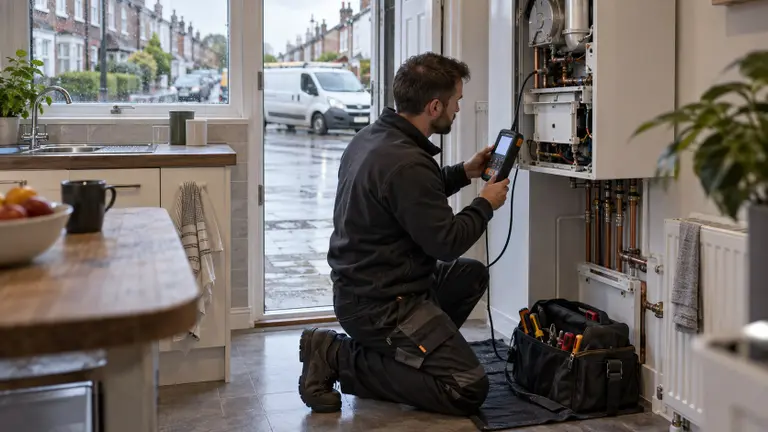
Gas Safe registration is the legal licence to do gas work in the UK. If you install, repair, service or move a gas appliance for money, your business must be on the Gas Safe Register, and every engineer touching gas must be on that registration. Not a badge. The law. Get caught without it and you're not losing a contract, you're facing prosecution.
People treat it like CHAS or TrustMark, something you add to look good. It's not. Here's who needs it, who doesn't, what it costs, how you qualify, and the work it gets you into.
What does Gas Safe registration actually mean?
The Gas Safe Register is the official list of businesses allowed to do gas work. It's required under the Gas Safety (Installation and Use) Regulations 1998. That law stands behind it, which is why it doesn't sit with the optional accreditations.
Two things get registered. The business, whether that's a sole trader or a limited company. And the engineers, each added to a business registration with the specific types of work they're qualified for.
That second bit matters. A Gas Safe engineer isn't licensed for "gas" in general. They're licensed for the categories on their card, for example domestic boilers, cookers, fires or meters. An engineer qualified on boilers isn't automatically allowed to fit a gas fire.
Legal requirement vs badge
Here's the part people get wrong. Other accreditations are things buyers ask for. Gas Safe is something the law asks for. A housing association can drop CHAS from a tender. Nobody can waive Gas Safe for gas work.
Who asks for Gas Safe when you're trying to win work?
We track the places UK contractors go to win work: housing association portals, council supplier lists, tier-1 supply chains, frameworks, trade platforms. As of October 2026, at least 102 of the 557 UK work sources we tracked capture Gas Safe somewhere in their registration. That's a floor, not an estimate. We only counted it where it shows up.
The shape tells you where the gas work is:
- Social housing is the biggest chunk. Housing associations and large landlords make up roughly a third of the sources asking.
- Councils come next, around a quarter, through their own portals and supplier lists.
- Public estate after that: universities, the NHS and public sector frameworks.
- The tail is retrofit and heating funding chains, insurance repair networks and trade platforms.
One honest caveat. Around four in ten of those sources ask for it as an "if applicable" field. They're not demanding it from a decorator. They want it from whoever's doing the gas.
Do you need Gas Safe registration?
Simple test. Are you, or anyone on your payroll, physically doing gas work? Then yes.
| Who you are | Do you need it? |
|---|---|
| Self-employed gas engineer or heating engineer | Yes. Register your own business, you're the engineer on it |
| Limited company with gas engineers on PAYE | Yes. The company registers, each engineer goes on its registration |
| Employed engineer working for a registered firm | You go on your employer's registration, not your own |
| Plumber doing water-only work, no gas | No |
| Oil boiler installer | No. That's OFTEC territory |
| Heat pump installer, no gas work | No. Look at MCS and F-Gas instead |
| Electrician | No, unless you also do gas work |
| Builder or operator who subs all gas work out | Usually not, if a registered business does the gas under its own registration. Check with the Register if you advertise gas services in your own name |
| Landlord or letting agent | No, but you must use a registered engineer for gas safety checks |
LPG counts as gas work too. People forget that on park homes, boats and off-grid properties.
How do you qualify?
You can't buy your way onto the register. You prove competence first, then register.
Route 1: You're already qualified
Experienced engineers get assessed under ACS, the Nationally Accredited Certification Scheme. You pass the core gas safety assessment plus the appliance categories you want to work on. ACS certificates last five years, then you get reassessed.
Route 2: You're new to gas
New entrants usually go through a Managed Learning Programme. It mixes centre-based training with a portfolio of real gas jobs done under supervision from a registered engineer, who acts as your mentor. Once you've got the MLP certificate, you sit your ACS assessments.
The other route is a Level 3 qualification through an apprenticeship.
The slow part is finding a registered engineer willing to mentor you.
Then register
Once you hold valid ACS certificates or an equivalent qualification:
- Apply for business registration through the Gas Safe Register website.
- Add yourself, and any employed engineers, with your qualification details.
- Pay the application fee.
- Expect an inspection of your work once you're registered.
- Get your ID card and licence number.
Use the official site only: gassaferegister.co.uk.
What does Gas Safe registration cost?
The Register itself is the cheap bit. Training and assessment cost more.
When we checked in October 2026, the Register's fees page listed a new business application at around £480 plus VAT, covering one engineer for the first year. Annual renewal was in the low to mid £200s including VAT, depending on whether you renew online. Each extra engineer added a smaller charge on top, and late renewal carried a penalty.
Fees change. Check the live page before you budget.
Training and ACS assessments are priced by each provider, and they vary a lot by region and by how many appliance categories you take. Get a few quotes from approved centres.
Then budget for the stuff around it: insurance, tools, a flue gas analyser, and the five-yearly reassessment.
How do you check someone's Gas Safe ID card?
If you run jobs and sub out gas, checking registration is your job. Not the subbie's word. Not a photo of a card from three years ago.
Every registered engineer carries a Gas Safe ID card. Check:
- The photo matches the person turning up.
- The licence number and the expiry date.
- The back of the card. It lists exactly which types of gas work they can do.
- The register itself. Search the licence number on the official site, or call the Register.
That third check is the one people skip. A subbie registered for boilers, sent to fit a gas hob, is still an illegal job.
My rule from running maintenance for housing associations and letting agents through a network of subbies: the card gets checked before the job gets sent, not after. If something goes wrong on a gas job, "they said they were registered" won't save you.
What does Gas Safe unlock?
On its own, it's a licence to trade. In the market, it's a filter that keeps most people out.
Look at that count again. At least 102 work sources ask for it. Most of them are the clients with volume: social landlords, councils, public estate. Planned servicing, boiler swaps, responsive repairs. Steady work, not one-off call-outs.
Registration is the minimum though. Those buyers usually want insurance and references on top. Gas Safe gets you past the first gate. The rest gets you the contract.
Where Plan@Job fits
Plan@Job is project and operations management for construction and property businesses. In Plan@Job, the Operator is the contractor business running the clients, the jobs, the subbies and the in-house team.
If you're an operator handling gas work, here's how the workflow looks.
Illustrative example: a client asks for a kitchen refit that includes moving a gas hob. You split the job into stages in the project plan: strip out, first fix, gas, tiling, fit. Each stage gets its own scope, dates, status and cost. The gas stage goes to your registered engineer, in-house or subbed. The client sees the agreed scope, the price and the evidence you share. Your stage costs and who did the gas stay internal.
The AI staff help with the chasing. Daniel Reed, the AI Operations Manager, follows up quotes and proposed dates. Sophie Bennett, the AI Enquiries Coordinator, checks a job brief for missing details and asks the client to clarify.
What stays with you: who you trust with gas. You check the card, you check the register, you approve the engineer. No software makes that call for you, and it shouldn't.
You'll probably want Plan@Job if you're an operator subbing out trades, gas included, and you're running too many jobs from WhatsApp. If you're a solo engineer doing your own boilers, get registered first. Software can wait.
See how it works for contractors in the UK, or create your operator account.
FAQ
Can I work under someone else's Gas Safe registration?
Only if you're their employee. If you're self-employed, you need your own business registration, even if you mostly work for one firm. Being a subbie on someone's job doesn't put you on their registration.
Does a gas engineer's registration cover every type of gas appliance?
No. Registration covers the categories on the back of the ID card, based on the ACS assessments the engineer has passed. Always check the categories match the job before work starts.
How long does Gas Safe registration last?
Business registration renews every year, and you pay the renewal fee each time. Each engineer's ACS certificates need reassessment every five years. Let either lapse and you have to stop doing gas work until it's sorted.