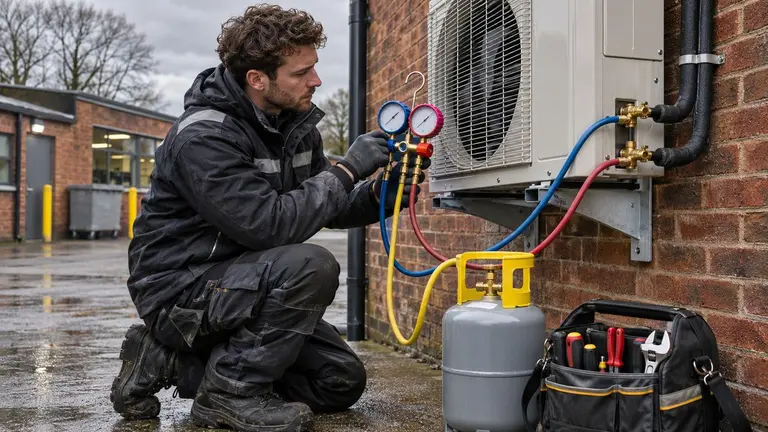
F-Gas certification is the legal proof that a person or company is competent to work on equipment containing fluorinated greenhouse gases, the refrigerants used in most air conditioning, refrigeration and many heat pump systems. In the UK, if you install, service, repair, leak check or decommission that kind of equipment, you normally need it. There are two parts: a personal certificate for the engineer and a company certificate for the business that employs them or trades on its own.
That is the short answer. The rest of this guide explains which certificate covers what, which trades need it, which trades usually don't, and how to organise refrigerant work on mixed jobs without getting caught out.
What F-Gas certification actually covers
F-gases are man-made gases such as HFC refrigerants. They are powerful greenhouse gases, so the law controls who can handle them and how. In Great Britain the rules come from the F-Gas regulations retained after Brexit. Northern Ireland follows the EU F-Gas rules. If you work on both sides of the Irish Sea, check which set applies to each job.
The current government guidance is on GOV.UK: F gas in refrigeration, air conditioning and fire protection systems. Treat that page as your starting point, not a forum post or a supplier leaflet.
Personal certification
This belongs to the individual engineer. It shows they have passed an approved practical and theory assessment. Personal certificates come in categories that depend on the activities the person carries out and the size of the systems they work on. A full category lets an engineer do everything, including breaking into the refrigerant circuit and recovering gas. Lower categories are narrower.
The point that catches people out: the category has to match the work. An engineer certified for leak checking only cannot legally recover refrigerant from a split system just because they own the kit.
Company certification
This belongs to the business. If your company installs, services, maintains, repairs or decommissions stationary refrigeration, air conditioning or heat pump equipment containing F-gases, the company itself needs a certificate from an approved certification body. To get it you usually show that you employ enough personally certified engineers for the work you take on, and that you have the tools and procedures to do it properly.
A sole trader still needs both. You hold the personal certificate as the engineer and the company certificate as the business.
Buying refrigerant
Suppliers should only sell F-gas refrigerant for these purposes to certified people or companies. If a wholesaler asks for your certificate number, that is why. Without certification you will struggle to buy gas legally, which is a practical limit on taking the work on at all.
Do you need F-Gas certification? A trade-by-trade guide
Use this as a first filter, then confirm against the GOV.UK guidance and your certification body. Equipment varies and so does the work you actually do on site.
| Trade or business type | Usually need it? | Why |
|---|---|---|
| Air conditioning installer or service engineer | Yes, personal and company | Installs and opens refrigerant circuits on F-gas systems |
| Commercial refrigeration engineer | Yes, personal and company | Cold rooms, display cabinets and chillers commonly use F-gases |
| Heat pump installer fitting split systems | Yes, personal and company | Making refrigerant connections on site counts as installation |
| Heat pump installer fitting sealed monobloc units only | Often not for the refrigerant side, but check | No refrigerant circuit is opened on site. Confirm the specific unit and current guidance |
| Heat pump installer using non-F-gas refrigerants such as R290 | Not F-Gas, but other competence applies | Natural refrigerants sit outside F-Gas rules but bring their own safety training needs |
| Plumber or heating engineer on the wet side only | No | Pipework, cylinders and emitters do not involve F-gas handling |
| Electrician supplying power to a unit | No | Electrical work only, provided they never touch the refrigerant circuit |
| Builder, roofer or groundworker mounting brackets or plinths | No | No contact with refrigerant |
| Fire protection engineer on gaseous suppression systems | Possibly, separate scope | Some systems use F-gases and have their own certification route |
| Vehicle air conditioning technician | Different qualification | Mobile air conditioning in vehicles is covered by a separate qualification |
| Main contractor subcontracting all refrigerant work | Not for the company, if no own staff do it | The subcontractor carrying out the work must hold the certificates |
The grey areas
A few situations come up again and again:
- "We only do the first fix." If your team runs pipework that later becomes part of the refrigerant circuit, talk to your certification body. Who brazes, pressure tests and commissions matters.
- "The heat pump arrives pre-charged." Pre-charged does not automatically mean exempt. What matters is whether anyone opens or makes connections in the refrigerant circuit on site.
- "We're replacing like for like." Removing an old unit means recovering the refrigerant. That is controlled work, even if the new unit is a sealed monobloc.
- "Our engineer is certified, so we're fine." Not if the business is trading without its own company certificate.
Why clients ask for it before you start
You will see F-Gas requirements turn up in pre-qualification questionnaires from main contractors, facilities managers and property managers. They are asking because they can be exposed if uncertified people handle refrigerant on their sites or in their buildings.
Expect to be asked for:
- Your company certificate number and the certification body.
- Names and certificate details for the engineers who will attend.
- How you record leak checks and refrigerant movements.
- How you dispose of recovered refrigerant.
Have these ready as a short document you can send on request. It saves a round of back-and-forth on every tender.
If you have come across trade certification schemes in other countries, the UK set-up is quite different. Our piece on whether Red Seal certification is worth it in Canada covers a broad trade credential. F-Gas is narrower: it is about a specific type of gas and a specific type of work, and it applies across several trades.
How to get certified
The route is usually:
- Pick the right personal category. Match it to the work you actually do and plan to do, not the cheapest course.
- Book an approved assessment. Training centres deliver recognised refrigerant handling qualifications. Ask whether the course leads to the F-Gas category you need.
- Apply for company certification. Choose an approved certification body, register your certified engineers and show your equipment and procedures.
- Keep it current. Company certificates need renewing, and certification bodies may audit you. Keep engineer details up to date when staff join or leave.
Costs vary by training centre, category and certification body, and they change. Get current prices directly from the providers rather than relying on figures you see quoted online.
Planning refrigerant work on mixed jobs
Most of the trouble with F-Gas is not the certificate itself. It is a job where several trades overlap and nobody is clear who touches the refrigerant.
Take a typical heat pump retrofit. The work may include an electrician, a plumber on the wet side, a builder for the base and a refrigerant engineer for a split system. If the plan just says "install heat pump", the controlled work can end up with whoever happens to be on site.
In Plan@Job, an Operator (the contractor business that manages clients, project delivery, subcontractors and in-house operatives) can split one job into internal stages, each with its own scope, dates, status and costs. You can put the refrigerant connection, pressure test and commissioning into its own stage and assign it to a certified subcontractor or in-house operative. The client sees the overall agreed scope and price plus any evidence you share. Your internal stage costs and the subcontractor's identity stay internal. See how stages work on the project management features page.
Illustrative example: a small heating firm wins a domestic retrofit with a split heat pump. They hold no F-Gas certification. They set up stages for groundwork, wet-side plumbing, electrics and refrigerant work. The refrigerant stage goes to a certified air conditioning subcontractor. The firm checks that subcontractor's company and engineer certificates before approving them for the stage, and keeps copies with the job records.
What still needs a person's decision:
- Deciding which work counts as controlled F-Gas work on that specific system.
- Checking certificates and approving the subcontractor for the stage.
- Signing off commissioning and handover.
Plan@Job's AI staff can help with the admin around this. Daniel Reed, the AI Operations Manager, supports sharing eligible work with your existing vetted network and following up quotes and proposed dates. He does not award work or set prices. Those choices stay with you.
If you run a contracting business and want to manage stages, subcontractors and in-house teams in one place, start on the Plan@Job page for contractors.
FAQ
Does a sole trader air conditioning engineer need company F-Gas certification?
Yes, in most cases. If you trade as a business installing or servicing stationary air conditioning, refrigeration or heat pump equipment containing F-gases, the business needs company certification as well as your personal certificate. Check the GOV.UK guidance and speak to a certification body if your situation is unusual.
Can a plumber install a heat pump without an F-Gas certificate?
It depends on the unit and the work. Wet-side work on its own does not need F-Gas certification. Making refrigerant connections on a split system does. Sealed monobloc units and systems using non-F-gas refrigerants may fall outside F-Gas rules, but confirm the specific product and current guidance before you price the job.
What should I check before using an F-Gas subcontractor?
Ask for the company certificate number and certification body, and the personal certificate details of each engineer who will attend. Make sure the personal category covers the work on your job. Keep copies with the job file and recheck when certificates are due for renewal.
Ready to plan staged jobs with the right people on each part? Create a free contractor account on Plan@Job.