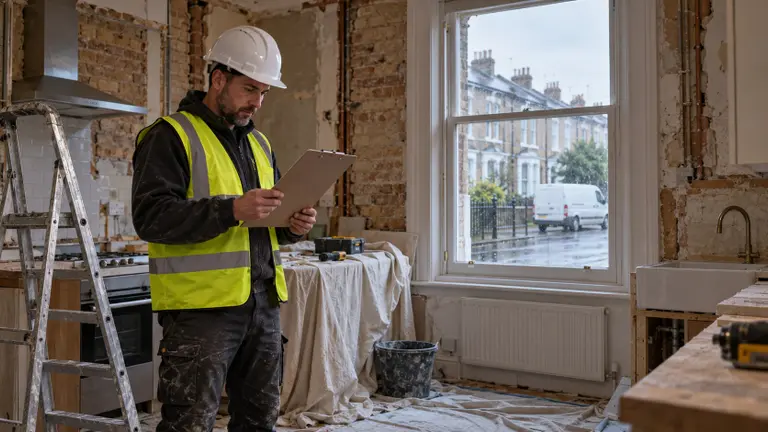
What are RAMS in construction? RAMS stands for Risk Assessment and Method Statement. They're two documents that sit together: one says what could hurt someone on this job, the other says the safe order you'll do the work in. That's it. The jargon makes it sound like a law degree. It isn't. It's you writing down how you'd brief your own lads on site, before anyone picks up a tool.
Here's the part people hate hearing: most RAMS get bounced not because the work is dangerous, but because the document is obviously copied from the last job.
What RAMS actually means on a real job
Two halves. Different jobs. Both about the same site.
The risk assessment
This is the "what could go wrong" bit. You walk the job, list the hazards, say who could get hurt and how, and write down what you're doing to control each one.
Working at height on a two-storey gutter. Asbestos possible in a 1970s artex ceiling. A tenant with kids still living in the flat while you strip the bathroom. Each hazard gets a control, and the control has to be something you'll actually do, not a line about "taking care".
The method statement
This is the "how we'll do it" bit. Step by step, in order. Who's on the job, what kit they bring, how they set up, how they protect the client's property, how they leave it.
Think of it as the briefing you'd give a new subbie in the van on the way there. If they could read it and do the job safely without calling you, it's a good method statement.
Is RAMS a legal requirement in the UK?
Short answer: the risk assessment is the law, the method statement is the market.
Under the Management of Health and Safety at Work Regulations 1999, every employer has to assess the risks to their workers and anyone else affected by the work. If you employ five or more people, you have to record the significant findings. The HSE's own guide on managing risks and risk assessment at work is the place to start, and it's written in plain English.
Method statements aren't named as a stand-alone legal document in the same way. But construction work also falls under CDM 2015, which expects planning, information and a construction phase plan. And in practice, the clients worth working for won't let you on site without a method statement. So treat it as required. Simple.
Who actually asks for RAMS: at least 24 of 557
We track the places UK contractors get work from: housing associations, councils, big repair contractors, insurance networks, FM firms and the accreditation schemes that sit in front of them.
At least 24 of the 557 UK work sources we tracked as of July 2026 ask for RAMS, risk assessments or method statements somewhere in their onboarding or tender process. That's a floor. We only counted the ones that say it outright.
The shape of those 24 tells you more than the number:
- 9 are SSIP and accreditation schemes, the health and safety checks that big buyers use as a gate.
- 9 are main contractors, repair networks, FM firms and compliance gateways that subcontract maintenance work.
- 5 are public sector buyers who ask for method statements per tender, not at sign-up.
- 1 is a housing association that wants it before work over a set value.
At least one of the accreditation schemes says outright that generic templates get rejected. Remember that when you're tempted to download something.
The ones that don't mention RAMS mostly push you through an SSIP scheme that does. So the real number is higher. If you want the bigger jobs, you need this.
Do you need RAMS? A quick decision table
| Your situation | Written RAMS? |
|---|---|
| Sole trader doing a small domestic job direct for a homeowner | Not usually asked for. You still have to think through the risks and plan the work safely. |
| Firm with 5 or more employees | Yes. The risk assessment findings must be recorded by law. |
| Subbie working for a main contractor | Yes. Expect to send RAMS before you start, often for every job. |
| Repairs or voids for a housing association or council | Yes, directly or through the SSIP scheme they use. |
| Applying for CHAS, SafeContractor, SMAS or Constructionline | Yes. Example RAMS are part of the assessment. |
| Insurance repair networks and FM firms | Usually yes, at onboarding. |
| Quoting a public sector tender | Yes, at tender stage, written for that contract. |
| Office admin, design-only work, no site attendance | No construction RAMS needed. A general workplace risk assessment still applies if you employ people. |
The honest rule: if someone else's name is on the building, assume they'll ask.
What a reviewer actually checks
When I ran my maintenance company in London for housing associations and letting agents, most of the actual work was done by subbies. The paperwork was half the job. And you learn fast what gets sent back.
A reviewer is checking whether you've thought about this job, not whether you can fill in a form. Here's what they look at:
- The site address and the actual task. If it says "general building works", it's dead.
- Hazards that match the work. A roof job with no working at height section tells them you didn't read it.
- Controls that are specific. "Scaffold tower, erected by a trained operative, checked before use" beats "use appropriate access equipment".
- Who's doing it and what they're qualified for. Names or roles, and the cards or tickets that matter for that trade.
- Occupied property. Tenants, kids, pets, vulnerable residents. Housing clients care about this more than almost anything.
- Emergency arrangements. Nearest A&E, first aider, how you report an accident.
- A date, a version and a signature. And proof the team actually read it.
That's what's under the jargon. They want to see you know the job.
A RAMS structure you can write tonight
No downloadable template padding. Just the bones. Write it once properly, then adapt it per job.
- Job details: client, site address, dates, scope of work in two or three sentences.
- People: who's on site, their role, relevant cards and training.
- Hazard table: hazard, who's at risk, controls, who's responsible.
- Method, step by step: arrival, set-up, protection, the work itself, clean-up, handover.
- Plant, tools and materials, including anything hazardous to health.
- PPE for this job, not every item you own.
- Waste: how it leaves site and where it goes.
- Emergencies and first aid.
- Sign-off: author, date, version, and a sheet for each operative to sign that they've been briefed.
Keep it to what's true for this job. Short and specific beats long and generic every time.
What it costs to get your RAMS assessed
You don't pay anyone to write RAMS. You pay when an SSIP scheme assesses your health and safety system, and your RAMS are part of that. Prices below are starting points I checked on the operators' own pages on 19 October 2026. They scale with headcount and change often, so check before you buy.
- CHAS: from about £429 to £949 a year depending on the level, Standard up to Elite.
- SafeContractor: from about £419 to £549 a year depending on the plan, plus a one-off joining fee they don't publish.
- SMAS Worksafe: quote-only on their site. Third-party sources put the smallest firms from around £195 a year plus VAT.
None of those pages say clearly whether VAT is included, so ask. And pick the scheme your target clients actually ask for. Paying for the wrong badge is not worth it.
Where Plan@Job fits
Plan@Job is project and operations management for construction and property businesses. In Plan@Job, you're the Operator: the contractor business managing clients, delivery, subbies and your own operatives.
Signing off a subbie's safety paperwork stays your call, every time. What Plan@Job does is keep the job straight. You split a job into stages in the project plan, each with its own scope, dates, status and costs, whether a stage is subcontracted or done in-house. That stage scope is exactly what each RAMS has to match.
When you share work with your vetted network, a subbie may be able to price before they're fully vetted in some workflows. Checking their RAMS before anyone goes to site is still your decision.
If you run jobs through subbies and you're tired of chasing paperwork across WhatsApp, have a look at Plan@Job for contractors. If the setup fits how you work, create your contractor account and put your next job in as stages. Write the RAMS against those.
FAQ
Do sole traders need RAMS?
Not always written down. If you work alone on small domestic jobs, nobody may ask. But the moment you work for a main contractor, a housing provider or through an SSIP scheme, they will. Have one ready.
Can I use a RAMS template?
Use one for the layout, never for the content. Reviewers spot copied RAMS straight away, and at least one scheme we track says it rejects generic templates. Change the site, the hazards and the steps for every job.
How often should RAMS be updated?
Every new job gets its own, even if it's a tweak of the last one. Update it on the day if anything changes on site: different access, a new hazard, a different crew. Then brief the team again and get it signed.