
Don't argue with it. When a property manager says "we already have a contractor", say good, and ask to be the one they ring when that contractor can't get there. That's the whole move. Handling objections cold calling trades mostly comes down to this one line, because you'll hear it more than any other objection. Nobody runs a lettings book without a contractor. So they're not saying no to you. They're saying they're covered today.
Today is the key word. Contractors get busy, go quiet, put their prices up, stop covering an area. You want to be the name on their list when that happens. Below is how I'd handle the call, and how to keep the follow-up from dying in a notebook, step by step in Plan@Job.
Quick note on the word. In Plan@Job, an Operator is the contractor business that runs the client relationship and the delivery, whether the work goes to subbies or your own team. If that's you, this is written for you.
Why "we already have a contractor" isn't a no
It's a reflex. The person on the phone has a list of jobs, a landlord shouting at them and a tenant with no hot water. You're interruption number nine that morning.
If you push back, you lose. If you try to slag off their current contractor, you lose faster. They picked that contractor. Criticise them and you're criticising the person on the phone.
Here's the part people hate hearing: you're not going to win the account on the first call. You're going to win a spot on the list. Then you win the first job. Then you do it better than whoever had it before.
When I ran my maintenance company in London, working for housing associations and letting agents, I lived by one rule on these calls. Never ask to be first. Ask to be second. Second gets the overflow, and the overflow is how you end up first.
Step 1: Build your list in Contacts before you call
Calling off a random spreadsheet is how you end up ringing the same agent twice in a week. Do this first.
- Open Contacts and add the property managers, letting agents and block managers you want to call.
- Set an owner on each one so you know who on your team is working that contact.
- Set a status so you can see at a glance who's new, who you've spoken to and who's gone cold.
- Check the last contact column before every session, so nobody gets rung twice in three days.
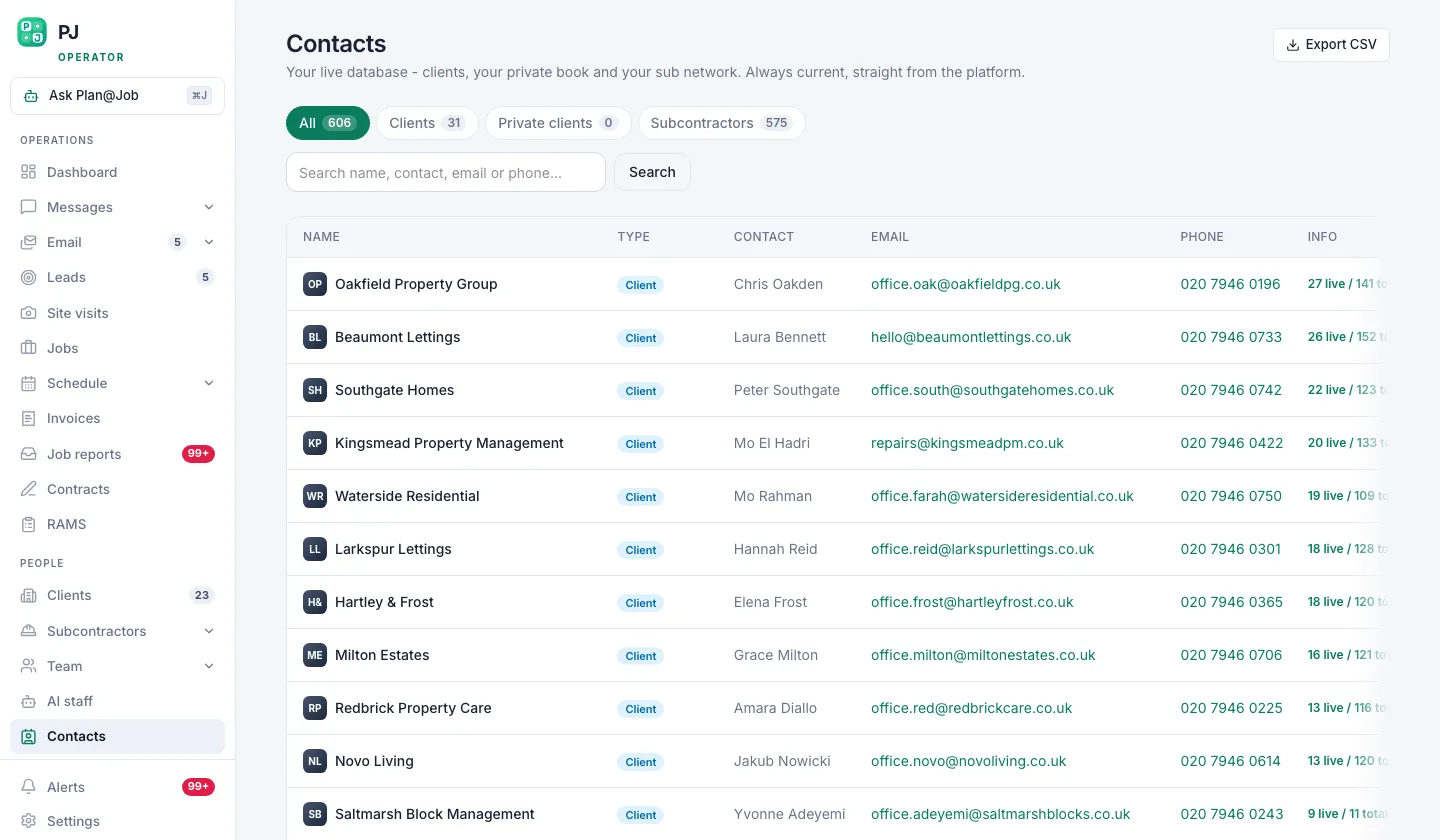 Contacts is the list you build before any campaign goes out.
This bit is all you. Plan@Job doesn't pick your targets. You decide which areas you can actually cover and which agents are worth the call.
Step 2: Make the call and agree with them
The objection usually lands in the first 20 seconds. Have the answer ready so you're not thinking on your feet.
What to say, in this order
- Agree straight away. "Good, you should have one. I'm not ringing to replace them."
- Reframe what you're offering. "I'm ringing to be your backup for when they can't get there."
- Ask one question about the gap. "When your contractor is booked up or it's a weekend, who do you call?"
- Shut up and listen. Whatever they say next is the real answer.
- Ask for something small. "Can I send you my details so you've got a second name on file?"
That's it. No pitch about your years of experience. No list of every trade you cover. They'll tune out.
If they say "nobody, we just wait", that's your gap. If they say "we've got three already", thank them, ask if any of them cover a particular area or trade badly, and move on. Not every call is a lead. That's fine.
Step 3: Find the gap their contractor leaves
Every contractor leaves a gap somewhere. Your job on the call is to find it, not to invent it. The usual ones:
- Out-of-hours and weekend callouts
- Void turnarounds, where the agent needs a property ready for the next tenant fast
- Trades the current contractor doesn't do in-house, so they're subbing it anyway
- Postcodes on the edge of the contractor's patch
- Planned works and bigger refurbs that a small reactive outfit can't take on
Pick the one you can genuinely deliver. If you can't do out-of-hours properly, don't offer it. Promising cover you can't give is how you lose the agent for good on the first job.
Step 4: Log the call straight after
Do it before you dial the next number. Not at the end of the day. You won't remember who said what.
- Go back to the contact in Contacts.
- Update the status to reflect where they're at.
- Add a note with the gap they mentioned, who you spoke to and when to call back.
- If they gave you an email, send your details the same day from Email so the thread sits with the contact.
You decide every word of that first follow-up. Plan@Job's AI staff don't cold call for you, and first contact with a new client normally needs a person's approval anyway. That's how it should be. The agent needs to hear from you, not a template.
Step 5: When the first job lands, deliver it properly
This is where most operators blow it. They win the job and treat it like any other. It isn't. It's an audition.
- Add it in Leads or Jobs, depending on whether it's a quote request or a confirmed job, and record that it came from your phone campaign.
- Let Sophie Bennett, the AI Enquiries Coordinator, check the job brief. If something's missing, like access details or a clear description of the fault, she asks for clarification, and after two attempts she hands it back to you.
- Find your subbie through Subcontractors, or use Cover a job if you need someone outside your usual team. You choose who gets it.
- Daniel Reed, the AI Operations Manager, can chase subbies for quotes and proposed dates, and he puts what's outstanding in your morning brief.
- You set the price and you approve what goes to the client. Nothing gets awarded or priced without you.
More on how the AI staff split the work is on the AI staff page.
Then send a proper Job report with photos when it's done. The agent compares you to their current contractor on that first job. Speed, communication, photos, no chasing. It's not the price, it's the service.
Step 6: Check Work sources once a month
Cold calling eats hours. You need to know if it pays.
- Open Work sources.
- Look at how many jobs came from the phone campaign against your other channels.
- Decide whether to keep calling the same type of agent, change area, or put the time somewhere else.
 Work sources answers the question most contractors cannot: which channel actually pays.
The report shows you where the work came from. The call on what to do about it is yours.
What usually goes wrong
I've seen the same mistakes over and over.
The first is arguing. "But are they really giving you a good service?" Dead. You've just made them defend their own choice.
The second is no follow-up. They said "send me your details", you sent nothing, and three weeks later their contractor lets them down and they ring whoever's card is on the fridge. Log it the same day.
The third is overpromising. You said "we'll be there in an hour, any time", then you send a subbie the next afternoon. The backup position only works if you're actually better on the job they give you.
The fourth is calling too often. Once a month is keeping in touch. Every week is a nuisance. The last contact column in Contacts is there so you don't do this.
If you want to talk this through with people doing the same calls, Contractor Club is the community I run for people building contracting businesses.
The next move
Build the list, make 20 calls, log every one. That's the job. Plan@Job keeps the contacts, the jobs, the subbies and the money in one place so the follow-up doesn't fall through the cracks. See how it works for operators on the UK contractors page, or create your contractor account and load your first list into Contacts today.
FAQ
Should I ask who their current contractor is?
No. It sounds like you're fishing, and it doesn't help you. Ask what happens when their contractor can't get there. That tells you the gap, which is the only thing you can actually sell into.
How long should I wait before calling back?
Roughly a month, unless they gave you a reason to call sooner, like a void coming up or a block they're taking on. Put the reason and the date in your note on the contact. Calling back with a reason beats calling back to "check in".
Can Plan@Job's AI staff make these calls for me?
No. The cold call and the first contact with a new client are yours. Where the AI staff help is after the work comes in: Sophie checks job briefs, Daniel chases quotes and dates and sends your morning brief, and Maya Collins prepares deposit and overdue payment actions for you to approve.