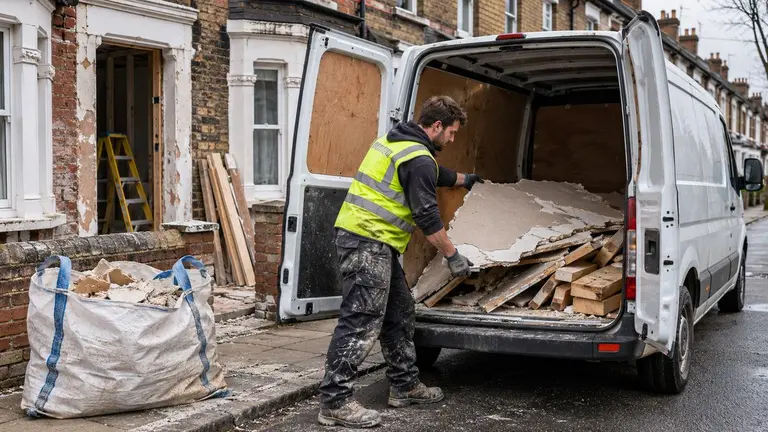
A waste carrier licence, properly called waste carrier registration, is the record that lets a business transport waste legally in the UK. There are two tiers. The lower tier is free, but it does not cover construction and demolition waste. If you are a builder, roofer, plasterer, kitchen fitter or any trade that carries rubble, offcuts or strip-out waste in your own van, you almost certainly need the paid upper tier. That is the short answer. The rest of this guide explains why, who genuinely qualifies for the free tier, how to apply, and the paperwork that goes with it.
What the two tiers actually cover
The word "licence" causes a lot of confusion. Most trades hear "waste carrier" and picture a skip lorry or a man-with-a-van clearance firm. In practice the rules apply to anyone who moves waste as part of their business, including waste they produced themselves.
Lower tier: free, but narrow
In England, the lower tier is for businesses that only carry their own waste and that waste is not construction or demolition waste. It also covers certain specific groups, such as charities and voluntary organisations, waste collection authorities and some businesses dealing with agricultural, mine or quarry waste or animal by-products.
Lower tier registration is free and, in England, does not need renewing.
The key word is exclusion. Construction and demolition waste is carved out of the lower tier. A café carrying its own cardboard to a recycling centre can use the lower tier. A builder carrying their own broken bricks cannot.
Upper tier: paid, three-year registration
You need the upper tier if you:
- carry construction or demolition waste, even if it is your own
- carry other people's waste of any kind
- buy, sell or dispose of waste
- arrange for someone else to move waste (acting as a broker or dealer)
Upper tier registration lasts three years and then needs renewing. It carries a fee.
Why "my own waste" does not get you off the hook
This is where most trades get caught. The reasoning usually goes: "It is my waste, I made it on the job, so I am only carrying my own waste, so the free tier is fine."
Half of that is right. Waste you create while doing the work is generally treated as your waste, because your activity produced it. The rip-out of an old bathroom, the offcuts from a stud wall, the spoil from a footing. You are the producer.
But that is precisely why the upper tier applies. Your own waste is fine for the lower tier only if it is not construction or demolition waste. For most trades, it is exactly that. So the "own waste" argument leads you straight to the upper tier, not away from it.
Do you need upper tier? A quick decision table
Use this as a starting point, then check your exact situation against the official guidance.
| Your situation | Tier you are likely to need |
|---|---|
| Builder, roofer, groundworker, plasterer carrying site waste in your own vehicle | Upper tier |
| Kitchen or bathroom fitter taking away old units, tiles or sanitaryware | Upper tier |
| Electrician or plumber carrying old cable, pipe, boilers or radiators from jobs | Upper tier in most cases, as this is waste from construction or refurbishment work |
| Gardener or landscaper carrying hard landscaping waste such as slabs or rubble | Upper tier |
| Any trade taking a customer's unrelated rubbish "while you are there" | Upper tier, because it is someone else's waste |
| Contractor who books skips or waste collections on behalf of clients and arranges disposal | Upper tier, which can include broker or dealer registration |
| Office-based business carrying only its own paper or packaging | Lower tier |
| Trade that never moves waste, because the skip firm or a registered carrier collects everything from site | You may not need to register, but you still have a duty to check your carrier is registered |
When you genuinely do not need it
You do not need to register as a carrier if you never transport waste. If every bit of waste goes into a skip on site and the skip company removes it, the skip company is the carrier. The same applies if a registered waste firm collects from your yard.
What you cannot do is skip registration and then "just take the odd van load to the tip". One van load is still carrying waste.
How to register
In England, you register with the Environment Agency through GOV.UK. Start at the official page: Register or renew as a waste carrier, broker or dealer.
Scotland, Wales and Northern Ireland each have their own regulator (SEPA, Natural Resources Wales and the Northern Ireland Environment Agency). The principles are similar, but processes, tiers and fees are not identical, so register with the regulator for the nation where your business is based.
What it costs
Our last fee check put the Environment Agency's upper tier charge at around £191 for a new three-year registration and around £130 to renew. Fees are reviewed and do change, and other UK nations set their own charges, so confirm the current amount on the official page before you apply. Lower tier registration is free.
What you will need
Have these ready before you start:
- Your business type and legal details (sole trader, partnership or limited company, plus company number if relevant)
- Names and dates of birth of the key people, such as directors or partners
- Details of any relevant environmental convictions
- Contact and address details for the business
- A way to pay the fee online
Once registered, you get a registration number. Keep it handy. Clients, main contractors and waste sites may ask for it.
The paperwork that sits alongside registration
Registration is only one part of your duty of care for waste. The other parts are where trades often slip.
Waste transfer notes
Whenever waste passes from one person to another, such as when you tip at a transfer station, a waste transfer note should record what the waste is, how it is contained, who handed it over and who received it. Keep these for at least two years. Many sites issue them at the weighbridge, and a season ticket arrangement can cover repeat visits. File them where you can find them.
Hazardous waste
Some construction waste is hazardous, such as asbestos, some treated timber, certain paints and solvents, and contaminated soil. Hazardous waste has its own rules, including consignment notes and specific disposal sites. Do not mix it in with general site waste. If you are unsure whether something is hazardous, check before you move it.
Checking the people you hand waste to
If you use a skip firm, a grab lorry or a subcontractor for clearance, check they are registered. The Environment Agency runs a public register of waste carriers, brokers and dealers, linked from GOV.UK. A quick search before you book takes a minute and protects you. If your waste ends up fly-tipped by an unregistered carrier you hired, you can be held responsible.
Building waste into how you run jobs
Waste is a cost and a compliance step on almost every job, so treat it like any other part of delivery rather than something you sort out on the last day.
If you run your work through Plan@Job as an Operator (the contractor business managing clients, project delivery, subcontractors and in-house operatives), you can split a job into internal stages, each with its own scope, dates, status and costs. A waste removal or skip stage sits naturally in that project plan, whether you handle it with your own van and upper tier registration or subcontract it to a clearance firm. Internal stage costs and subcontractor identity stay internal. The client sees the overall agreed scope and price, plus any evidence you choose to share.
Illustrative example: a small refurbishment firm plans a bathroom strip-out. Stage one is strip-out and waste removal, assigned to their in-house operatives, costed for tip charges and van time. Stage two is first fix, assigned to a plumbing subcontractor. The waste stage has its own date and status, so nobody turns up to first fix with the old suite still in the hallway.
Some decisions still need a person. Plan@Job does not check waste carrier registrations for you. Before you award waste or clearance work to a subcontractor, look them up on the public register yourself and decide whether they are right for the job. Daniel Reed, the AI Operations Manager, can help chase quote and proposed-date follow-ups and gives you a morning brief, but awarding work and setting prices stay with you.
If you want to swap notes with other UK contractors on how they handle waste costs and tip runs, Contractor Club is a related community for UK trades.
Frequently asked questions
If I hire a skip, do I still need my own waste carrier registration?
Not for the skip itself. If waste goes into a skip on site and the skip company takes it away, the skip company is the carrier. You do need upper tier registration if you also carry waste in your own vehicle, even occasionally. And you should still check the skip firm is registered, because your duty of care continues until the waste is handed to someone authorised to take it.
Is there a minimum amount of waste before registration applies?
No. There is no small-load exemption. A single van load of rubble from a job counts. The question is whether you transport waste as part of your business, not how much.
I am a sole trader. Does the upper tier apply to me?
Yes. Registration applies to businesses of all sizes, including sole traders. If you carry construction or demolition waste, or anyone else's waste, the upper tier applies whether you work alone or run a team.
If you are ready to plan waste, materials and labour as proper stages on every job, see how Plan@Job works for contractors.