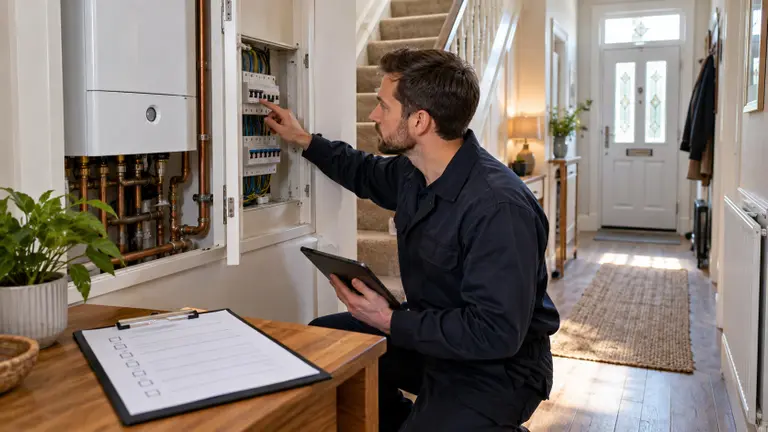
If you manage rental properties in Victoria, you already have a legal duty that's easy to lose track of because it only comes around every two years: gas and electrical safety checks. Under Victoria's rental minimum standards, every rental property must have its gas installations and electrical installations checked by a licensed tradesperson at least once every two years, and the rental provider - not the renter - is the one who has to make it happen. Miss the window and you're not just out of compliance on paper; you're carrying real risk on a gas leak, a faulty circuit or an insurance claim that gets knocked back because the paperwork wasn't there.
What the two-yearly rule actually requires
The obligation sits in Victoria's Residential Tenancies Regulations, which set out the safety-related minimum standards rental providers must meet on top of the Residential Tenancies Act 1997 (Vic). Two separate checks are required, and both run on the same two-year clock, though they don't have to happen on the same day or by the same person.
Gas safety checks
A licensed or registered gasfitter has to check any gas installations and the gas appliances the rental provider has supplied - the cooktop, the ducted heater, the instantaneous hot water unit, gas log fires and so on. The check covers things like gas leaks, ventilation, flueing and whether appliances are operating safely, not just whether they turn on. If a property has no gas connection at all, this particular obligation doesn't apply - but plenty of Victorian rentals that "feel" all-electric still have a gas cooktop or a gas hot water service tucked away, so it's worth confirming rather than assuming.
Electrical safety checks
A registered electrician has to check the property's electrical installation - wiring, switchboard, safety switches and power points - for faults and safety hazards. This is a check of the fixed electrical installation, not an appliance-by-appliance test of everything the renter has plugged in.
Both checks need to be repeated at least once every two years for as long as the property is tenanted. There's no exemption for owner-occupied history, a "recently built" property, or a change of managing agent - the clock runs on the property, not on who's managing it.
Why this particular obligation catches people out
Annual jobs get built into a calendar without much thought - smoke alarm servicing, for instance, is expected every year, so most portfolios have a rhythm for it. A two-year cycle is a different shape of problem. It's frequent enough to be a real legal obligation, but infrequent enough that it falls outside the natural annual review most property managers already run, and it's very easy for a due date to drift quietly past while everyone's attention is on rent arrears, re-lets and maintenance requests that renters are actually chasing.
It gets worse at scale. A property manager running forty or fifty tenancies doesn't have forty or fifty checks due on the same date - they're staggered across whenever each check was last completed, which for older properties may not be well documented in the first place. Without a system tracking each property's own due date, the honest answer to "when was this one last checked?" is often "we're not sure."
Don't confuse it with the annual obligations
It's worth being precise here, because conflating the two-yearly gas and electrical checks with other safety jobs is a common mistake:
- Smoke alarms need to be checked and tested more often than gas and electrical installations - broadly annually, and again around the time a new renter moves in. That's a separate minimum standard with its own cycle.
- Pool and spa barriers, where relevant, sit under separate safety obligations again.
- The gas and electrical safety check covered in this article is specifically the two-yearly installation check by a licensed gasfitter and registered electrician.
Treating all of these as one generic "safety compliance" task invites exactly the kind of drift that gets a rental provider in trouble - a renter or Consumer Affairs Victoria isn't interested in whether you were "generally on top of safety," they're interested in whether the specific, dated check that was legally required actually happened.
Building a compliance calendar so nothing lapses
A workable system tracks each property individually rather than the portfolio as a whole. In practice that means:
- Record the due date against the property, not the file. Every rental property needs its own next-due date for gas and its own next-due date for electrical, calculated from when each check was last completed - not from the tenancy start date or the property's age.
- Book both checks together where you can. If a gasfitter and an electrician can attend on the same access visit, you cut the number of times you need to coordinate access with the renter and reduce the chance one check gets done while the other quietly slips.
- Set the reminder well ahead of the due date, not on it. Licensed gasfitters and registered electricians book out, especially around EOFY and just before a compliance deadline everyone else is also chasing.
- File the certificate immediately once the work's done, rather than waiting for a renter or an auditor to ask for it. If a renter requests a copy, you want to be able to produce it, not go looking for it.
- Check the record before a new renter moves in. Starting a new tenancy on a property with an overdue check is a bad look and an avoidable one - it should be one of the items you verify before signing anyone up, alongside the usual condition report and bond steps.
What happens if a check is missed
If a gas or electrical safety check lapses, a renter can raise it as a breach of the rental provider's duties, and unresolved disputes can end up before the Victorian Civil and Administrative Tribunal (VCAT), which can order the work to be done or make other orders around the tenancy. Consumer Affairs Victoria also has powers to take enforcement action against rental providers who don't meet the state's rental minimum standards. Beyond the regulatory exposure, there's the practical risk: if a gas or electrical fault causes an incident and the safety check was overdue, that's a hard conversation to have with an insurer, let alone with the renter or their family.
None of this requires drama to avoid. It requires the check being scheduled, actually happening, and being documented - which is exactly the kind of recurring, unglamorous task that gets missed when it's tracked in someone's memory instead of a system.
Keeping the cycle on track with Plan@Job
This is a natural fit for Plan@Job's project workflow: each property's gas and electrical safety check can be set up as a recurring job, with its own scope, due dates and status, and delivery handled by a subcontracted gasfitter or electrician from your vetted network rather than a scramble to find someone free. Because the platform tracks stage status and dates rather than relying on a spreadsheet somebody has to remember to open, a check that's approaching its two-year mark shows up as upcoming work rather than a surprise. Where the workflow includes AI support, Daniel Reed (Plan@Job's AI Operations Manager) can help chase quotes and confirm proposed dates with subcontractors, though any award of work and every price still needs your sign-off - there's no autonomous booking or payment happening in the background.
Plan@Job is live in the UK today, and an Australian rollout is on the way. If you're a Victorian property manager and want to be notified when it lands here, you can register your interest at planajob.com/au/property-managers. In the meantime, you can see how the underlying project and job-stage workflow operates at planajob.com/features/project-management, and read more about the AI support roles at planajob.com/ai-staff.
FAQ
Do I still need a gas safety check if the property has no gas appliances?
No. The gas safety check obligation applies to gas installations and appliances the rental provider has supplied. If a property is genuinely all-electric with no gas connection, that specific check doesn't apply - but it's worth confirming there's no gas cooktop, gas hot water unit or gas heater on site before assuming so, since these are easy to overlook in an older property.
Who's legally responsible for booking the check - me or my agency's principal, or the property owner?
The legal duty sits with the rental provider (the owner, in most cases), but a managing agent acting under a management agreement typically carries out this obligation on the rental provider's behalf as part of standard property management duties. Whoever holds day-to-day responsibility for the property, the safest approach is to confirm in writing who is arranging and paying for each check, so it isn't assumed away between owner and agent.
What happens if the two-yearly check is overdue when a new renter is about to move in?
Get it done before the new tenancy starts, or as close to it as possible. Starting a fresh lease on a property with a lapsed gas or electrical check leaves both the incoming renter and the rental provider exposed, and it's one of the easiest issues to fix in advance simply by checking the record before advertising the property again.