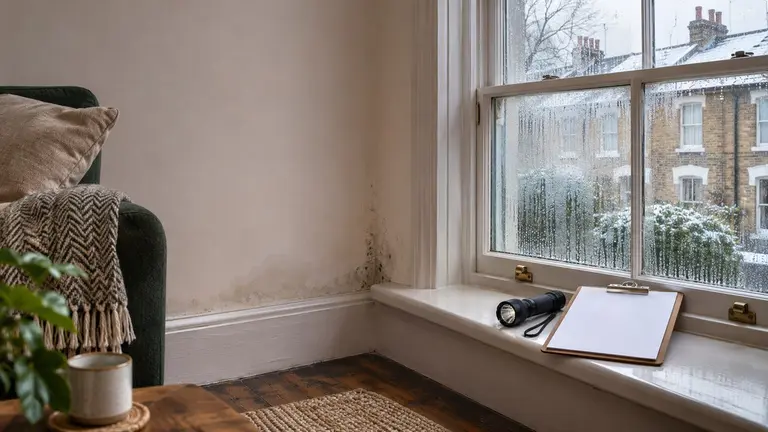
There are three main types of damp you will meet in rented homes: condensation, rising damp and penetrating damp. Condensation comes from moisture inside the home settling on cold surfaces. Rising damp is ground water drawn up through the base of a wall. Penetrating damp is water getting in from outside, usually through a defect in the building. Telling them apart matters because each has a different cause, a different fix and a different person responsible for the next step. Get the diagnosis wrong and you can spend money on the wrong repair while the real problem carries on.
This guide is for property managers and letting agents who need to triage a damp report quickly, decide what to check, and know when to bring in a surveyor.
Why the type of damp matters
A tenant report that says "there is damp in the bedroom" could mean almost anything. A few black spots behind a wardrobe and a wet patch spreading down a chimney breast are both "damp", but one may be a ventilation and heating issue and the other may be a failed flashing on the roof.
The type of damp shapes three decisions:
- Who you send. A roofer, a builder, a plumber or an independent damp surveyor.
- How urgent it is. Active water ingress and visible mould affecting health need prompt action.
- What you record. Damp and mould are a recognised hazard in rented housing in England. Current government guidance on damp and mould, the Housing Health and Safety Rating System and, for social landlords, Awaab's Law all expect landlords to investigate causes, not just treat symptoms. Check the current official guidance for the duties that apply to your properties rather than relying on a summary.
Condensation: moisture from inside the home
Condensation is the most common of the types of damp in UK rentals. Everyday living puts water into the air through cooking, showers, drying clothes and breathing. When that warm, moist air meets a cold surface, it turns back into water.
Signs of condensation
- Water droplets on windows and window reveals, especially in the morning.
- Black mould spotting in corners, on ceilings near external walls, behind furniture and inside wardrobes.
- Mould on soft furnishings, curtains, shoes or clothes.
- Worse in autumn and winter, better in summer.
- No clear tide mark and no white salt deposits.
- Often worst in bedrooms, bathrooms and rooms with the least heating.
What usually drives it
Condensation is rarely just a "lifestyle" issue, and it is a mistake to treat it that way. Building factors often make it worse:
- Extractor fans that are missing, too weak, blocked or switched off at the isolator.
- Trickle vents painted shut or windows with no background ventilation.
- Cold spots from missing loft insulation, cold bridging around lintels or single-skin walls.
- Heating that is inadequate, expensive to run or not working properly.
Occupant habits play a part, but so does the building. A good response covers both: fix the fans, vents and cold spots you are responsible for, then give the tenant practical, respectful advice.
Rising damp: ground moisture moving up the wall
Rising damp happens when moisture from the ground moves up through masonry by capillary action. Most houses built in the last century have a damp-proof course (DPC) near the base of the walls to stop this. Older solid-wall properties may have no DPC or one that has failed.
Genuine rising damp is less common than many people assume. A lot of what gets called rising damp turns out to be a bridged DPC, a leak, or condensation at low level.
Signs of rising damp
- A tide mark low on the wall, usually confined to the lower part of the wall.
- White, fluffy salt deposits on the plaster surface.
- Crumbling or blown plaster and lifting paint near skirting level.
- Rotting skirting boards or floor timbers.
- Ground-floor walls only. Rising damp does not appear upstairs.
- Present all year, though it may vary with ground water levels.
Common causes of a bridged DPC
Before anyone recommends injecting a new chemical DPC, check whether the existing one is being bypassed:
- External ground, paths or patios built up above DPC level.
- Render or pebbledash taken down past the DPC to the ground.
- Debris in the cavity sitting above the DPC.
- Internal plaster or screed bridging the DPC.
- Leaking downpipes or gullies soaking the base of the wall.
These are often cheaper to fix than a full damp-proofing job, and they fix the actual cause.
Penetrating damp: water coming in from outside
Penetrating damp is water moving sideways through walls, roofs or openings. It can appear at any height and on any floor.
Signs of penetrating damp
- Localised damp patches that grow or darken after heavy or wind-driven rain.
- Patches on ceilings below roofs, valleys or flat roofs.
- Damp around window frames, door frames or chimney breasts.
- Staining that lines up with something outside, such as a downpipe or a cracked section of render.
- Wet plaster that dries out in long dry spells.
Typical external defects
Walk the outside of the building and look for:
- Blocked, cracked or overflowing gutters and downpipes.
- Missing or slipped roof tiles and slates.
- Failed lead flashing around chimneys and abutments.
- Eroded mortar pointing or cracked render.
- Gaps in window and door seals or failed sills.
- Leaking or damaged chimney stacks and flaunching.
One more source worth ruling out early is internal plumbing. A slow leak from a pipe, radiator valve, shower tray or a flat upstairs can look exactly like penetrating damp.
A quick triage checklist for damp reports
When a tenant reports damp, ask these questions before you book anyone. The answers often point to the type straight away.
- Where is it? Room, wall, height from the floor, inside or external wall.
- When does it appear? All year, winter only, or after rain.
- What does it look like? Black spotting, a tide mark, a spreading wet patch, white salts.
- Is there water on the windows? Every morning, sometimes or never.
- What is outside that wall? Downpipe, raised patio, render, a neighbouring property.
- Is anything wet to the touch? Active water suggests a leak or ingress.
- Photos. Close-up and wide shots inside, plus the outside of the same wall if safe to take.
A note on moisture meters: handheld pin meters are designed mainly for timber. On plaster and masonry, salts can give high readings even when a wall is not especially wet. A reading on its own is not a diagnosis, so treat it as one clue among several.
When to book a damp survey
You can handle some cases from the triage alone, such as an obvious blocked gutter or a broken extractor fan. Book a proper survey when:
- The pattern does not fit neatly into one type.
- Damp keeps coming back after a repair.
- Someone has recommended chemical injection, tanking or replastering.
- There is mould affecting a vulnerable tenant and you need a clear record of cause and action.
- You are dealing with a solid-wall or period property where breathable materials matter.
Where possible, choose a surveyor who is independent of the company selling the treatment. Ask for a written report that names the cause, shows the evidence, and explains why other causes were ruled out.
Illustrative example
This is a fictional scenario to show the triage in practice. A tenant in a 1930s semi reports damp in the ground-floor front room. The photos show a patch about knee height, worse after a week of rain, sitting just inside the wall where a downpipe runs outside. There are no salts and the windows are dry. That pattern points to penetrating damp from the downpipe rather than rising damp, so the first job is a gutter and downpipe check, with a surveyor booked if the patch does not dry out.
Raise a damp survey on Plan@Job
Once you have done the triage, Plan@Job helps you turn it into a clear job rather than a chain of emails. You raise the job with the address, the location of the damp, when it appears and the photos the tenant sent.
Sophie Bennett, the AI Enquiries Coordinator, checks the job brief for missing information, such as no exterior photos or no detail on when the damp appears, and asks for clarification. If the details are still missing after two attempts, the job is handed to a person rather than guessed at.
Daniel Reed, the AI Operations Manager, can support sharing eligible jobs with the existing vetted network and follow up on quotes and proposed visit dates. You stay in control of the decisions that matter:
- Which surveyor or contractor you instruct.
- Which quote and date you accept.
- What you tell the tenant and when.
No job is awarded automatically and no price is set for you. When the work is done, the contractor can share evidence, such as photos of the repair, so you have a record against the property.
See how this works for your portfolio on the Plan@Job property managers page, or read more about how the AI staff support your team.
FAQ
Can a property have more than one type of damp at once?
Yes. A cold, poorly ventilated room can have condensation while the same building has a leaking gutter causing penetrating damp. This is one reason a survey that explains each cause separately is worth having.
Is rising damp the landlord's responsibility?
Rising damp and penetrating damp usually come from the structure of the building, which normally sits with the landlord. Condensation can involve both building and occupant factors. Check the tenancy agreement and current official guidance for the duties that apply to your property.
Will a dehumidifier fix damp?
A dehumidifier can reduce condensation in the short term, but it will not fix a leak, a bridged DPC or a building defect. Use it as a stopgap while the real cause is found and repaired.