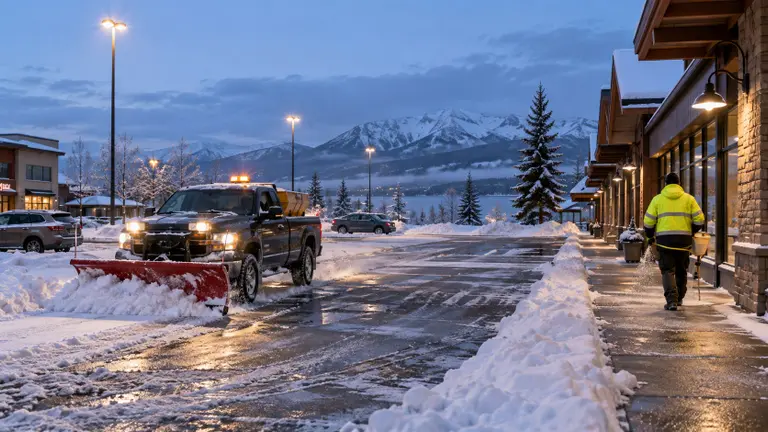
Pricing a snow removal contract comes down to one question: who carries the risk of a heavy winter, you or the client? A seasonal contract puts that risk on you. Per-push puts it on the client. Per-event sits in the middle. Pick the model first, then do the maths. Most contractors do it the other way round, and then spend February working for free.
I'll be straight with you. I never ran a plow route in Canada. I learned construction on the tools, then built a property maintenance company in London that worked for housing associations and letting agents, with subbies doing the work. The weather was different but the business was the same. You've got recurring contracts across lots of sites, a client who wants one number, and a crew who wants paid either way. The pricing logic carries straight over.
What are the three snow removal pricing models?
Seasonal (flat-rate) contracts
The client pays a fixed amount for the season, usually split into monthly instalments from November through March or April. You clear the site every time it snows, within the terms of the contract.
The client loves it because they can budget. You love it in a light winter. In a heavy winter you're pushing snow at a loss by the third big storm.
Per-push contracts
You charge every time the truck clears the site. Two pushes in one storm means two charges. It's fair to you, because every visit gets paid.
The client hates not knowing the bill. Expect the "why did you come out twice?" call, and keep timestamped photos so you can answer it.
Per-event contracts
You charge per storm, however many pushes it takes, usually in bands by depth. One rate for a light storm, a higher rate for a big one. Your risk is a long, slow storm that needs four visits for one event price.
Which model should you pick?
Match the model to the client and to how much cash you've got behind you.
- Seasonal suits clients who set budgets a year ahead: condo corporations, property management firms with several buildings, commercial landlords. They need one number to take to the board or the owner.
- Per-push suits small commercial sites and clients who'd rather pay for what they actually get.
- Per-event suits clients who want some predictability when you're not prepared to eat a heavy winter.
- A hybrid is a seasonal base that covers an agreed number of events, with a per-event rate for anything above that cap. It's the one I'd put in front of multi-site clients.
Here's the part people hate hearing: a seasonal contract with no cap is a bet on the weather. You're not a weather forecaster. Cap it.
Also remember Canada doesn't have one winter. Coastal BC, Calgary with its chinooks, the freeze-thaw cycles in Ontario and Quebec, and Atlantic nor'easters are all different businesses. Don't price off last winter or off what someone in another province charges. Look at several winters of history for your area. Environment and Climate Change Canada publishes historical climate data by weather station, and that beats guessing.
How do you work out a price per push?
Start here every time. Even a seasonal contract is built on a per-push number.
- Walk the site before the snow. Measure the lot, the sidewalks, the stairs and the entrances. Then work out where the snow goes. Snow storage is where sites go wrong. Once the piles fill the corner of the lot, you're hauling, and hauling is a separate price.
- Time it. Count truck time on the lot, shovel crew time on the walks, and salting time. Add travel between sites on the route, because the truck isn't earning while it drives.
- Load your hourly cost properly. That means labour (including overtime and night work, because storms land at 3am), the truck and blade, maintenance, fuel, insurance, subbie rates, overhead and standby. Standby is the one people forget. You're paying people to be ready, snow or no snow.
- Price materials separately. Put salt, sand or ice melt on its own line per application. Material costs move, and a freeze-thaw week can mean salting three times with no plowing at all.
- Add your margin, then add GST/HST at the rate for the province where you're doing the work. Say clearly on the quote whether tax is included.
Illustrative example (made-up figures to show the method, not market rates): a mid-size plaza lot needs about 1.5 hours of truck time per push and an hour of shovel crew on the walks. Multiply each by your own loaded hourly cost, add margin, and that's your per-push price. Salting gets priced per application on its own line.
How do you turn that into a seasonal price?
The formula is simple:
per-push price x expected pushes in a typical season + expected salting applications + a risk allowance = seasonal price
Then split it into monthly instalments.
Take expected pushes from several winters of local history, not just the last one. Use an average winter, not your best or your worst. Then write the cap into the contract: above a set number of events or total centimetres, the per-event rate applies.
Continuing the illustrative example: if your records for that lot point to roughly 20 pushes in an average season, you price 20 pushes plus salting plus a risk allowance. You cap it at an agreed number of events and charge per event above that.
There's also a cash point people miss. Seasonal money arrives every month, even in a dry December, and that pays for the truck. Per-push money only arrives when it snows. If you run mostly per-push, keep a buffer for the gaps.
What goes in a snow removal contract?
Running maintenance contracts in London taught me a rule I still live by. If it isn't written down as included, it's an extra, and you say so on day one. The contracts that hurt me were never the cheap ones. They were the vague ones.
For snow, put these in writing:
- The trigger depth, written in centimetres, and what happens below it (salting only, or nothing).
- The service window, for example lots cleared before the business opens.
- What's included and what isn't: lots, walks, stairs, loading docks, roofs, hauling.
- Salting, either included or priced per application, and which product you use.
- Damage. Do a pre-season walk, stake the curbs and islands, and agree how damage gets reported. Plows hit things.
- The cap and the overage rate.
- Season start and end dates, and how you handle an early or late storm.
- Payment terms and what happens when they pay late.
Then there's insurance. Slip-and-fall claims are the big exposure in this trade, and the rules on liability and claim notice vary by province. Talk to your broker and a lawyer before you sign multi-site work, not after. Make sure you and every subbie have workers' compensation coverage with the provincial board (WSIB in Ontario, WorkSafeBC in BC, CNESST in Quebec, and so on). Many municipalities also have bylaws that set deadlines for clearing sidewalks, so check the local rules for each site and make sure your service window meets them.
How do you run multi-property routes without losing control?
Here's the ugly side. A storm hits at 2am, a subbie doesn't turn up, and the property manager calls at 7 asking why the lot at site four isn't done. Your margin goes in those mornings, not in the quote.
You need to know who's on which site, have photo evidence with times, and invoice each property correctly. That's what Plan@Job is built for. It's AI-powered project and operations management for construction and property businesses.
In Plan@Job you're the Operator. That's the contractor business that manages the clients, the delivery, the subbies and your own crew. Each client contract becomes a job split into internal stages, by site or by service (plowing, walks, salting), and each stage has its own scope, dates, status and costs. The client sees the agreed overall scope, the price and the evidence you share. Your internal stage costs and the names of your subbies stay internal, so the client never sees your spread.
The AI staff help with the admin. Daniel Reed, the AI Operations Manager, handles follow-ups on quotes and proposed dates and sends you a morning brief. Maya Collins, the AI Finance Coordinator, prepares deposit requests and overdue payment actions for you to approve. Nothing goes out on price or money without you signing it off. Pricing and who gets the work stay your decisions.
One honest note on availability. The UK is the live market right now. In Canada, Plan@Job is running a reserve list.
My verdict
Price every site per push first, even if you sell it as seasonal. Sell seasonal to multi-site clients who need a fixed budget, always with a cap. Use per-push or per-event for everyone else until you've got a few winters of your own numbers.
The goal for winter is a route full of multi-property contracts, not one-off callouts. If you want to run those contracts through Plan@Job when it opens in Canada, reserve your spot on the Canadian contractors page.
FAQ
Is per-push or seasonal pricing better for a new snow removal business?
Start with per-push or per-event. Seasonal only makes sense once you've got a solid business in place: real site data, a few winters of history and enough cash to survive a heavy year. Sell seasonal before you know your numbers and you're gambling with your truck payments.
Do I charge GST/HST on snow removal contracts?
If you're registered for GST/HST, yes. Charge the rate for the province where the service is supplied and show it clearly on the quote and invoice. If you're small and not sure whether you need to register, check the current CRA guidance or ask your accountant.
What happens if the winter is much heavier than expected?
With a cap in the contract, events above the agreed number get billed at the per-event rate, so you're covered. Without a cap you absorb the whole cost on a seasonal deal. That's why the cap matters more than the headline price.