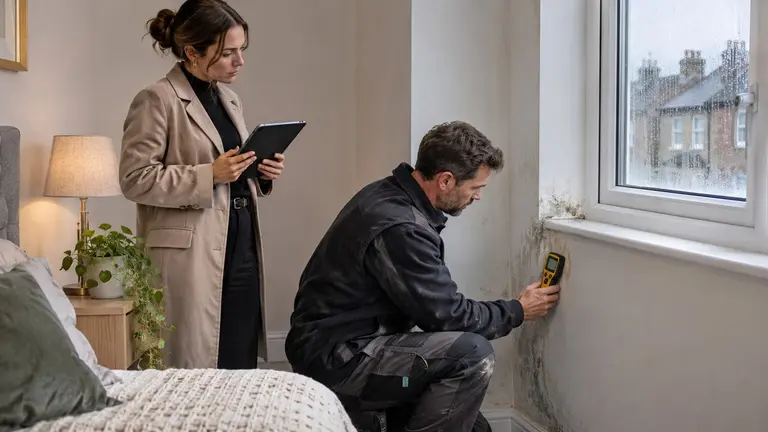
How to get rid of mould in a rental property starts with one fact: mould is a symptom of excess moisture, not the problem itself. Wipe it off without finding and fixing the moisture source and it will usually return. The reliable approach is to respond to the report quickly, diagnose the cause, fix that cause, then treat the surfaces and check the room stays dry. This guide walks UK property managers and letting agents through each step, what needs your decision, and how to keep a clear record of the work.
Updated 20 November 2026.
Why mould keeps coming back after cleaning
Mould needs moisture, a surface to grow on and time. Remove the moisture and it cannot establish itself. So before anyone picks up a sponge, you need to know where the water is coming from. There are four usual culprits.
Condensation
This is the most common cause in UK homes. Warm, moist air from cooking, showers, drying clothes and breathing hits a cold surface and turns to water. You see it in corners of external walls, behind wardrobes, around window reveals and on bathroom ceilings. The pattern is often patchy and worse in winter.
Penetrating damp
Water gets in from outside through defects such as cracked render, blocked or leaking gutters, failed pointing, damaged roof coverings or poorly sealed windows. Staining often appears after rain and tends to sit in one area rather than spreading in a pattern.
Rising damp
Ground moisture rising through walls is less common than often claimed, but it does happen, particularly in older properties with a failed or bridged damp-proof course. Look for a tide mark low on ground floor walls and salts on the plaster.
Leaks and plumbing faults
A weeping pipe, a failed shower seal or a leak from the flat upstairs can soak a wall or ceiling from inside the building. These are often the easiest to fix once found.
The cause matters because the fix is completely different for each. A new extractor fan does nothing for a leaking gutter.
Your responsibilities, in general terms
Damp and mould growth is one of the hazards assessed under the Housing Health and Safety Rating System in England, and homes let in England must be fit for human habitation. Awaab's Law now sets investigation and repair requirements for damp and mould in social housing, and the government has legislated to allow similar requirements to apply to private renting. Wales and Scotland have their own standards.
Rules and timescales are changing, so check current GOV.UK guidance (or the Welsh or Scottish Government equivalent) for the property you manage, and take legal advice where you are unsure. Government guidance on the health risks of damp and mould is also clear that landlords should not put mould down to tenant lifestyle and leave it there. Investigate first.
In practice, treat every mould report as a repair that needs a prompt, documented response.
Step by step: how to get rid of mould properly
- Log the report the day it arrives. Record the date, the rooms affected, how long the tenant has noticed it and whether anyone in the household has health concerns. Ask for photos of the affected areas.
- Book an inspection. A contractor should take moisture meter readings on affected and unaffected walls, check humidity with a hygrometer, and inspect the outside of the building, gutters, roof and windows. Ask for dated photos.
- Agree the cause in writing. You want a clear statement such as condensation from an inadequate bathroom fan, or penetrating damp from a cracked downpipe. Vague reports lead to repeat visits.
- Fix the cause first. Repair the leak, clear the gutter, fit or upgrade extraction, repair the render. If the wall is saturated, allow drying time before redecoration.
- Treat the mould safely. For surface mould on sound paint or tiles, a fungicidal wash used to the manufacturer's instructions is the standard approach. Avoid dry brushing, which spreads spores. Household bleach can lighten staining but is not a reliable treatment on porous surfaces. Badly affected plaster, sealant or silicone often needs cutting out and replacing. Contractors should use suitable protection such as gloves, eye protection and a mask.
- Redecorate once dry. Anti-mould paint can help on bathroom and kitchen ceilings, but it is a finish, not a fix. Painting over a damp wall hides the evidence and the mould returns.
- Revisit after a few weeks. Check the area, take new readings and photos, and ask the tenant whether it has stayed clear. Close the job only when it has.
How to keep mould away
Prevention is mostly about moving moist air out and keeping surfaces warm. Useful measures include:
- Extractor fans that actually work. Check they run, extract to outside and are not blocked. Humidistat or run-on timer fans help because they keep running after the room is used.
- Trickle vents. Make sure window trickle vents are present, clear and not painted shut.
- Whole-house ventilation where needed. In persistently humid properties, a contractor may recommend a positive input ventilation unit or similar. Get a specialist view rather than guessing.
- Insulation and heating. Cold external walls and poorly heated rooms attract condensation. Insulation upgrades, draught-proofing that keeps ventilation intact, and a heating system the tenant can afford to run all help.
- Building maintenance. Clear gutters and check roofs, pointing and seals on a planned cycle, not only when something leaks.
- Practical tenant guidance. Share simple tips such as lids on pans, fans on during and after showers, drying clothes in a ventilated room and leaving a gap behind furniture on outside walls. Frame it as help, not blame, and never use it as a substitute for fixing a defect.
A short damp and mould check at every routine inspection catches problems early. Look in corners, behind furniture and around windows, and note it on the inspection record.
What needs a person's decision
Some parts of a mould repair should always sit with you or a qualified contractor:
- Deciding whether the cause is condensation, penetrating damp, rising damp or a leak, based on the inspection.
- Approving the quote and the scope of work, including whether plaster needs replacing.
- Deciding whether the tenant needs to move out of a room, or the property, while work happens.
- Handling health concerns raised by the household, and any legal questions about your obligations.
- Signing off the job as resolved after the follow-up visit.
Software can keep the job moving and the record tidy. It should not make these calls for you.
Running a mould repair on Plan@Job
Plan@Job is AI-powered project and operations management for construction and property businesses. For property managers, it gives you one place to raise a repair, track it through to completion and keep the evidence together. Your contractor works as an operator, which is the contractor business that manages the job, its in-house operatives and any subcontractors.
Illustrative scenario, not a real customer. A tenant in a two-bed flat reports black mould on the bedroom wall and bathroom ceiling. The property manager raises a repair job with the tenant's photos and a short description.
- Sophie Bennett, the AI Enquiries Coordinator, checks the brief for missing information, such as access arrangements or how long the mould has been present, and asks for clarification. If there is no answer after two attempts, she hands over to a person.
- Daniel Reed, the AI Operations Manager, supports sharing eligible jobs with the existing vetted network, follows up on quotes and proposed dates, and includes outstanding items in a morning brief.
- The property manager decides. They review the quote, approve the contractor and agree the visit date. Nothing is awarded or priced automatically.
- The contractor plans the work. They can split the job into internal stages, such as inspection, cause repair, mould treatment and redecoration, each with its own scope, dates and status. The property manager sees the overall agreed scope and price, plus the photos and evidence the contractor shares.
The result is a dated trail showing when the report came in, what was found, what was approved and what was done. That record is useful if the problem returns or if questions are raised later.
You can read more about how this works for letting agents and managing agents on the Plan@Job property managers page, and about the AI colleagues on the AI staff page.
If you have a mould report sitting in your inbox now, the next step is simple: raise a repair job on Plan@Job with the tenant's photos and get an inspection booked.
FAQ
Can a tenant just clean mould off themselves?
Tenants can wipe small patches of surface mould from hard surfaces, and simple guidance helps. But a cleaned patch tells you nothing about the cause. Any report of mould should still be logged and investigated, because recurring mould usually points to a defect or ventilation problem that is the landlord's to deal with.
Is black mould more dangerous than other mould?
All indoor mould can affect health, particularly for children, older people and anyone with respiratory conditions. Colour is not a reliable guide to risk. Treat any visible mould as something to investigate and resolve promptly, and follow current government guidance on health risks.
How long should a mould repair take?
It depends on the cause. A failed fan or a leaking pipe can be fixed quickly, while penetrating damp may need external work and drying time before redecoration. For social housing in England, Awaab's Law sets specific timescales. For other tenures, check current official guidance for your area and act without unnecessary delay.