
You win your first property maintenance contract with no track record by asking for one small job, running it better than anyone expects, and handing back proof the same day. That's it. Nobody gives a new contractor a whole portfolio. They give you a dripping tap in an empty flat and watch what you do with it.
Here's the part people hate hearing: the missing track record isn't really the problem. Every contractor started with none. The problem is asking for the contract before you've done a single job for that person.
This guide is for operators. In Plan@Job, an operator is the contractor business that manages the clients, runs the jobs and sends the work out to subcontractors and in-house operatives. If that's you, this is the order I'd do it in.
Step 1: Sort the boring stuff before you knock on a door
A property manager can't check your track record, so they check everything else. Make that list clean before you ask for anything.
- Insurance in place, with the certificate ready to send as a PDF. Check what the agent's own contractor terms ask for, because some will tell you exactly what cover they need.
- Company details that look like a business. A registered name, a proper email address, a phone that actually gets answered.
- The right registrations for anyone doing gas or electrical work. If that isn't you, it's your subbie, and you need their details on file before they go anywhere near a property.
- A one-page capability sheet. Trades you cover, the areas you cover, how fast you respond.
Then set up your Plan@Job account as an operator. Add any operatives under Team and the subbies you trust under Subcontractors. You want the system ready before the first job lands, not while the tenant is ringing you about a leak.
Step 2: Build a short list of people who actually give out work
Don't email every agent in the country. Pick a patch you can physically get to. Letting agents, block managers, landlords who run a few properties themselves. A short list you'll follow up properly beats a long one you'll forget about.
Log each one in Leads. Who you spoke to, when, and what they said. When you ring back in a fortnight, you know whether it was the lettings manager or the person on reception who said "send it over".
And go in person. Walk into the branch, ask who handles maintenance, leave the sheet. An email from a company they've never heard of gets deleted. A face they've met gets a callback.
Step 3: Ask for the job nobody wants
This is the whole trick. Don't ask for the contract. Ask for one job.
Every agent has jobs their current contractor keeps pushing back. The small reactive repair. The empty property that needs a clean and a touch-up before the next tenant moves in. The snag list from a check-out that's been sat there for weeks. Those jobs are your way in.
What I'd say is simple: "I know you've already got a contractor. Give me the one they haven't got round to. If I get it wrong, you've lost nothing."
Don't go in cheapest to get the door open. It's not the price - it's the service. Cheap gets you the jobs nobody wants to pay for, and it sets your price for every job after that. Price it properly and win on speed and proof.
Step 4: Turn the yes into a client account
When they say yes, set them up the same day.
- Go to Clients and add the agency. Every job, quote and invoice for them sits under that name from now on, so you're not digging through WhatsApp to find what you did for whom.
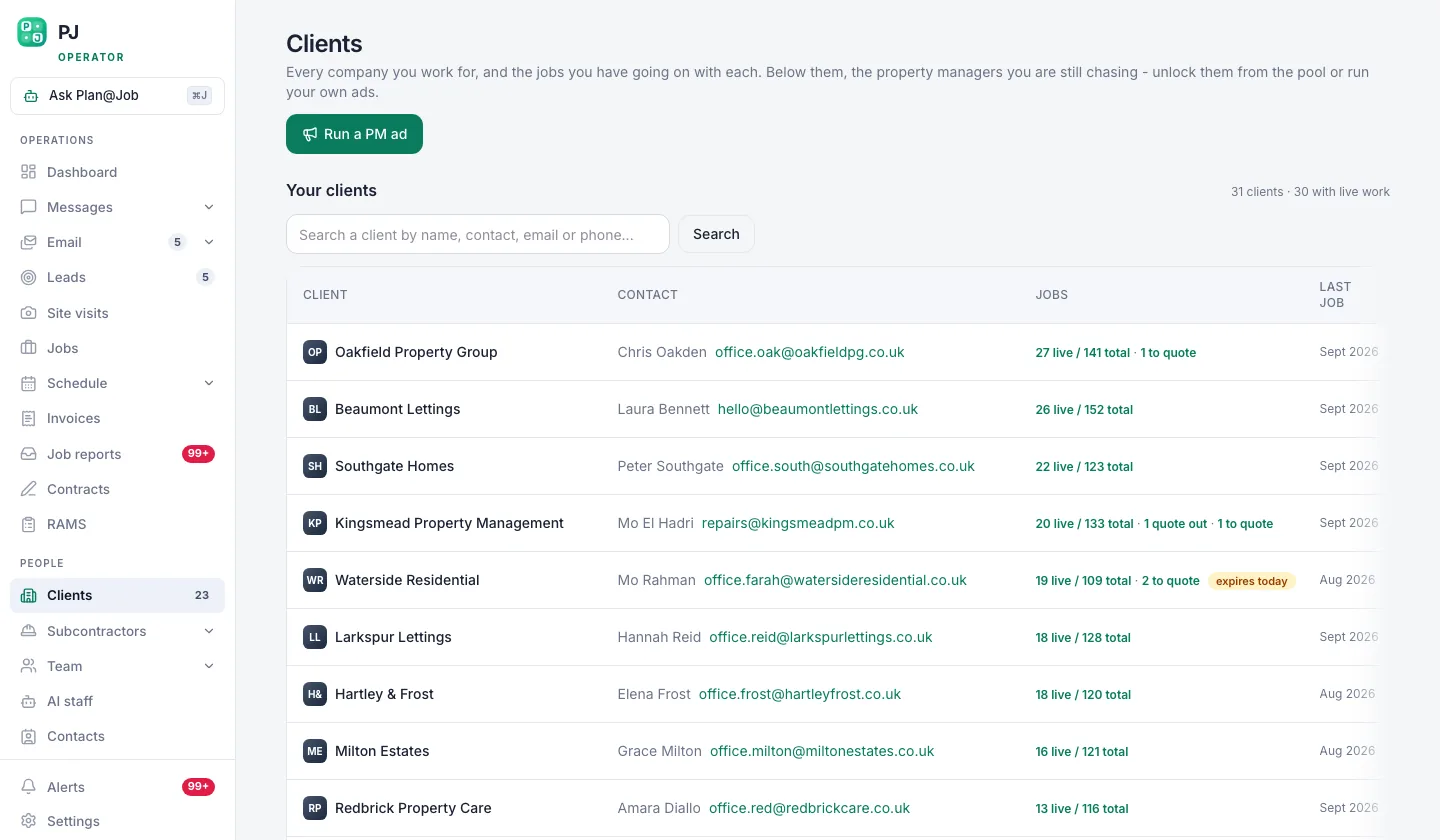 A prospect becomes a client here, with every job and invoice under their name.
- Go to Invites and send the property manager their invite link. Once they accept, they've got an account and can raise repairs straight into your system instead of texting you at ten at night.
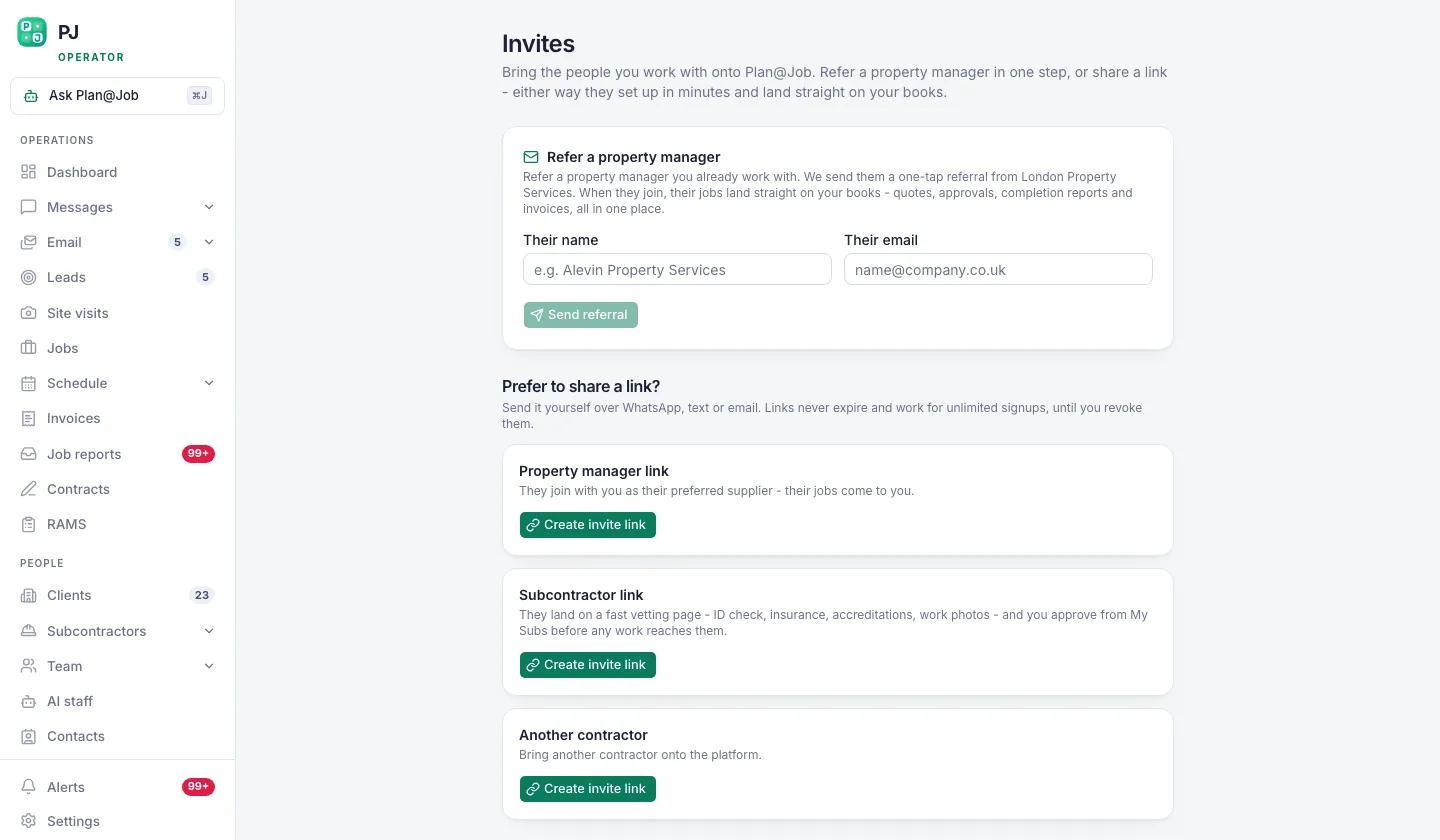 The invite link is what turns a property manager into an account that raises repairs in your system.
You decide who gets invited. The platform just sends the link. That small step changes how you look to the agent. You're no longer a number in their phone. You're a contractor with a system.
Step 5: Run the first job like an audition
This job isn't really about the tap. It's about whether they can trust you with the next fifty. Run it properly.
- Create the job in Jobs with the full brief: address, access arrangements, tenant contact, what's wrong, any photos they sent.
- If the brief came in thin, Sophie Bennett, the AI Enquiries Coordinator in AI staff, checks it for missing information and asks for clarification. If she still hasn't got an answer after two attempts, she hands it back to you to deal with.
- If you need to see it before pricing, book it under Site visits. Don't price a leak off a blurry photo.
- Send the quote. You set the price. Plan@Job doesn't price jobs for you, and it shouldn't.
- Once it's approved, put it in the Schedule. If a subbie is doing it, assign it through Subcontractors or the Subcontracting desk, and agree their price before they go.
- If the work needs a risk assessment and method statement, sort it in RAMS before anyone's on site.
- Keep the agent updated in Messages. One message when it's booked, one on the day, one when it's done.
Daniel Reed, the AI Operations Manager, can chase quotes and proposed dates and gives you a morning brief, so the first job doesn't slip while you're out chasing the second.
Step 6: Close it with proof, then invoice
The job isn't finished when the subbie leaves. It's finished when the agent has proof.
Open Job reports and build the completion report. Before and after photos, what was done, anything you noticed while you were there. If you saw damp in the bathroom while fixing the tap, say so. That's a second job and it shows you're paying attention.
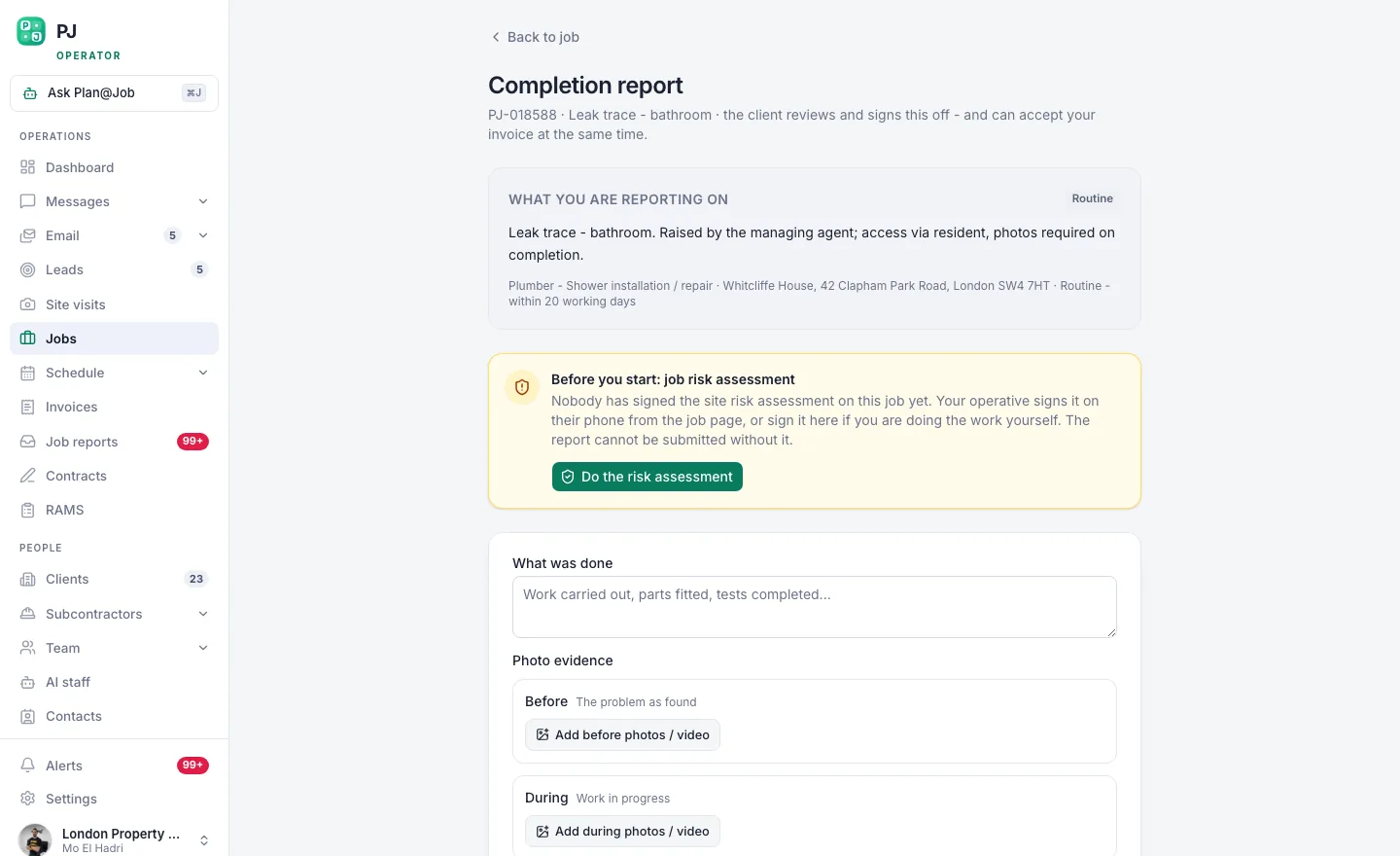 The completion report is the thing property managers actually pay for: proof the work happened.
Then raise it in Invoices. If it goes overdue, Maya Collins, the AI Finance Coordinator, prepares the chaser for you to approve. Nothing goes to your new client without you signing it off, and on a first job you want to see every word.
When I was running my maintenance company in London for housing associations and letting agents, the rule was simple: the agent should never have to chase us. If they're ringing to ask whether it's done, you've already lost points. The report means they never have to ring.
Step 7: Turn one job into the next
Ring the agent about a week later. Ask if anything could have gone better. Then ask for the next job. Most people never ask, and that's why they stay on one job.
Once you've done a few for them, ask if you can use them as a reference when you approach other agents. With their permission, that reference is your track record now.
Who decides what
To be clear about where the line is:
- You decide who to approach, what to charge, which subbie does the work, and what goes on the invoice.
- You approve first contact with a new client and any payment chasers before they go out.
- Plan@Job holds the client, job and invoice records and sends the invite link.
- AI staff do the background work: Sophie checks briefs, Daniel follows up quotes and dates, Maya prepares payment actions. None of them wins work, sets prices or sends money.
What usually goes wrong
The biggest one is saying yes to too much too early. You win one agent, they send ten jobs in a week, and you've only got one reliable subbie. Line up a second one in Subcontractors before you need them.
The next one is going quiet. A job that's running late with an update is fine. A job that's running late with silence loses you the client. And the third is skipping the photos. No report, no proof, no next job.
If you want to see how operators run this day to day, have a look at Plan@Job for contractors and how the AI staff work. When you're ready to run that first job properly, set up your operator account. Then go and ask for the job nobody wants.
If you'd rather talk it through with people who've built contracting businesses themselves, that's what Contractor Club is for.
FAQ
Do I need accreditations to win my first property maintenance contract?
You need the right insurance, and the right registrations for any regulated work like gas or electrics, whether that's you or your subbie. Beyond that, some agents ask for accreditation schemes and some don't. Ask them what they need, rather than guessing and paying for schemes nobody asked for.
Can I win work if subcontractors do the jobs?
Yes. That's how plenty of maintenance companies run. You hold the client, the subbies do the work, and you're responsible for the result. The agent cares whether the job got done properly and on time, not whose van turned up.
How long does it take to win the first one?
There's no fixed answer, and anyone who gives you one is guessing. It comes down to how many agents you actually speak to and how fast you follow up. The quickest route I know is going in person and asking for one small job, not a contract.