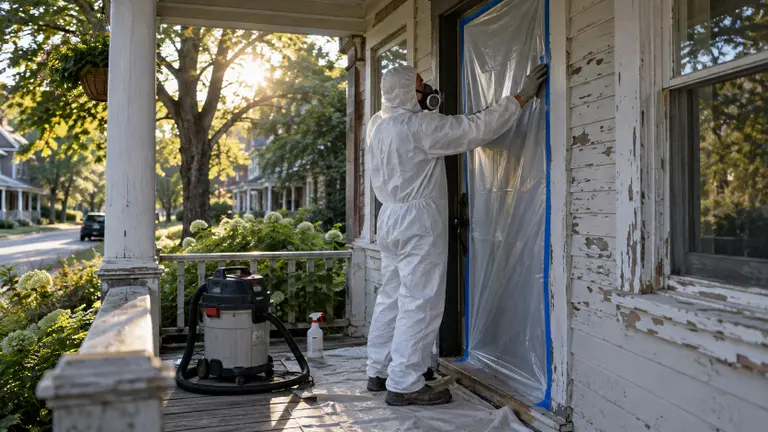
EPA RRP certification is what lets you get paid, legally, to disturb paint in a home built before 1978. You need two things. Your company certified as a firm, and at least one Certified Renovator assigned to every job, someone who passed a one-day course with an accredited trainer. That's it. One day in a classroom and some admin, and you can quote on a slice of work a lot of contractors walk straight past.
I ran my maintenance company in London, where the lead rules are different. But the lesson carries over the water. The paperwork gets you in the door. The work keeps you there.
What is EPA RRP certification, and who needs it?
RRP stands for Renovation, Repair and Painting. It's the EPA's Lead Renovation, Repair and Painting Rule, and it covers paid work that disturbs painted surfaces in two kinds of buildings:
- Housing built before 1978, which is when lead-based paint was banned for residential use.
- Child-occupied facilities built before 1978, like daycares and schools where young kids spend regular time.
If you're paid to do the work and it disturbs paint in one of those buildings, the rule applies. That includes general contractors, painters, window installers, plumbers and electricians cutting into walls, and maintenance staff at rental properties. Being a sub doesn't get you out of it either.
Here's the part people hate hearing: "it's only a small job" is not an exemption unless it actually fits the minor repair limits. More on those below.
Some states run their own program instead of the EPA. In those states you certify with the state agency, and their rules can be stricter. Check the EPA's lead pages at epa.gov/lead to see whether your state is one of them before you apply anywhere.
The two certifications: firm and renovator
This is where people get confused. There are two separate certifications, and you need both.
Firm certification
Your business, as a company, has to be certified. Sole trader, LLC, doesn't matter. If you do RRP-covered work for pay, the firm needs certification. You apply to the EPA online (or to your state if it runs its own program), pay the fee and wait for approval. Firm certification lasts five years, then you renew.
You can't do covered work while the application is pending. Apply before you need it, not the week a job lands.
Certified Renovator
This is the person. Someone in your company takes the initial RRP course from an EPA-accredited training provider. It's a one-day course with a hands-on part, and you walk out with a certificate.
Every covered job needs a Certified Renovator assigned to it. That person is responsible for the lead-safe work practices on that job and trains the rest of the crew on site. Your other workers don't all need the full course, but they do need to be trained by the Certified Renovator on the practices they'll use.
The renovator certificate expires. You take a refresher course before it runs out. If the refresher includes hands-on training, you're good for five years. If you take it without the hands-on part, it only lasts three.
How to get EPA RRP certified, step by step
Do it in this order:
- Check whether your state runs its own lead renovation program or uses the EPA's.
- Book the initial Certified Renovator course with an accredited trainer. The EPA keeps a searchable list of accredited providers. Send whoever will actually run your jobs, not just the owner.
- Apply for firm certification with the EPA or your state agency, and pay the fee.
- File both certificates where you can find them in ten seconds. Clients and property managers will ask.
- Put the expiry dates in your calendar now, with a reminder a few months before each one.
- Build your job kit: plastic sheeting, tape, warning signs, a HEPA vacuum, disposable cloths, cleaning verification cards and the Renovate Right pamphlet.
- Make a records template so every job gets documented the same way.
Simple. Most contractors who don't have it never sat down and did these seven things.
What the rule actually asks of you on the job
Certification is the entry ticket. The job is where you prove it.
Before you start
Give the owner and the occupants the EPA's Renovate Right pamphlet before work begins and get written acknowledgment. In multi-unit buildings, common-area work means notifying the tenants as well.
The rule doesn't apply if a certified inspector or risk assessor has found no lead-based paint on the surfaces you're disturbing, or if a Certified Renovator tests with an EPA-recognized test kit and finds none. Keep the records either way.
Minor repair limits
Small jobs can fall outside the work practice requirements. The thresholds are 6 square feet or less per room inside, and 20 square feet or less outside. Two catches. Window replacement is never minor, whatever the size. And the minor exemption doesn't cover prohibited practices.
During the work
Post warning signs. Contain the work area so dust stays where it is. And don't use the prohibited methods:
- Open-flame burning or torching of painted surfaces.
- Power sanding, grinding, planing or blasting without a HEPA exhaust control.
- Heat guns at 1,100°F or higher.
After the work
Clean the area properly, then do cleaning verification. That means wiping surfaces with a wet disposable cleaning cloth and comparing it to the EPA verification card. Fail it, clean again, wipe again.
Then keep your records for three years. Pamphlet acknowledgment, who the Certified Renovator was, what was done, how the area was cleaned and verified.
If the property gets federal housing assistance, HUD's lead rules can add more requirements on top. Ask the property manager before you quote.
Why EPA RRP certification wins jobs
It's not the price. It's the paperwork.
Think about who owns pre-1978 housing. Landlords with older rentals. Property managers running portfolios of them. Housing nonprofits. People who bought an old house and have kids. Every one of them has a reason to care about lead, and the ones who know the rule can't legally hire you for covered work without it.
So the certified contractor gets the call. The one without it gets filtered out before the quote stage, and probably never finds out why.
There's a second effect. When you turn up with the pamphlet, the containment, the signs and a clean verification at the end, you look like a business, not a guy with a van. Property managers remember that. That's how one job becomes the next ten.
My rule from running maintenance for housing clients: they want the documents before they want the price. Have them ready.
Run lead-safe jobs as stages, not an afterthought
The contractors who get burned on RRP jobs usually lose money on the bits they didn't price. The containment. The extra cleaning. The time to verify. The records.
So plan them as real stages. In Plan@Job, an operator (the contracting business that manages the client, the delivery and the subs) can split a job into internal stages, each with its own scope, dates, status and costs. A lead-safe job breaks down naturally.
Illustrative example: a window replacement in a 1950s rental. Stage one, pamphlet and acknowledgment plus setup and containment. Stage two, the window work itself, done by your own crew or a sub. Stage three, cleaning and cleaning verification. Stage four, records filed and handover.
The client sees the agreed overall scope and price, plus whatever evidence you choose to share, like photos of the containment. Your internal stage costs and which sub did which piece stay internal. You can see how project planning works at planajob.com/features/project-management.
To be straight with you: Plan@Job doesn't certify anyone, doesn't check your RRP status for you, and doesn't give lead-safe contractors special matching. And it's live in the UK first. In the US it's on a waitlist for now.
The decisions that stay with you
No software makes these calls, and no client should make them for you:
- Whether a job is covered, minor, or exempt because testing showed no lead.
- Who your Certified Renovator on each job is, and whether they're actually on site enough to do the job properly.
- Whether a sub's certification is current before you put them on a pre-1978 property.
- Whether cleaning verification passed.
If you're a general contractor using subs, check their firm certification and their renovator's certificate yourself. Their mistake lands on your job.
FAQ
How long does EPA RRP certification take?
The Certified Renovator course is one day. Firm certification is an application to the EPA or your state, and approval takes time, so apply well before you need it. You can't do covered work until the firm certification comes through.
Do all my workers need RRP certification?
No. Each covered job needs a Certified Renovator assigned to it, and that person trains the other workers on the lead-safe practices they'll use. Your firm still needs its own certification on top.
Does RRP apply to rental property maintenance?
Yes. If someone is paid to disturb paint in pre-1978 housing, rentals included, the rule applies. Landlords' maintenance staff and the contractors they hire are both covered.
Get the course booked this month and the firm application in. Then, if you want to run your jobs, stages and subs in one place when Plan@Job opens in the US, join the waitlist at planajob.com/us/contractors.