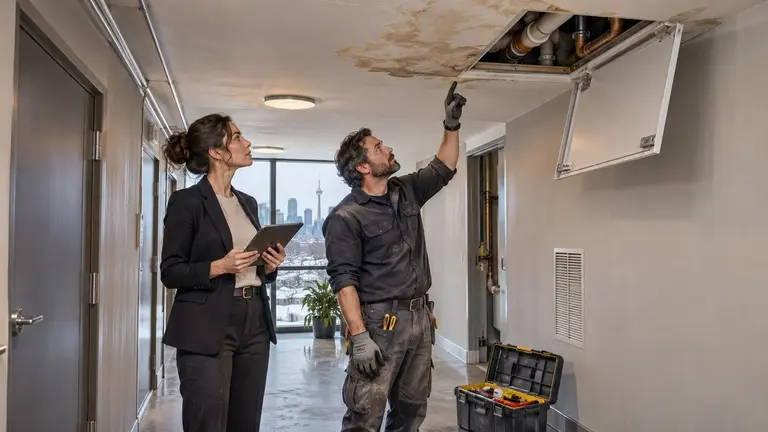
A condo maintenance callback review is a short, structured check you run every time someone has to go back to a job that was already marked complete. It answers four questions: what was reported, what was done, why it did not hold, and who pays for the return visit. Run it before the second visit is booked, not after. The checklist below works for property managers acting for a condo corporation and for the maintenance contractors doing the work.
What counts as a callback
A callback is a return visit to the same fault, in the same place, after the job was closed.
It is not a new problem in the same unit. It is not a planned second visit, such as coming back to paint once a drywall patch has dried. Keep those separate, or your callback numbers will mean nothing.
Most callbacks fall into one of four groups:
- Workmanship. The right repair was chosen but it was not done properly.
- Misdiagnosis. The repair was done well, but it fixed the wrong thing.
- Incomplete scope. A part was missing, access was refused, or the job was closed early.
- Not a true callback. A new fault, outside damage or resident use caused the second report.
You cannot tell which group applies from the complaint alone. That is what the review is for.
The desk review: before anyone goes back
Do this at your desk. It takes a few minutes and often changes who you send.
- Pull the original request. Read the resident's exact words, the date, the unit number and any photos. Do not rely on a summary.
- Read the completion notes. Look at what the technician said they found, what they did and what they photographed.
- Compare the two. Did the work address the symptom that was reported? A resealed tub does not answer a report of water coming through a ceiling light.
- Check where the fault sits. Is it inside the unit or in a common element? In a condo this decides who authorizes the work and who pays. The answer comes from the corporation's declaration and bylaws and from provincial legislation, which varies. The terms vary too: a strata corporation in British Columbia, a syndicate of co-ownership in Quebec. If the boundary is unclear, check the governing documents or ask the board. Do not guess.
- Check the history. Look for the same fault in the same stack, riser or floor. Three reports in units above and below each other are rarely three separate problems.
- Ask what changed. A cold snap, a thaw, heavy rain, another trade working nearby or a change of occupant can all explain a repair that held for a while and then failed.
- Decide who attends. The same technician knows the job. A different one brings fresh eyes. If you suspect misdiagnosis, consider sending someone with different skills, not just a different person.
- Confirm access. Give notice of entry under the corporation's rules. Book the service elevator if needed. Tell the concierge or security desk. If water will be shut off, warn the affected units.
On the return visit
The second visit needs more discipline than the first. The aim is to find the cause, not to repeat the repair.
- Reproduce the fault before touching anything. Run the tap, cycle the fan coil, open the door. See it fail.
- Photograph the condition as found. Include the original repair in the frame.
- Test the first repair on its own. Is it intact? If it is, the cause is somewhere else.
- Look one step upstream. Check the unit above, the riser, the shutoff valve, the exterior wall or the shared duct.
- Write the cause in plain words. A note that says the supply line fitting behind the vanity was cross-threaded is useful. A note that says the leak was fixed is not.
- Stop if the scope grows. If the real fix is bigger than what was authorized, or sits in a common element, report back before carrying on.
- Prove the fix. Test it, photograph it and, where possible, show the resident or site staff.
After the visit: close the review
Assign a cause
Put the callback into one of the four groups above. Use one group only. If two apply, pick the one that came first.
Decide who pays
This is a decision for a person, not a default.
If the cause was workmanship, the terms agreed with the contractor will normally say what happens. If the cause was misdiagnosis, look at the original brief. A contractor who was told to reseal a tub and did so has done what was asked. If the fault turns out to be in a common element, or if a unit owner may be responsible for the cost, the governing documents and the board decide. Where there is a real dispute, get legal advice. Do not rely on a blog post.
Tell the people affected
The resident wants to know what was wrong and whether it is fixed. The board wants to know if there is a building-wide issue. An owner who does not live in the unit may need to know as well. Write two or three plain sentences and attach the photos.
Look for the pattern
One callback is a job. Several with the same cause is a process problem. Common fixes include a better intake question, a clearer scope, a standard part, or a different contractor for that type of work.
An illustrative example
This scenario is fictional and is here to show the review at work.
A resident on the ninth floor reports a stain on the bathroom ceiling. The contractor attends the unit above, finds tired caulking around the tub and reseals it. The job is closed.
Two weeks later the stain has grown. The manager runs the desk review before booking anyone. The history shows the owner of the unit above was away during both reports. Nobody was using that tub.
That points away from the tub and toward a pipe in the wall. The manager sends a plumber, not the caulking crew. The plumber opens an access panel and finds a slow leak on a shared riser.
The first repair was not bad work. It was the wrong repair. The cause is logged as misdiagnosis, the riser is treated as a common element question under that corporation's documents, and the manager takes the larger repair to the board for authorization.
What needs a person's decision
A checklist organizes the facts. People still decide:
- Whether the second report is a true callback or a new job
- Who pays for the return visit
- Whether the work needs board authorization
- What evidence is shared with the resident, owner or board
- Whether to change the brief, the scope or the contractor next time
Where Plan@Job fits
Plan@Job is AI-powered project and operations management for construction and property businesses. Property maintenance is one of its uses.
A callback review depends on having the original scope and the evidence in one place. In Plan@Job, an operator, meaning the contractor business that manages clients, project delivery, subcontractors and in-house operatives, can split a job into internal stages with scope, dates, status and costs. The client sees the overall agreed scope and price and the evidence that has been shared. Internal stage costs and subcontractor identity stay internal. You can read more on the project management page.
Thin job briefs are a common root of misdiagnosis. Sophie Bennett, the AI Enquiries Coordinator, checks existing job briefs for missing information and asks for clarification. After two attempts she hands the question to a person. She does not decide the cause of a callback or who pays for it. Those calls stay with you. The AI staff page explains each role.
The UK is the live market at present. If you manage condos in Canada, your next step is the Canadian property managers page, where you can check current availability and reserve a place.
FAQ
When should a callback review happen?
Before the return visit is booked. The desk review often changes who you send and what you ask them to check. Reviewing after the second visit only tells you what you could have known earlier.
Who pays for a callback in a condo?
It depends on the cause, the terms agreed with the contractor and the corporation's governing documents. Workmanship, misdiagnosis and common element faults can each lead to a different answer. A person has to make that decision with the facts in front of them.
Should the same technician go back?
Sometimes. The original technician knows what was done and can check their own work quickly. If the review suggests the wrong cause was treated, send someone with the right trade for the likely cause. Either way, give them the full history first.
Last updated: 15 November 2026.