
Cold calling letting agents works when the email has already landed. Ring two or three working days after you sent it and ask for the person who looks after maintenance. Don't ask 'did you get my email'. Tell them why you're calling, ask one question about how they choose contractors, then stop talking. You want one of two things off that call: a test job, or a date to ring back. That's the whole game. The email gets you a name. The call is where they decide if you're a real business or another contractor in the inbox.
Why the call matters more than the email
Letting agents get contractor emails all the time. Most get read once and forgotten. That's not because the contractor was bad. It's because nobody followed up with a voice.
When I ran my maintenance company in London, letting agents were a big part of the work. The rule I kept was simple: no email goes out unless somebody is ready to ring that person within the week. An email with no call behind it is a leaflet.
Agents don't buy contractors. They buy less hassle. A tenant ringing about a leak, a landlord who won't approve the quote, a void that needs turning round before the next move-in. Your call has to sound like the end of that hassle, not the start of another sales conversation.
Step 1 - Get your list straight in Contacts
Before you pick up the phone, know exactly who you're calling and what you already said to them.
- Open Contacts in Plan@Job. This is the list of property managers and agencies you've been building.
- Look at the owner on each contact. Whoever owns it makes the call. Two people from your business ringing the same branch in one week kills you.
- Check the status and last contact columns. You're looking for people you emailed two or three working days ago who haven't replied.
- Open Email and reread what you actually sent them. If you mentioned voids and out-of-hours callouts, the call starts there.
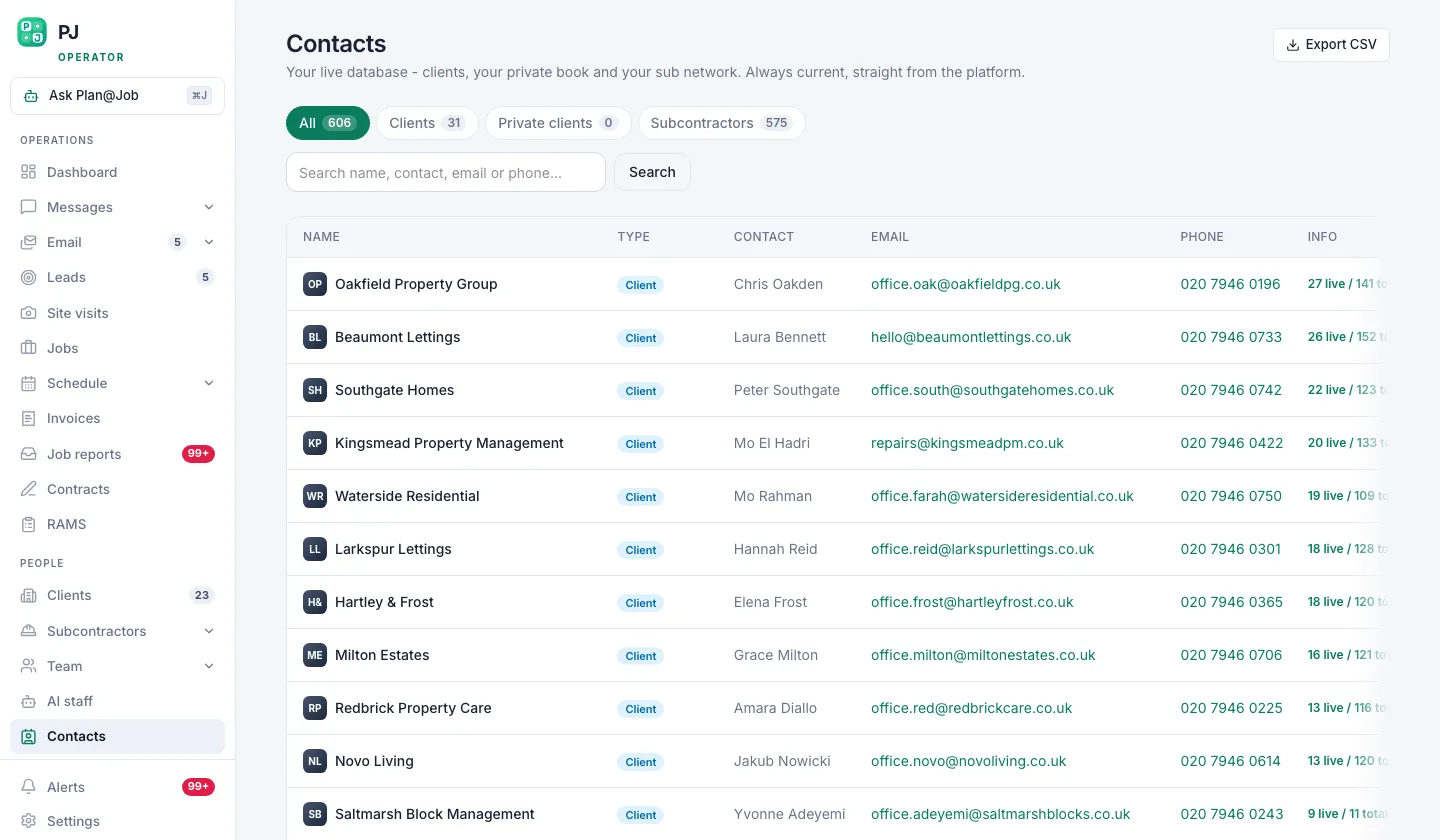 Contacts is the list you build before any campaign goes out.
The platform holds the list and shows who was contacted and when. Deciding who gets rung today is yours.
Step 2 - Pick the right time to ring
Timing is half of it. Here's how I'd plan the week:
- Avoid Monday morning. Agents are clearing whatever went wrong over the weekend.
- Avoid Friday afternoon. Nobody is taking on a new contractor at 4pm on a Friday.
- Mid-morning, Tuesday to Thursday, is your window.
- Be careful around the start and end of the month, when lettings teams are busy with check-ins and check-outs.
Block an hour, ring through the list in one go, and don't stop to tidy the van in between.
Step 3 - Get past reception
Most of the time a receptionist or lettings negotiator answers. Don't pitch them. They can't say yes, they can only say no.
If you have a name, ask for them by name. If you don't, ask: 'Who looks after maintenance and contractors for your managed properties?' In a small independent agency that's often the director or branch manager. In a bigger one there'll be a property management team or a maintenance coordinator.
If they're not available, get the name, the direct email and the best time to call. Then go back into Contacts and update it. That alone makes the second call twice as easy.
Step 4 - What to say in the first thirty seconds
This is an illustrative script. Change it to fit your business and your area.
'Hi Sarah, it's Mo from [your company]. I emailed you on Tuesday about maintenance across your managed properties in [area]. I'll be quick. How do you normally get new contractors onto your list?'
Then shut up. Let them talk. The question is doing the work.
Notice what's not in there. No 'sorry to bother you'. No list of every trade you cover. No 'did you get my email'. You're a business calling another business, not someone asking for a favour.
Questions worth asking
Once they're talking, find out how they actually work:
- Do they keep an approved contractor list, and what does it take to get on it?
- What jobs do their current contractors struggle with? Small jobs, out-of-hours callouts and voids are the usual answers.
- Do they need landlord approval before a quote goes ahead?
- What paperwork do they want from you? Insurance, trade certificates, RAMS for certain work.
Write the answers down while you're on the call. You'll forget half of it by the next dial.
Ask for a test job, not a contract
Don't ask to be their maintenance contractor. Ask for one job. 'Send me the small one nobody wants to go to.' A dripping tap, a sticking door, a void that needs a clean and a touch-up.
That's a small yes for them. For you it's the audition. Here's the part people hate hearing: the first job barely makes money. It's not the price that wins the agent - it's how you handle that job.
Step 5 - Handle the three answers you'll actually hear
'We've already got contractors.' Good. Every agent does. Ask what happens when their usual person can't get there. You're not replacing anyone on day one. You're the backup that turns up.
'Send me your details.' Send them that day, while you're still fresh in their head. Insurance, any trade certificates that apply, a short list of what you cover and where. Then ask when you can ring to check they've got what they need.
'Call me next month.' Fine. Get a date, not a month. Put it against the contact and ring on that date. Most people say it to get you off the phone. The ones who mean it remember that you actually called back.
Step 6 - Log the call straight away
Put the phone down and go back into Contacts before you dial the next number. Update the status. Write who you spoke to, who actually decides, what they need from you and when you're calling next.
Be clear on who does what here. Plan@Job keeps the record so anyone in your team can pick it up. It does not make these calls for you, and its AI staff don't start contacting a new prospect without your approval. The relationship with the agent is yours to build.
Step 7 - When the first job comes in, set it up properly
The moment they send a job, the agent stops being a prospect. Add them in Clients, so every job, quote and invoice for that agency sits under their name.
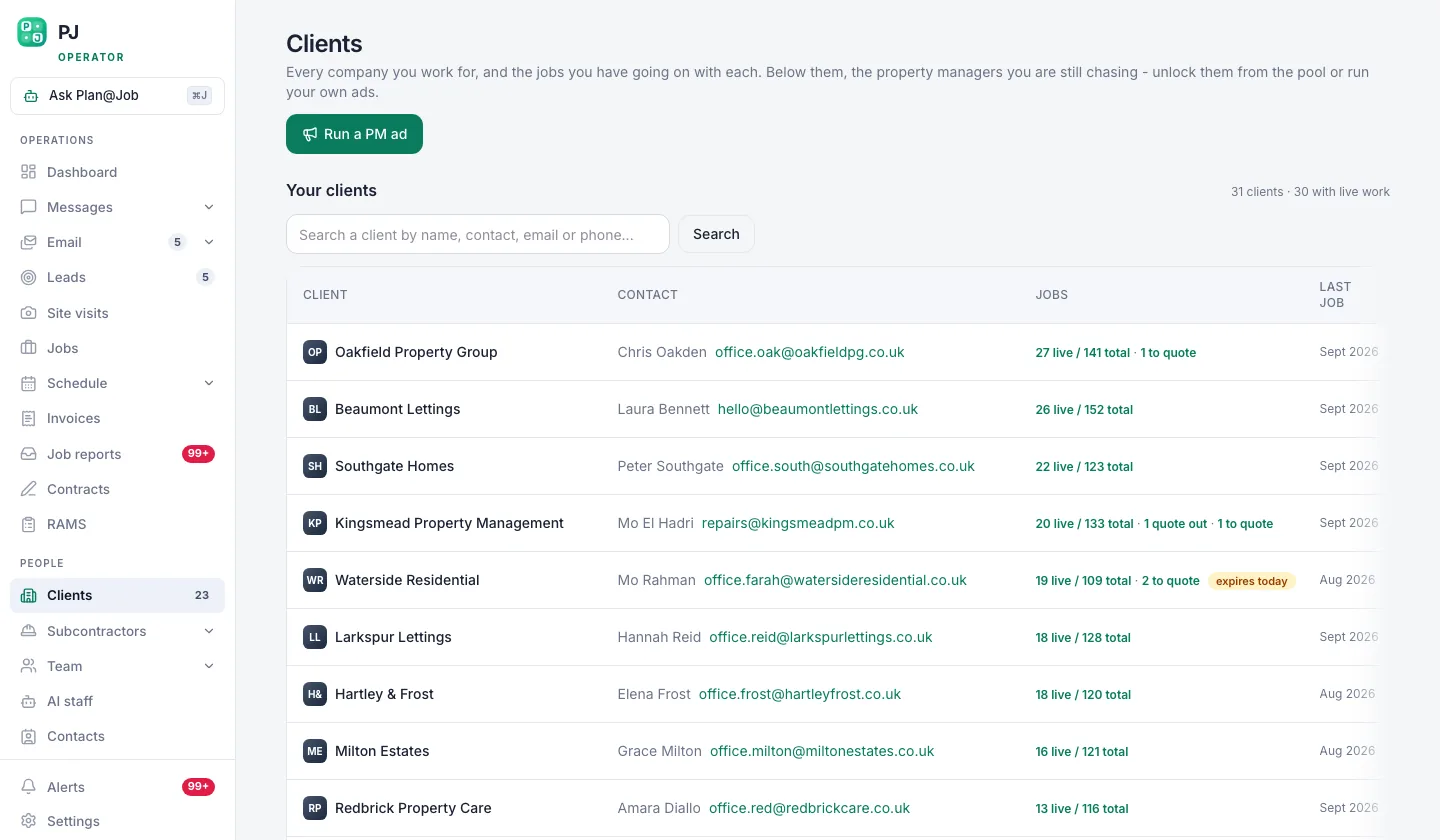 A prospect becomes a client here, with every job and invoice under their name.
Then run the job in this order:
- Create it in Jobs, or in Leads if you're still pricing it.
- Sophie Bennett, the AI Enquiries Coordinator, checks the brief for missing information, such as access details or photos, and asks the agent for it. If she doesn't get an answer after two attempts, it comes back to you.
- Book a visit in Site visits if you need to see it before you price.
- You set the price and you decide who does the work, whether that's your own team or someone from Subcontractors. If you're short, Cover a job is there for that.
- Daniel Reed, the AI Operations Manager, follows up quotes and proposed dates and puts it in your morning brief. He doesn't award work or set prices.
- When it's done, send the agent a proper Job report with photos, then raise it in Invoices.
More on what each of them does, and what still needs your sign-off, is on the AI staff page.
What usually goes wrong
I've seen these again and again, and done a couple myself:
- Opening with 'did you get my email'. It hands them an easy no.
- Pitching every trade you cover. Pick the one problem they mentioned and talk about that.
- Two people from your business ringing the same agent. You look disorganised before you've done a job.
- Saying yes to a test job you can't staff. If you can't get someone there, the first job becomes the last one.
- Not having your insurance and certificates ready to send the same day.
- Giving up after one call. Agents are busy, not hostile.
Your next move
Pick five agents you've already emailed. Ring them this week, Tuesday to Thursday, mid-morning. Log every call before the next dial. That's it.
If you want the list, the follow-ups and the first jobs in one place, start with Plan@Job for contractors in the UK. And if you want to compare notes with other people building contracting businesses, that's what Contractor Club is for.
FAQ
Is cold calling letting agents allowed in the UK?
Yes, calling a business about your services is normal practice. Check the number against the Corporate Telephone Preference Service first, because UK rules restrict unsolicited marketing calls to numbers registered there. If someone asks you not to call again, take them off your list and mean it.
How many times should I call before I give up?
I'd make three proper attempts over a few weeks, each one logged with what happened. After that, park the contact and send a short update every few months. Agents change contractors when something goes wrong, and you want to be the name they remember that week.
Can Plan@Job make the calls for me?
No. The calls are yours. Plan@Job keeps your Contacts and Clients in order, and once jobs come in, the AI staff help with briefs, quote follow-ups and your morning brief, with people approving the decisions that matter.