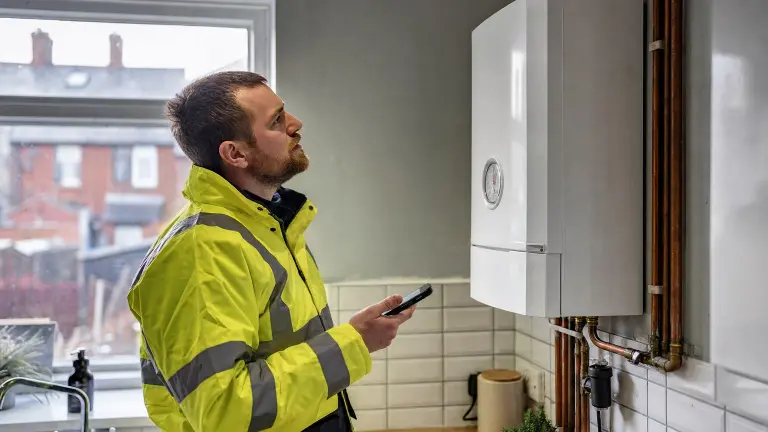
Boiler not working is the call that wrecks a Monday, and the first thing to do is find out whether it's a comfort problem or a safety problem. Smell of gas, a carbon monoxide alarm sounding, or a tenant feeling dizzy means stop the triage and get people safe. Everything else is a calm, ordered process, and the order is what saves you money.
I ran a property maintenance company in London for housing associations and letting agents. I learned that the expensive boiler jobs are rarely the ones where the boiler is dead. They're the ones where nobody asked the right questions before the engineer got in the van.
Here's the order I'd work in.
Step 1: Rule out danger before anything else
You ask three things before you ask anything about heating.
- Can anyone smell gas?
- Is a carbon monoxide alarm going off, or has anyone felt headaches, nausea or drowsiness?
- Is there water leaking from the boiler or the pipes near it, especially near electrics?
If it's gas or an alarm, the tenant opens the windows, leaves the property and calls the National Gas Emergency Service on 0800 111 999. That's the tenant's call to make from outside, not yours to talk them out of. You log it and arrange the follow-up afterwards.
If it's a leak, the tenant isolates the water if they know how to, and you treat it as an emergency water job as well as a boiler job.
No danger? Move on.
Step 2: Ask who is in the property
This decides your priority more than the fault does. A no-heating call in July is not the same as one in January with a baby, an elderly tenant or someone with a health condition in the house.
Ask who lives there and whether anyone is vulnerable. Write the answer on the job. Whoever picks it up next shouldn't have to ask again.
Step 3: Run the five-minute tenant call
This is the bit most people skip, and it's where you save the wasted callout. Get the facts in one call and write them down.
- What exactly is happening - no heating, no hot water, or both?
- Is there a display on the boiler, and does it show a fault code? Ask for a photo of the display and the boiler's make and model label.
- When did it stop, and did anything happen first - a noise, a power cut, a very cold night?
- Has it done this before?
- What does the pressure gauge say, if there is one?
- Is the thermostat or timer set correctly, and are the batteries in it fresh?
- When is someone home to give access?
A photo of the display and the model label does more than ten minutes of description. A decent engineer can often tell what parts to bring from a fault code and a model number.
Step 4: The safe checks a tenant can do
Some boiler faults are tenant-fixable and genuinely boring. Walk them through these, and only these.
- Check the thermostat and timer are on and calling for heat, and swap the batteries if it's a battery unit.
- Check the electric supply to the boiler is on and the fused spur hasn't been switched off.
- Check the gas meter or prepayment meter has credit and the supply is on.
- Look at the pressure gauge. If it's well below the usual range and the boiler has a filling loop, some tenants can top it up following the manufacturer's instructions, if you're comfortable with that and have told them how.
- In freezing weather, if the boiler shows a condensate fault, the external pipe may have frozen. Pouring warm - not boiling - water over it is a known fix, but only if they can reach it safely.
Tenants do not open the boiler casing. They do not touch the gas supply. They do not bleed or fiddle with anything they haven't been shown. If a reset once works, tell them to leave it alone and report it if it happens again. A boiler that needs repeated resets has a fault, and a repeated reset isn't a repair.
Be honest with yourself about this step. It's a way to filter out the thermostat-batteries calls, not a way to dodge sending an engineer for a real fault.
Step 5: Set the priority
You now know enough to rank the job. Here's how I'd think about it.
Top priority: any gas or carbon monoxide concern, a leak, or no heating or hot water with a vulnerable person in the house in cold weather.
Urgent: no heating and no hot water, no one vulnerable, but it's cold. Aim for a fast visit and say so to the tenant.
Standard: hot water works but heating doesn't in mild weather, or a boiler that's noisy, losing pressure slowly or cycling oddly but still running.
Your repair duty as a landlord or agent covers heating and hot water installations, so don't let a standard job drift into a complaint. Set your own target times, write them down and tell tenants what they are. Then keep to them.
Step 6: Send the right person, once
Any work on a gas boiler has to be done by a Gas Safe registered engineer. Check the registration and that they're registered for the type of work involved. Don't take it on trust because someone's cousin does a bit of plumbing.
Before you book, check the property's records. When was the last gas safety check? Is the boiler old or has it been repaired recently? A boiler that has had three callouts this year may be a replacement conversation, and that's the landlord's decision, not the engineer's and not yours.
Give the engineer everything you collected: the fault code, the photos, the model, the tenant's access times, who is vulnerable, and a name and number. If they arrive with the right information, there's a fair chance of a first-visit fix. If they arrive blind, there's a fair chance of a return visit.
When a repair quote comes back, the landlord approves it if it's over their limit. Nobody should be pressing ahead on a big spend without sign-off.
Step 7: Keep the tenant in the loop
Tenants without heating will forgive a delay. They won't forgive silence.
Tell them the priority, who is coming, roughly when, and what to do if it gets worse. Update them if the visit slips. Offer a plug-in heater only if your landlord approves it and it's safe to use in that property. Don't improvise.
After the visit, check that heating and hot water are actually back, that the job is closed with notes on what was done, and that any follow-up work is booked. Put the engineer's findings on the property record so the next triage starts from a better place.
How this works on Plan@Job
Plan@Job is AI-powered project and operations management for construction and property businesses. Property maintenance is one of the main things people run on it, and a boiler callout is a good example of how the workflow holds together.
You raise the job with what you gathered on the tenant call. Sophie Bennett, our AI Enquiries Coordinator, checks existing job briefs for missing information, such as a missing access window or no fault description, and asks for clarification. If the gap is still there after two attempts, she hands it over to a person rather than looping. She doesn't automatically turn every incoming email into a job, so you stay in charge of what gets raised.
Daniel Reed, our AI Operations Manager, can support sharing the job with your existing vetted network where it's eligible, and follow up on quotes and proposed dates. There's also a morning brief so you can see what's open before the day gets away from you. No one awards the work for you and nothing is priced for you. Awards, prices and approvals stay with you and your landlord.
If you want the detail on how the AI staff fit together, it's on the AI staff page. If you manage lettings or blocks, the property managers page shows how repairs, access and updates sit in one place.
The sequence is the same wherever you run it. Danger first, facts second, priority third, right engineer fourth, and the tenant told throughout. When your boiler triage is written down, anyone on your team can run it at 8am on a freezing Tuesday.
When you're ready, raise a repair job on Plan@Job and put your next boiler call through the process above.
FAQ
Can a tenant reset the boiler themselves?
A simple reset, following the manufacturer's instructions on the boiler, is usually fine once. If it needs resetting again, or a fault code keeps coming back, stop and book an engineer. Tenants should never open the casing or touch the gas supply.
What should I do if a tenant says they can smell gas?
They leave the property, open doors and windows on the way out if it's safe, and call the National Gas Emergency Service on 0800 111 999 from outside. Don't try to diagnose it over the phone. Once it's made safe, you arrange the Gas Safe engineer and log everything.
Who is responsible for fixing a boiler in a rented home?
In most tenancies the landlord is responsible for keeping heating and hot water installations in repair, and the agent usually handles the job on the landlord's behalf. Check your management agreement for who approves spend, and check the tenancy and current guidance if the boiler is tenant-owned or the situation is unusual.