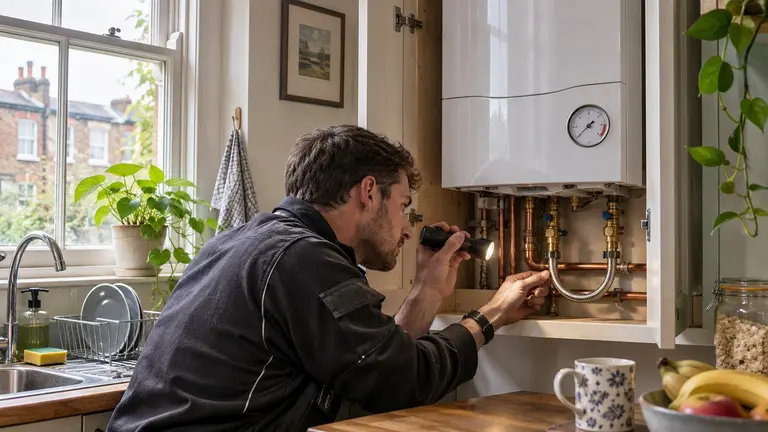
A boiler losing pressure is usually a sign that water is escaping from the heating system somewhere. That might be through a leak, a dripping pressure relief valve or an expansion vessel that has lost its charge, or simply because radiators were recently bled. In a rental, the quick fix is often a top-up by the tenant using the filling loop, following the manufacturer's instructions. If the pressure keeps dropping after that, stop topping up and treat it as a repair job for a Gas Safe registered engineer. This guide covers what to ask the tenant, what they can safely check, and how to brief the job so the engineer arrives ready to fix it.
How boiler pressure works in a sealed system
Most UK homes with a combi or system boiler have a sealed heating system. The water in the radiators and pipes is held at a set pressure, shown on a gauge on the front or underneath the boiler.
The correct range varies by model, so the manufacturer's manual is the reference. Many boilers sit somewhere around 1 to 1.5 bar when the system is cold, and the reading rises a little when the heating is on.
A small drop over a long period can happen. A drop that needs a top-up every few days is not normal. When the pressure falls too low, most boilers lock out and show a fault code. The tenant then has no heating and often no hot water, which is why these calls tend to come in on cold evenings.
Common causes of a boiler losing pressure
Radiators were recently bled
Bleeding a radiator releases trapped air, and a little water with it. The pressure drops as a result. If the tenant has just bled the radiators, a single top-up may be all that is needed.
A leak in the pipework or radiators
Weeping radiator valves, a loose compression joint or a pinhole in old pipework will all lose pressure slowly. Ask the tenant to look for:
- Damp or green staining around radiator valves
- Water marks on skirting boards or flooring near pipe runs
- New stains on a ceiling below the heating pipes
- Wet patches under the boiler itself
Some leaks are hidden under floors or in walls. If the flat below reports a stain, take that seriously.
The pressure relief valve is discharging
The pressure relief valve lets water out if the pressure gets too high. It usually connects to a small copper pipe that runs through an outside wall. If that pipe is dripping or there is a wet mark beneath it, the valve is releasing water. This often follows over-filling during a top-up, or a problem with the expansion vessel.
The expansion vessel has lost its charge
The expansion vessel absorbs the extra volume when water heats up. If it loses its air charge, pressure climbs high when the heating is on, the relief valve dumps water, and the pressure then reads low once the system cools. A tenant reporting very high readings when hot and low readings in the morning is a strong clue. Recharging or replacing the vessel is engineer work.
A leak inside the boiler
Seals, pumps and heat exchangers can fail inside the casing. Nobody other than a Gas Safe registered engineer should remove the casing or work inside a gas boiler.
Recent work on the system
If a plumber, decorator or flooring fitter has recently been in, ask about it. Disturbed pipework or a radiator taken off the wall and refitted is a common source of a new slow leak.
Quick fixes the tenant can safely try
These steps are for a tenant who is comfortable doing them and has the manufacturer's instructions to hand. Many manuals can be found online using the model number on the boiler's data label.
- Read the gauge with the heating off and the system cold. A reading taken while the heating is running can be misleading.
- Top up using the filling loop. This is usually a braided hose or a built-in lever or key under the boiler. Open the valves slowly, watch the gauge and close them fully once it reaches the level in the manual. Do not overfill.
- Make sure the filling loop is fully closed. A loop left slightly open can push the pressure too high and set off the relief valve.
- Reset the boiler following the manual if it has locked out.
- Note the reading again the next morning. This tells you whether the drop is slow, fast or a one-off.
- Check for visible leaks inside and look at the relief valve pipe outside.
The tenant should not remove the boiler casing, adjust internal parts or attempt to recharge the expansion vessel. If anyone smells gas, they should leave the boiler alone and call the National Gas Emergency Service on 0800 111 999.
A short, model-specific note in the tenant handbook or check-in pack saves a lot of back and forth. Check what your tenancy agreements say about the tenant's role in basic upkeep, and keep the instructions simple.
When it becomes a repair job
Arrange an engineer when any of the following apply:
- The boiler needs topping up again within days of the last top-up
- There is visible water around radiators, pipework or the boiler
- The relief valve pipe outside is dripping
- The pressure reads high when hot and low when cold
- The fault code returns after a correct top-up and reset
- The tenant is not comfortable using the filling loop
- The household includes elderly, very young or unwell occupants and has no heating
Landlords are generally responsible for keeping heating and hot water installations in repair and proper working order, and gas appliances must be checked under current gas safety rules. For specific obligations and timescales, check current guidance on GOV.UK and from the HSE rather than relying on memory.
What to put in the job brief
A vague brief such as "boiler not working" means a wasted first visit. A good brief gives the engineer what they need to bring the right parts. Include:
- Property address, access arrangements and tenant contact details
- Boiler make and model, ideally with a photo of the data label
- The fault code shown on the display
- Pressure readings, and when each was taken
- How many times it has been topped up and when
- Photos of any leaks, stains or the dripping relief valve pipe
- Any recent work on the heating system
- Whether there is heating and hot water right now
- Vulnerable occupants, if any
- The landlord's approval limit for repairs
Raising the repair job on Plan@Job
Plan@Job is AI-powered project and operations management for construction and property businesses, and property maintenance is one of its core uses. For a boiler fault, the workflow looks like this.
You raise a repair job with the details above. Sophie Bennett, the AI Enquiries Coordinator, checks the job brief for missing information, such as no boiler model or no pressure readings, and asks for clarification. If she has not got what she needs after two attempts, she hands the job to a person on your team.
Daniel Reed, the AI Operations Manager, supports sharing eligible jobs with the existing vetted network and follows up on quotes and proposed dates. He also includes open jobs in a morning brief, so a boiler that is still waiting for an engineer does not slip off the radar.
The decisions stay with you:
- Which quote to accept and who is awarded the job
- Whether the cost sits within the landlord's approval limit
- Confirming access with the tenant
- Confirming the engineer is Gas Safe registered for the work, which you can check on the Gas Safe Register
The AI staff do not award jobs, set prices or guarantee outcomes. You can read more about how they work on the AI staff page.
Illustrative example
This scenario is fictional. A tenant in a two-bed flat reports the boiler showing a low pressure fault for the second time in a week. The property manager asks for photos and finds the relief valve pipe outside is dripping. The tenant also mentions the gauge reads high when the heating has been on for a while. The manager raises a repair job noting a likely expansion vessel or relief valve fault, attaches the photos and the data label, and records the readings. Sophie asks for the landlord's approval limit, which was missing. The job goes to engineers in the network, Daniel chases the quotes, and the manager approves one within the limit and confirms access with the tenant.
Next step
If a boiler losing pressure is already on your list this week, raise a repair job on Plan@Job with the readings and photos from the tenant, and keep the decisions where they belong, with you.
FAQ
Is it safe for a tenant to top up boiler pressure?
Using the filling loop is a routine task described in most boiler manuals, and many tenants do it without trouble. They should follow the manual for their model, avoid overfilling and close the loop fully afterwards. Anything inside the boiler casing is for a Gas Safe registered engineer.
Why does my boiler keep losing pressure after a top-up?
Repeated loss usually points to a leak, a discharging relief valve, a failed expansion vessel or a fault inside the boiler. Topping up again will not fix any of these. Book an engineer and give them the pressure history and photos.
Who pays for a boiler that keeps losing pressure in a rental?
In most tenancies the landlord is responsible for repairing heating and hot water installations, unless the tenant caused the damage. Check the tenancy agreement and current official guidance on GOV.UK for the position on a specific property.
Published 18 November 2026.