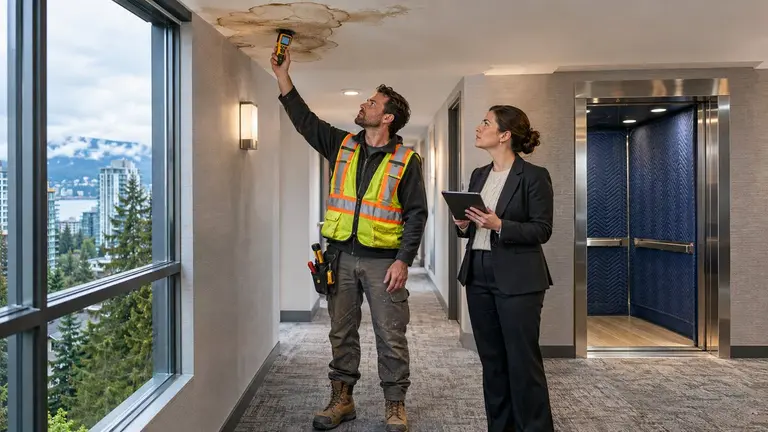
A strata contractor site visit checklist is the difference between one useful visit and three wasted ones. Before a contractor walks into a strata building, the property manager and the contractor should agree on the location, who is responsible for the area, how access works, what is safe, and what evidence comes back afterwards. Get those five things right and the quote, the council decision and the repair all move faster. This guide sets out the checklist in order, from booking to report, for strata managers in British Columbia, condominium managers in other provinces, and the maintenance contractors they call.
Why strata site visits go wrong
Most failed visits are not about workmanship. They are about information. Common reasons include:
- The contractor arrives at the wrong unit because the job came in as "leak, 4th floor".
- Nobody can let them into the suite, the electrical room or the roof hatch.
- The area turns out to be limited common property or part of a strata lot, so the quote goes to the wrong decision-maker.
- The elevator is booked for a move-in and the contractor carries tools up nine flights, or leaves.
- The report comes back as a single line with no photos, so council cannot decide anything.
Every item on that list can be fixed before the visit. That is what the checklist is for.
Before the visit: what the property manager confirms
Location and the actual problem
Write the job brief as if the contractor has never seen the building. Include the civic address, building name, strata lot or unit number, floor, and the exact location of the problem. "Ceiling stain in the bathroom of unit 402, below unit 502" is a brief. "Water issue" is not.
Add what the resident reported, when it started, whether it is getting worse, and any photos they sent. If there was a previous repair on the same issue, say so and attach the old report.
Responsibility and authority
Before you book anyone, check whether the area is common property, limited common property or part of a strata lot. The strata plan, the bylaws and any relevant council resolutions tell you. Responsibility for repair and cost follows those documents and the provincial legislation that applies, such as the Strata Property Act in British Columbia or the condominium legislation in other provinces. If you are unsure, ask before the contractor quotes, not after.
Also confirm your own authority. Your management agreement and the council's instructions set what you can approve without a council decision. Some visits are simply an inspection and quote. Others are emergency work. Be clear which one this is when you book.
Access and notice
Strata access has more moving parts than a house call. Confirm:
- Whether a resident needs to be home, and whether notice to the owner or tenant is required under the bylaws and current provincial rules.
- Who holds keys or fobs for mechanical rooms, electrical rooms, the roof and the parkade.
- Elevator booking and any protective pads needed.
- Contractor parking and parkade clearance for a van or ladder rack.
- Building hours for noisy work, if the bylaws set them.
- The caretaker, resident manager or concierge contact on the day.
Known hazards
Pass on what you know. That includes any hazardous materials report for an older building, roof anchor locations, fire alarm or sprinkler work that means the monitoring company must be told, and anything unusual like a confined space or a known slip hazard. The contractor remains responsible for their own safety under provincial workplace safety rules, but they cannot plan for what nobody told them.
Before the visit: what the contractor confirms
The contractor has their own checklist. Confirm with the manager:
- The scope of the visit: inspect and quote, make safe, or complete a repair.
- Who the report and quote go to, and whether council will see them.
- Current proof of liability insurance and workers' compensation coverage, if the manager asks for it. Some managers want a clearance letter or certificate on file before a first visit.
- Whether a municipal permit could be needed if the work goes ahead.
- Tools, access equipment and PPE for the specific location, including ladders long enough for the ceiling height or roof access.
- A named contact on site and a backup number.
If anything in the brief is vague, ask before the day. A five-minute call saves a wasted trip.
On arrival
Sign in wherever the building requires, usually with the caretaker, concierge or a contractor log. Introduce yourself to the resident if you are entering a suite, explain what you are checking, and say roughly how long you will be.
Before you touch anything, photograph the area as you found it. Include the wider room, not just the defect. In a strata building this protects everyone if there is later a question about existing damage.
During the inspection
Work through the problem methodically. A useful on-site checklist:
- Confirm the reported issue matches what you see.
- Check the obvious source and the less obvious ones. Leaks in strata buildings often start in a neighbouring unit, a common pipe riser, a balcony membrane or the building envelope.
- If the source may be in another unit, tell the manager. Do not knock on doors or enter another suite unless the manager has arranged access.
- Measure and record. Moisture readings, dimensions and materials help whoever prices or approves the work.
- Note whether the area looks like common property, limited common property or part of the strata lot, but leave the final call to the manager.
- Identify anything urgent. If there is an active leak, an electrical risk or another safety hazard, call the manager before you leave the building.
- Photograph each finding with something for scale and a clear sense of location.
- Leave the area as you found it, or safer. Tell the resident what happens next in general terms only. The manager decides what is shared about cost and responsibility.
After the visit: the report
A good site visit report lets a council member understand the problem without having been there. Include:
- Date and time of the visit and who attended.
- The location, matched to the unit number and floor in the brief.
- What you found, with photos.
- The likely cause, stated as likely if you are not certain.
- Recommended scope, split into stages if the work has them, for example make safe, investigate, repair, reinstate finishes.
- Anything urgent and what you did about it on the day.
- Access you will need for the next stage.
Send the quote with the report or separately, as the manager prefers. Keep prices to the agreed scope and state your assumptions, such as "price assumes no damage to the subfloor".
What needs a person's decision
Several points in a strata repair need a human decision. The checklist should make them visible rather than bury them:
- Whether the area is common property, limited common property or the owner's responsibility.
- Whether the spend is within the manager's authority or needs a council decision.
- Which contractor and quote is accepted.
- Whether an insurance claim is made, and by whom.
- What is communicated to owners and residents, and when.
- Whether emergency work goes ahead before a full quote.
None of these should be left to a template or a tool.
Running strata visits in Plan@Job
Plan@Job is AI-powered project and operations management for construction and property businesses. In Plan@Job, an Operator is the contractor business that manages clients, project delivery, subcontractors and its own operatives. For a strata visit, the workflow looks like this.
The job starts as a brief. Sophie Bennett, the AI Enquiries Coordinator, checks existing job briefs for missing information, such as the unit number or access details, and asks for clarification. If two attempts do not get an answer, the brief is handed to a person.
Once the visit leads to work, the operator can split the job into internal stages in the project plan, each with its own scope, dates, status and costs, whether a stage is delivered in-house or by a subcontractor. The client sees the overall agreed scope and price and the evidence the operator chooses to share. Internal stage costs and subcontractor identity stay internal. You can read more on the project management features page.
Daniel Reed, the AI Operations Manager, supports follow-ups on quotes and proposed dates and prepares a morning brief. Awards, prices and first contact with a client stay with people. Nothing is accepted or paid automatically.
Illustrative example (fictional): a strata manager logs a ceiling stain in a fourth-floor suite. The brief is missing the unit above. Sophie asks for it. The contractor visits, photographs the stain and the balcony door above, and recommends three stages: make safe, investigate the balcony membrane, reinstate the ceiling. The manager takes the quote to council, and council decides.
Plan@Job is live in the UK. If you manage strata or condominium buildings in Canada, visit the Canadian property managers page to check current availability and register your interest. Maintenance contractors can do the same on the Canadian contractors page.
FAQ
Who should attend a strata contractor site visit?
At minimum, the contractor and someone who can grant access, usually the caretaker, resident manager or resident. The property manager does not always need to attend an inspection, but should be reachable by phone in case the source is in another unit or something urgent turns up.
Does the strata council need to approve every contractor visit?
Not usually for an inspection. What needs council approval depends on the bylaws, any council resolutions, the management agreement and the provincial legislation that applies. Check those documents for your building rather than relying on a general rule.
What should a contractor send after a strata site visit?
A dated report with photos, findings, likely cause, recommended scope and any urgent action taken, plus a quote against that scope with assumptions stated. Send it to the person named in the brief so it reaches the right decision-maker.