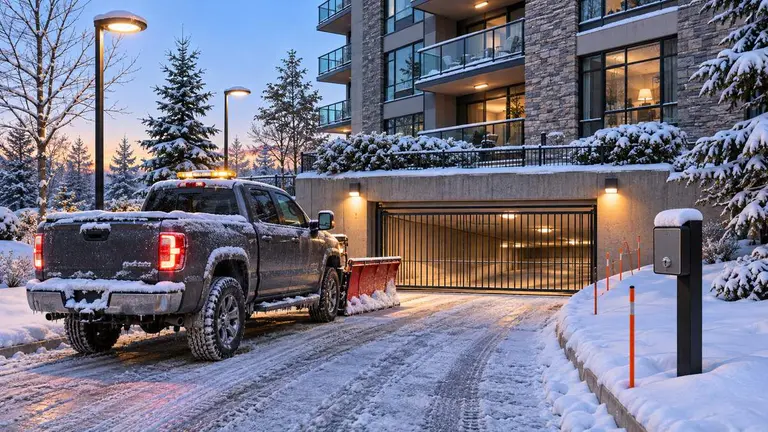
Snow contractor equipment access comes down to one question: can the crew and the machine reach every area they are paid to clear, in the dark, without phoning anyone? If the answer depends on a key in someone's truck or a code that changed in October, the site is not ready. The fix is a written access record for each property. Agree it before the first snowfall and update it whenever something changes. This checklist covers what property managers and snow contractors should capture together, who decides what, and how to keep the record current through the winter.
Why equipment access breaks down in winter
Most access problems are small. A gate code is changed after a resident complaint. A new bollard goes in by the loading area. A parkade entrance gets a lower clearance bar. A fob is switched off in a routine security audit. None of these matters in July. All of them can stop a plow at 4 a.m.
Snow work also runs on short notice and at odd hours. The property manager may be asleep when the crew arrives. The superintendent may be off shift. So the information has to travel with the job, not sit in someone's head or phone.
The pre-season equipment access checklist
Walk each site with the contractor before the ground freezes. Take photos of every entrance, obstacle and storage area. Then record the answers in one place both sides can see.
Entry and keys
- Every gate, barrier arm and overhead door the crew needs, and how each one opens.
- Current codes, fobs, remotes and keys, who holds them and how they are returned at season end.
- Lockbox locations and who is allowed to change the combination.
- Who to call if access fails, with a backup name for nights and weekends.
- Any building rules on hours, such as limits on machine work near bedrooms early in the morning, if your property has them.
Machine clearances and routes
- Height clearance for parkades, underground garages, canopies, carports and covered walkways. Measure them. Do not rely on old signs.
- Width of drive aisles, gate openings and ramps, compared with the widest machine the contractor plans to bring.
- Turning room for trucks with plows and for loaders.
- Any weight limits on podium decks, parkade roofs or older paving noted in building records or by your engineer.
- Areas that are hand-shovel or sidewalk-machine only.
Hazards and no-push zones
- Fire hydrants, fire routes and fire department connections that must stay clear.
- Catch basins and drains, so meltwater has somewhere to go.
- Gas meters, transformers, EV chargers and garbage enclosures.
- Curbs, landscaping beds, irrigation heads and bollards that disappear under snow. Stake them before freeze-up.
- Speed bumps and drain grates that catch blades.
Snow storage
- Agreed piling locations, marked on a site map.
- Places piles must never go, such as sight lines at exits, accessible parking stalls and paths, and on top of drains.
- What happens when storage runs out: hauling, relocating piles, or a call to the manager first.
Materials and equipment on site
- Where salt, sand or ice melt is stored, and who restocks it.
- Whether the contractor can leave a machine or salt bin on site, and where.
- Power or water access, if any is offered.
Residents, tenants and parked vehicles
- How residents are told about clearing events and any lot-clearing schedule.
- What crews do when a car blocks a lane. The manager should decide this in advance. It should not be worked out by the crew on the night.
- Contacts for commercial tenants with early deliveries or opening hours.
Who decides what
An access record only works if everyone knows which choices are theirs.
The property manager or owner decides:
- Which areas are in scope and to what standard, as set in the contract.
- Where snow can be stored and when hauling is approved.
- How residents and tenants are notified, and what happens with blocking vehicles.
- Who holds keys and codes, and how changes are passed on.
- Whether extra work outside the contract is approved, and at what price.
The snow contractor decides:
- Which machines and crew suit each site, within the recorded clearances.
- Safe operating practice for their people.
- When a hazard means stopping work and calling the manager.
Confirm insurance, workers' compensation coverage and contract terms with your own advisers and current provincial sources. This checklist does not replace them.
Keeping the record current through the winter
The walkthrough is the easy part. Keeping the record true in February is harder.
Set one simple rule. Any change to access gets written into the site record the same day, and the contractor is told directly. That covers code changes, new obstacles, a broken gate, construction fencing or a moved storage area.
After each event, ask the crew to note anything that slowed them down. A gate that stuck, a buried stake, a vehicle in a fire route. Review those notes weekly with the contractor. Small fixes add up over a season.
Damage is the other recurring issue. Agree up front how it is reported: photos, location, time and who was told. Pre-season photos turn these conversations into a comparison of facts rather than an argument.
Illustrative example
Fictional scenario for illustration only. A manager looks after a mid-rise condo with an underground parkade and a surface lot. In November the board approves a lower clearance bar at the parkade entrance after a delivery van hits a sprinkler pipe. Nobody tells the snow contractor. At the first storm, the crew arrives with a compact loader that no longer fits. They clear the surface lot, the ramp waits until a smaller machine is found, and residents complain about being stuck. A one-line update to the access record, with the newly measured height, would have prevented it.
How Plan@Job keeps access details on the job
Plan@Job is AI-powered project and operations management for construction and property businesses. Winter maintenance is one use case. The value for this checklist is simple: access details stay attached to the job instead of being scattered across texts and emails.
In Plan@Job, the contractor business running the work is called the Operator. That is the business managing clients, project delivery, subcontractors and its own in-house operatives. A snow Operator might send its own crew to some sites and an external subcontractor to others.
Parts of the workflow that fit this checklist:
- Job briefs with gaps flagged. Sophie Bennett, the AI Enquiries Coordinator, checks existing job briefs for missing information and asks for clarification, for example when a brief has no night contact for a failed gate. If two attempts do not resolve it, a person takes over. Sophie does not turn every incoming email into a job.
- Stages for larger scopes. An Operator can split a job into internal stages with scope, dates, status and costs, delivered in-house or by subcontractors. The client sees the overall agreed scope and price, plus the evidence that is shared with them, such as site photos. Internal stage costs and subcontractor identity stay internal. More on project management in Plan@Job.
- People make the calls. Plan@Job does not award work, set prices or move money on its own. Approvals stay with the people responsible.
Plan@Job's current launch market is the UK. If you manage properties in Canada, check the Plan@Job page for Canadian property managers to see availability and join the waitlist. Snow and maintenance contractors can do the same on the Canadian contractors page.
FAQ
When should the access walkthrough happen?
Before freeze-up, so stakes can go in and clearances can be measured on bare ground. Walk the site again after any construction, repaving or security change during the season.
Should snow contractors hold permanent keys or fobs?
That is the property manager's decision. Common options are a lockbox or a dedicated fob that can be switched off at season end. Whatever you choose, record who holds what and how it comes back.
What should a crew do if they find a new obstacle mid-storm?
Stop where it is unsafe, photograph it and call the night contact on the access record. Then update the record so the next crew knows before they arrive.