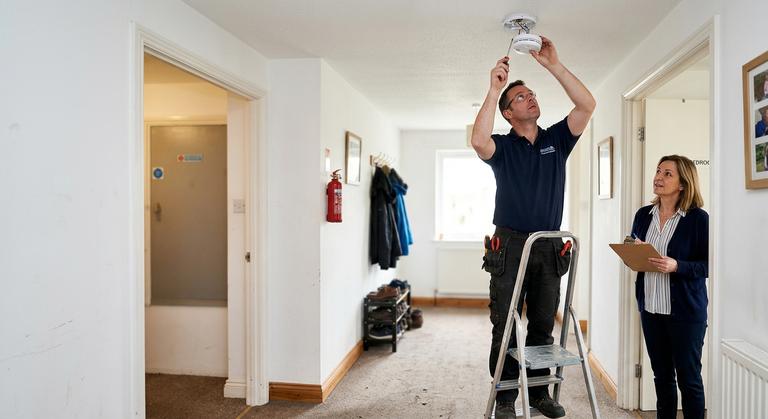
Smoke detector laws for rental properties are written at the state and local level, not by one federal statute, and that patchwork is exactly what trips up landlords who own units in more than one jurisdiction. A setup that passes inspection in one state - battery-powered alarms in hallways only - can be a code violation one state over, where sealed long-life photoelectric units are required inside every bedroom. This guide breaks down where the rules actually come from, the main ways they differ from state to state, and how to run a compliance process that holds up when a fire marshal, an insurance adjuster, or a plaintiff's attorney starts asking for records.
Where Smoke Alarm Requirements Actually Come From
There is no single national smoke alarm law covering private rentals. Instead, your obligations stack up from several layers:
- State statutes. Virtually every state requires smoke alarms in rental housing in some form, usually inside the landlord-tenant code or the state fire code. These statutes set the baseline: where alarms go, what type is acceptable, and who maintains them.
- Model codes adopted by your state or city. Most jurisdictions adopt a version of the International Residential Code, the International Fire Code, or NFPA 72, often with local amendments. The adopted edition matters - newer editions generally require more alarms in more places.
- Local ordinances. Cities and counties frequently go beyond state law. A city fire department can require photoelectric sensors, interconnection, or inspections at tenant turnover even when the state statute does not.
- Federal rules for assisted housing. If you participate in federally assisted housing programs, separate federal requirements apply on top of everything else.
The operating rule is simple: when layers conflict, comply with the strictest one that applies to your building. "We met state law" is not a defense against a city code violation.
How Smoke Detector Laws for Rental Properties Vary by State
Once you compare statutes side by side, the differences cluster into four areas. Build your compliance matrix around these.
Sensor technology
Some states and cities specify photoelectric alarms, or dual-sensor units, particularly for alarms installed near kitchens and bathrooms where ionization alarms cause nuisance tripping. Others are silent on technology and defer to the adopted building code. If you standardize on photoelectric or dual-sensor hardware portfolio-wide, you rarely have to think about this axis again.
Power source
New construction is almost universally required to have hardwired alarms with battery backup, and many codes require interconnection so that one alarm triggers all of them. For existing buildings, the split is between states that still allow replaceable-battery alarms and a growing number that require sealed alarms with a non-removable long-life battery when a battery-only unit is installed or replaced. The sealed-battery trend exists for a reason: it eliminates the classic failure mode of a tenant pulling the battery to stop chirping.
Placement
The widely adopted modern baseline is an alarm inside each bedroom, one outside each sleeping area, and at least one on every level of the dwelling including basements. Older statutes sometimes require less - perhaps only one per level - but if your local code has adopted a recent edition of the model codes, the fuller layout likely applies at least whenever you renovate or replace units. Installing to the modern layout everywhere is cheap insurance against getting the jurisdiction-by-jurisdiction analysis wrong.
Maintenance responsibility
Most states put installation and initial working order on the landlord, then split ongoing duties: the landlord verifies alarms work at the start of each tenancy, the tenant tests periodically, reports failures, and in some states handles battery replacement during the tenancy. Critically, several statutes only shift battery duty to the tenant if the lease says so in writing, or if the tenant signs an acknowledgment that alarms were working at move-in. If your lease is silent, assume the duty stays with you.
Carbon Monoxide Detector Rules Add a Second Layer
Most states now have some form of carbon monoxide alarm requirement for residential rentals, but the triggers vary more than smoke alarm rules do. Common patterns include:
- CO alarms required only in units with fuel-burning appliances, fireplaces, or an attached garage - all-electric buildings are often exempt.
- CO alarms required outside each sleeping area rather than inside every bedroom.
- Combination smoke and CO units expressly permitted, which simplifies hardware and reduces ceiling clutter.
- Requirements that apply at the point of sale, new construction, or alteration rather than retroactively - though rentals are frequently treated more strictly than owner-occupied homes.
Because the exemptions are appliance-driven, your unit data has to be accurate. A portfolio spreadsheet that does not record whether each unit has a gas furnace, gas range, or attached garage cannot tell you where CO alarms are legally required. Fix the data first.
A Portfolio Compliance Checklist
Here is the process that works for managers running units across multiple cities or states:
- Build a jurisdiction matrix. One row per city or county where you hold units. Columns: smoke alarm placement rule, sensor type rule, power source rule, CO alarm trigger, tenant duty rules, and the code edition adopted. Pull from the state statute and the local fire code, and confirm anything ambiguous with the local fire marshal's office - they answer these questions all day.
- Audit every unit against the strictest applicable rule. Walk each unit and record alarm locations, model numbers, power source, and the date of manufacture printed on the back of each alarm.
- Standardize hardware above the minimum. Sealed long-life combination units that meet the toughest jurisdiction in your portfolio are usually cheaper to manage than three different specs.
- Put duties in the lease. State that alarms were tested and working at move-in, define the tenant's duty to test and report, and prohibit tampering. Get a signature on a move-in condition form that lists each alarm.
- Test and photograph at every turnover. A dated photo of each alarm, plus a test log entry, takes minutes and becomes your best evidence later.
- Calendar replacements. Smoke alarms have a manufacturer-stated service life - commonly around ten years - and an expired alarm can be a violation even if it chirps on test. Track date of manufacture, not date of install.
Documentation Is Your Legal Defense
After a fire or a CO incident, the questions are predictable: were alarms present, were they working, and can you prove it? A landlord with signed move-in checklists, dated photos, work orders showing professional installation, and a replacement schedule is in a fundamentally different legal position from one relying on memory. Store records per unit, not per building, and keep them past the end of each tenancy. We cover record-keeping systems in more depth on the PlanaJob blog.
Getting the Work Done Across a Portfolio
Battery and sealed-unit swaps are handyman-grade work, but hardwired and interconnected systems need a licensed electrician, and some jurisdictions require permits or inspections for that wiring. If you manage at scale, the bottleneck is rarely the hardware - it is coordinating dozens of small jobs across scattered addresses without losing the paper trail. Platforms like PlanaJob let property managers compare quotes from vetted contractors and keep the documentation attached to each job, and you can schedule portfolio-wide detector installs and inspections in one PlanaJob work order instead of chasing individual bookings. If that sounds like your next quarter, create a free account or see how PlanaJob works for property managers. Contractors quoting this kind of volume work may also find the pricing and scheduling discussions at Construction Arbitrage useful for structuring multi-site jobs profitably.
FAQ
Do smoke detector laws for rental properties apply to older buildings?
Generally yes. Unlike many owner-occupier rules that apply only at sale or new construction, rental requirements are usually retroactive - the landlord-tenant statute applies to the tenancy regardless of when the building was built. What varies is the standard: some states let older buildings keep battery alarms where new construction needs hardwired units. Check both your state statute and the local fire code before assuming grandfathering.
Who is responsible for replacing batteries, the landlord or the tenant?
It depends on the state and on your lease. The common pattern is landlord responsibility for working alarms at move-in, with battery replacement during the tenancy shifting to the tenant only where the statute allows it and the lease documents it. Sealed long-life alarms sidestep the argument entirely, which is one reason smoke detector laws for rental properties in several states now push toward them.
How often should alarms themselves be replaced?
Follow the manufacturer's stated service life, which for most modern smoke alarms is around ten years from the date of manufacture printed on the unit - not from the date you installed it. CO alarms often have shorter lifespans, so check each model. Put replacement dates in your maintenance calendar at install time, because an alarm past its service life may fail to detect even when the test button still works.