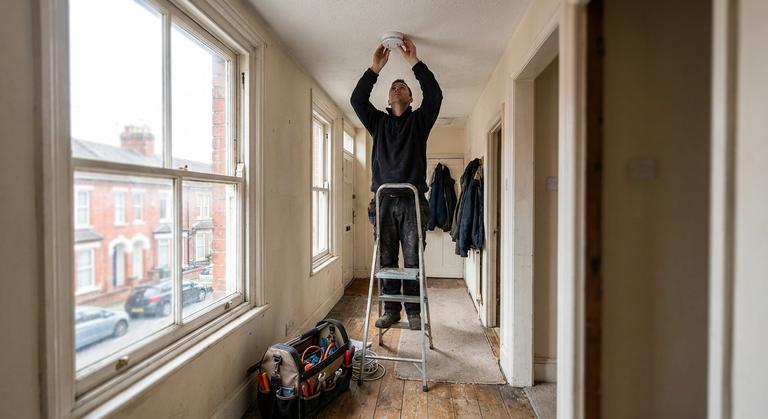
Smoke and carbon monoxide alarms are the cheapest items on any lettings compliance list, and still among the most commonly failed at inspection. The smoke alarm regulations for rented property in England changed significantly in 2022, Scotland runs an entirely separate interlinked standard, and Wales rewrote its requirements under new tenancy legislation. A policy written even four years ago is probably out of date somewhere. This guide covers what landlords and property managers must have in place in each UK nation, where portfolios typically slip, and how to build a testing and installation routine that holds up when the council or a tenant's solicitor comes asking.
Smoke Alarm Regulations for Rented Property: The England Rules
The English requirements sit in the Smoke and Carbon Monoxide Alarm (England) Regulations 2015, as amended from October 2022. They apply to rented homes in England with only limited exemptions, and the 2022 amendment caught out plenty of landlords who assumed the smoke alarm regulations for rented property were a solved problem.
Smoke alarms
- At least one smoke alarm on every storey that contains a room used as living accommodation. A bathroom or toilet counts as living accommodation for this purpose, so a converted loft with only a shower room still needs an alarm on that storey.
- Alarms must be in proper working order on the day a new tenancy begins. Testing them and recording the test in the inventory or check-in report is the only reliable way to prove this later.
Carbon monoxide alarms
- A CO alarm is required in any room used as living accommodation that contains a fixed combustion appliance. Gas cookers are excluded, but gas boilers, gas fires, oil-fired appliances and log burners are all in scope.
- Before the 2022 amendment the duty covered solid fuel appliances only. The extension to gas and oil means a combi boiler in a kitchen cupboard now needs a CO alarm in that kitchen. This is the single most common gap in portfolios that were fully compliant in 2021.
During the tenancy
- Once a tenant or agent reports an alarm as faulty, the landlord must repair or replace it as soon as reasonably practicable. Day-to-day testing can sit with tenants, but the repair duty cannot be delegated.
- Local authorities enforce the regulations. They can serve a remedial notice, and failing to comply with one can lead to a financial penalty of up to £5,000 per breach.
Scotland and Wales Run Different Systems
Applying an England-only policy across a multi-region portfolio is one of the fastest routes to failure, because the smoke alarm regulations for rented property in Scotland and Wales go further than the English baseline.
Scotland
Every home in Scotland must meet the interlinked standard: a smoke alarm in the living room, a smoke alarm in every hallway and landing, a heat alarm in the kitchen, and all of them interlinked so that when one sounds they all sound. A CO alarm is also required wherever there is a carbon-fuelled appliance or a flue. Standalone alarms that do not interlink do not satisfy the standard, however new they are.
Wales
Under the Renting Homes (Wales) regime, rented homes must have smoke alarms on every storey that are connected to the electrical supply and interlinked, plus CO alarms wherever there is a gas, oil or solid fuel appliance. These requirements sit within the fitness for human habitation rules, so a failure can affect the landlord's wider legal position rather than just risking a fine. Treat Wales as its own checklist, not an extension of the English one.
Where Portfolios Actually Get Caught Out
In practice, the smoke alarm regulations rented property managers struggle with are rarely misunderstood on paper. The failures are operational:
- No record of the tenancy-start test. The alarm worked, but nobody signed anything. If a dispute surfaces two years later, an unticked box in the inventory reads like a test that never happened.
- The 2022 CO gap. Properties with gas boilers that were compliant under the original 2015 rules and have never been revisited since.
- Dead batteries in year three. Cheap alarms with removable batteries fail quietly, and tenants who take the battery out after burning toast rarely put it back.
- A new appliance with no new alarm. A log burner fitted mid-tenancy creates a CO alarm requirement that nobody logs.
- HMO conditions ignored. Licensing conditions frequently demand mains-wired, interlinked systems and heat alarms that go well beyond the baseline regulations.
- Placement that fails inspection. A smoke alarm inside a cupboard, or a CO alarm still in its packaging in a kitchen drawer, satisfies nobody.
Placement, Alarm Types and Standards
Where alarms should go
The English regulations do not prescribe exact positions, but inspectors work from established good practice: smoke alarms on the ceiling, ideally in hallways and landings that form the escape route, and away from kitchens and bathrooms where steam causes false activations. CO alarms belong in the same room as the appliance they cover, sited according to the manufacturer's instructions rather than tucked behind the boiler. Follow the siting guidance in the box and keep a photographic record - it costs nothing and settles arguments.
Which alarms to buy
Buy units certified to the relevant British Standards for domestic smoke and CO detection, and check the printed expiry date - most alarms have a stated life of around ten years, after which the sensor is unreliable regardless of whether the test button still beeps. Sealed long-life battery units remove the dead-battery problem entirely. For Scotland, Wales and most licensed HMOs, interlinked units are the requirement rather than the upgrade.
Building a Routine That Scales Across a Portfolio
One-off compliance is easy. Staying compliant across a hundred tenancies with constant turnover is a process problem. A workable routine looks like this:
- Audit once, properly. Record every alarm in every property: location, type, expiry date, interlinked or not, and which appliance each CO alarm covers.
- Test at every tenancy start and capture a signed record in the check-in report.
- Test at every inspection. Mid-tenancy visits already happen - pressing two buttons per floor adds minutes.
- Log every reported fault with a timestamp and treat alarm faults as urgent works, not routine maintenance.
- Diarise expiry dates the same way you diarise gas safety renewals, and batch replacements street by street to reduce call-out visits.
- Re-check after any appliance work. A new boiler, stove or fire should automatically trigger the question of whether provision still matches the smoke alarm regulations for rented property in that nation.
For the install and replacement work itself, this is exactly the kind of job that benefits from competition: platforms like PlanaJob let property managers compare quotes from vetted local contractors instead of waiting on one electrician's diary. There is more on how that fits a PM workflow at PlanaJob for property managers. And if you run your own bank of trades, communities such as Contractor Club are where many UK contractors swap notes on changing alarm standards and what inspectors actually check.
Raising Install Jobs Without the Back and Forth
An alarm audit usually ends with a works list: a batch of CO alarms to close post-2022 gaps, an interlinked system or two for HMOs, a handful of expired units. Raising that as install jobs on PlanaJob takes minutes - describe the scope, attach the audit list, and let vetted electricians and multi-trade contractors quote against it. You get comparable prices, a record of who fitted what and when, and a paper trail that drops straight into your compliance file. Create a free account to raise your first install job, and you will find more compliance guides like this one on the PlanaJob blog.
FAQ
Do I need a carbon monoxide alarm for a gas cooker?
No. Gas cookers are specifically excluded from the CO alarm requirement in England. Fitting one anyway is cheap insurance, though, and if the same room also contains a gas boiler or gas fire the exclusion no longer helps you - the alarm is required for that appliance.
Who is responsible for testing alarms during the tenancy?
In England the landlord must ensure alarms work on the first day of the tenancy. Routine testing during the tenancy is generally treated as the tenant's responsibility, but the moment a fault is reported the duty to repair or replace falls back on the landlord. Sensible practice is to test at every inspection anyway, because a tenant who never pressed the button is not a defence that impresses a council officer.
Do smoke alarm regulations for rented property apply to HMOs too?
Yes, as a baseline - and HMOs usually face stricter requirements on top through licensing conditions and fire safety law. Many licensing schemes require mains-wired, interlinked smoke and heat alarm systems throughout the building. Always check the specific conditions on the licence rather than assuming the standard rules are enough.