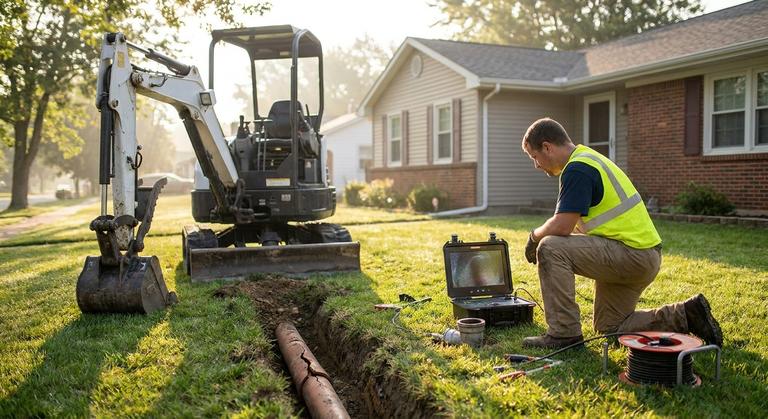
A sewer lateral is the pipe nobody thinks about until wastewater backs up into a ground-floor tub, and by then the decision in front of you is rarely a cheap one. For property managers, sewer line replacement cost is one of the hardest numbers to budget for, because two nearly identical buildings can produce wildly different quotes depending on pipe depth, material, and what happens to sit above the run. This guide breaks down how traditional excavation and trenchless methods differ, what drives the price of each, and how to collect quotes you can compare line by line instead of guessing.
Why Sewer Laterals Fail in the First Place
The lateral is the privately owned pipe running from your building to the public main. In most US cities the property owner is responsible for it, and in some jurisdictions that responsibility extends all the way to the tap at the main, including the stretch under the sidewalk or street. Confirm the boundary with your local sewer utility before you spend anything, because it changes both the scope of work and who pulls the permits.
The pipe material usually tracks the age of the building. Early twentieth-century properties often have vitrified clay tile, whose joints tree roots love. Mid-century construction leaned on cast iron, which corrodes from the inside, and in some regions Orangeburg, a bituminous fiber pipe that deforms with age and almost always needs full replacement once it fails. PVC and ABS became standard from the 1970s onward and usually fail from installation problems - poor bedding, bellies, crushed sections - rather than the material itself.
Failures announce themselves gradually: slow drains across multiple fixtures, gurgling toilets, unusually lush patches of lawn, or a sewage smell near the cleanout. If tenants in more than one unit report slow drains in the same week, think lateral, not fixture.
What Drives Sewer Line Replacement Cost
Two jobs that look identical from the curb can come in at very different prices, and it is rarely because one plumber is gouging you. Sewer line replacement cost is driven by a stack of site-specific factors:
- Length and depth of the run. A short, shallow lateral in sandy soil is a different project from a long, deep run through clay or rock. Depth also triggers trench shoring requirements, which add labor and equipment.
- Pipe material and condition. Lining needs a structurally intact host pipe. A collapsed section forces at least a spot excavation no matter which method you prefer.
- What sits above the pipe. Driveways, mature trees, retaining walls, porches, and other buried utilities complicate digging - or rule it out.
- Surface restoration. Concrete, asphalt, irrigation, and landscaping repair can rival the pipe work itself on a traditional dig, and it is the line item quotes most often leave vague.
- The connection at the main. A tie-in under the street usually means street-opening permits, traffic control, and deeper excavation.
- Permits and inspections. Most municipalities require a sewer permit and an inspection before backfill, and some require a licensed sewer contractor rather than a general plumber.
- Timing. An emergency dig with sewage on the ground costs more than a planned project in dry weather.
Ask for itemized quotes so you can see which factor is inflating the number - that tells you whether trenchless will actually lower the sewer line replacement cost on your particular property.
Traditional Excavation: The Open-Trench Approach
Traditional replacement means digging a trench along the full run, removing the old pipe, laying new PVC at the correct slope on proper bedding, then backfilling, compacting, and restoring the surface. It is disruptive and slower, but it has one big advantage: the crew sees and replaces everything, and you end up with a brand-new pipe set at the right grade.
When digging is the right call
- The pipe has collapsed or been crushed, leaving nothing sound to line or burst through.
- The line has a significant belly. A sag holds standing waste, and lining a belly just gives you a smooth-walled belly - only re-laying the pipe fixes the grade.
- The original installation has the wrong slope.
- The run is shallow under open lawn, so restoration is cheap and the usual downside of excavation mostly disappears.
Trenchless Replacement: Pipe Bursting and CIPP Lining
Trenchless methods renew or replace the pipe through small access pits instead of a full trench, which is why they dominate on properties where the lateral runs beneath a driveway, patio, mature trees, or finished landscaping.
Pipe bursting
A bursting head is pulled through the old line, fracturing it outward while dragging a new high-density polyethylene (HDPE) pipe into place behind it. You get a genuinely new pipe, often slightly upsized, with only an entry pit and an exit pit to restore. It works even on badly degraded pipe, but it cannot correct a belly and it needs room for the pits.
Cured-in-place pipe (CIPP) lining
A resin-saturated liner is inserted into the existing pipe and cured in place, creating a jointless new pipe inside the old one. It is excellent for root intrusion, cracks, and leaking joints in a host pipe that still holds its shape. The trade-offs: it slightly reduces internal diameter, it cannot span collapsed sections, and reinstating branch connections takes skill - which is why you want the installer's track record, not just their price.
Where trenchless wins on total cost
Per foot, trenchless work is often priced higher than open-trench pipe laying. The comparison flips once you count everything around the pipe: concrete demolition and repouring, driveway repair, landscaping, and days of disruption to tenants and parking. On an occupied property with hardscape over the run, the total sewer line replacement cost for a trenchless job frequently comes in below the all-in cost of a dig. On a shallow lawn run, the dig usually wins. Camera footage plus an itemized quote tells you which side of that line your property is on.
How to Decide: A Practical Checklist
- Camera inspection first, always. Nobody can honestly quote a replacement without seeing the inside of the pipe and locating the defects from the surface.
- Keep the recording and locate marks. You paid for the inspection - the footage belongs in your property file, and it lets other bidders quote without repeating the work.
- Match the defect to the method. Roots and cracks in a round pipe point to lining. Deteriorated Orangeburg points to bursting. Collapse or a belly points to excavation, at least for that section.
- Price restoration separately. Make every bidder state exactly what surface repair is included, to what standard, and what is excluded.
- Compare warranties in writing. New pipe, liner, and workmanship warranties differ between contractors and materials.
- Ask about a hybrid. A spot excavation of one failed section combined with lining the rest is often the cheapest sound fix on a long run.
Getting Quotes You Can Actually Compare
Sewer work is where vague quotes go to become change orders, so control the process. Insist that every bidder either performs a camera inspection or quotes from your existing footage, and confirm that 811 utility locates are called in before anyone breaks ground. Then compare scope, not just totals: pipe material, bedding and backfill spec, compaction, cleanout installation, permit responsibility, restoration standard, and warranty terms.
Collecting three comparable bids is the single most effective way to keep sewer line replacement cost under control, and it is far easier when the bidders arrive pre-screened. Platforms like PlanaJob let you compare quotes from vetted contractors side by side instead of chasing voicemails, and PlanaJob specifically connects you with plumbers who run a camera down the line before quoting the big dig - so you are choosing between diagnosed solutions, not guesses. If you run a portfolio, see how it works for property managers, or create a free account and post the job with your camera footage attached.
Two closing notes from the management side. Check whether your property insurance includes sewer or water backup coverage - it is often a separate endorsement, and any claim conversation goes better with dated footage and quotes on file. And if a bid seems high, remember the contractor is pricing risk: unknown utilities, shoring, weather, restoration. The business breakdowns at Construction Arbitrage show how contractors price heavy work like this, and reading a few makes you a sharper negotiator. For more guides like this one, browse the PlanaJob blog.
FAQ
Is trenchless sewer replacement as durable as new pipe?
Pipe bursting installs a genuinely new HDPE pipe, so durability is comparable to an open-trench replacement. A properly installed CIPP liner forms a jointless structural pipe inside the old one and typically carries a long manufacturer warranty, but installation quality matters more than it does with new pipe - check the installer's certifications and ask for post-cure camera verification.
How long does the work take?
Most residential trenchless jobs take a day or two on site once permits are in hand, because there is little digging and little restoration. Traditional excavation takes longer, and surface restoration - concrete curing, landscaping - extends the disruption well past the plumbing. Either way, agree on a water shutoff window with tenants in advance.
Who is responsible when the break is under the street?
It depends on your municipality. Some cities take over at the property line; others hold the owner responsible all the way to the tap at the public main, including the section beneath the sidewalk and street. Call your local sewer utility with the address before commissioning work - the answer determines scope, permits, and occasionally whether a city program shares the cost.