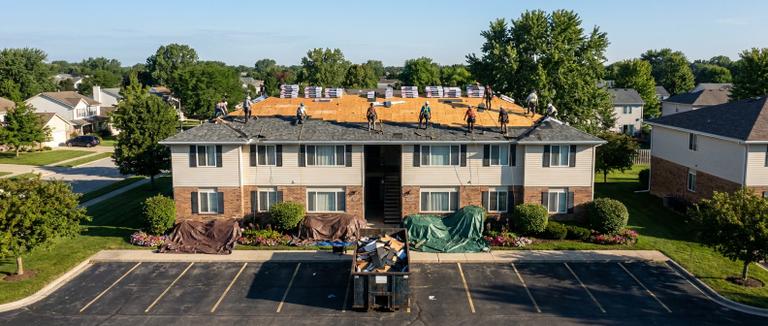
Ask three roofers to bid the same 24-unit garden apartment complex and the spread between the low and the high number can run into five figures. That does not automatically mean someone is padding. Roof replacement cost in the US is assembled from a short list of measurable inputs - roof area in squares, material, pitch, how many layers come off, what the deck looks like underneath, and what crews charge in your county - and every bidder makes slightly different assumptions about each one. Learn to read those assumptions and bid comparison stops being guesswork. Here is how US roofers build the number, what shifts it by material and region, and which line items decide whether the price you sign holds at closeout.
How US Roofers Actually Price a Roof
Nearly every estimate in the US, residential or light commercial, is built on the square: 100 square feet of finished roof surface. A 2,400 square foot roof surface is 24 squares. Materials, labor, disposal and warranty are all quoted per square, then adjusted upward for anything that slows a crew down. If you ask a roofer how many squares the job is and they cannot answer within a minute, you are talking to a salesperson, not an estimator.
Your roof surface is bigger than your footprint
Two errors show up constantly in PM budget spreadsheets. The first is using the building footprint as the roof area. Pitch is pure geometry: a 6/12 slope adds a bit over 11 percent to the surface, and a 12/12 slope adds over 41 percent. The second is forgetting waste. Every valley, hip, dormer and rake generates offcuts, so estimators add a waste allowance on top of measured area, and a cut-up hip roof with four dormers carries a noticeably higher allowance than a plain gable. Satellite measurement reports are cheap and worth ordering before you read a single bid, purely so you can check whether bidders are even measuring the same roof.
Pitch, height and access
A walkable pitch on a single-story building is the cheapest labor scenario there is. Once the roof gets steep enough to need staging and fall protection, or the building goes to three stories, or the only dumpster spot is 200 feet from the loading point, labor hours climb fast. On occupied multifamily, add tenant notices, vehicle protection, and the fact that crews cannot start at 6 a.m. without complaints. Those constraints are real cost, and the bidder who ignores them in the estimate tends to rediscover them as a change order.
Roof Replacement Cost by Material
Material is the single biggest lever on roof replacement cost, and it is the one decision that outlives everyone involved in the project. Rather than chase dollar figures that move with commodity markets and storm season, think in tiers and service life.
Asphalt shingles
Three-tab is the entry point and increasingly a false economy: shorter service life, weaker wind ratings, and it reads as cheap on a property you may want to sell. Architectural (dimensional) shingles are the default for most US rental housing, with better wind performance and a longer manufacturer warranty for a modest step up. Class 4 impact-resistant shingles cost more but can qualify for a property insurance discount in hail-prone states, so call your carrier before you rule them out.
Metal
Exposed-fastener metal panel is a budget option common on rural and light commercial buildings. Standing seam is a different animal - concealed fasteners, long panel runs, high labor skill - and it lands at a clear multiple of a comparable architectural asphalt job. The trade is service life measured in decades and fewer reroofs across a long hold.
Tile, slate and synthetics
Concrete and clay tile dominate parts of the Southwest and Florida. Slate sits at the premium end and is common on older East Coast stock. Both are heavy: before you budget a switch from asphalt to tile or slate, budget a structural engineer to confirm the framing can carry it. Synthetic composite shingles fall between asphalt and slate and are worth a look on historic-district properties with appearance rules.
Low-slope membranes
Many multifamily buildings are hybrids: pitched shingle over the units, low-slope membrane over corridors, stairwells or an attached garage. TPO, EPDM and modified bitumen are priced per square too, but they need a different crew and a different warranty. Do not let a shingle contractor treat the flat sections as an afterthought, because that is where the leak calls come from.
What Region Does to Roof Replacement Cost
Two identical 30-square roofs in different states can price very differently, and it is rarely just wages.
- Labor market. Metro and high cost-of-living areas price well above rural crews in the same state.
- Code-driven scope. Cold climates require ice barrier at the eaves, high-wind coastal jurisdictions require specific fastening patterns and often a secondary water barrier, and some wildfire-exposed areas set a minimum fire classification. These are scope items, not upsells.
- Trigger rules. Some jurisdictions require the entire roof to be brought to current code once you replace more than a set portion of it, which can turn a large repair into a full replacement. Ask before you scope.
- Permits and inspections. Fees and required stages vary; some jurisdictions want a mid-roof inspection before the underlayment gets covered.
- Disposal. Tipping fees for tear-off debris vary widely by county.
- Storm demand. After a regional hail or hurricane event, local pricing and lead times move together. If the roof can safely wait a season, you usually save.
- Freight. Tile, slate and metal ship heavy, and distance from the nearest distributor shows up in the number.
The Line Items That Decide Your Final Number
Roof size sets the base. The line items decide whether you close at the contract price. Insist that every bid states the following in writing:
- Tear-off scope and the number of existing layers coming off. The second layer is not free.
- A unit price for deck replacement per sheet of sheathing, with a stated allowance. Rotten deck is normal on older stock and it is the number one source of change orders.
- Underlayment type - synthetic or felt - and where each is used.
- Ice and water barrier coverage at eaves, valleys and penetrations.
- Drip edge, starter strip and ridge cap priced as separate items, not assumed.
- Ventilation: intake and exhaust, and whether existing vents are reused.
- All flashing replaced rather than reused, including step, counter, chimney, skylight and wall flashing.
- New pipe boots and any HVAC curb work.
- Gutter removal, reinstallation or replacement.
- Permit and inspection fees, who pulls the permit, plus dumpster, daily cleanup, magnet sweep and landscape protection.
When two bids differ by 20 percent, nine times out of ten one of these items is missing from the cheaper one.
How to Compare Bids Without Getting Burned
- Normalize the scope before you compare prices. Send all bidders the same written scope so the numbers are actually comparable.
- Verify the contractor license in your state and confirm the roofing classification, not just a general business license.
- Get the certificate of insurance directly from the carrier, covering general liability and workers compensation, and have your entity named as additional insured.
- Ask who is physically on the roof. Many roofing companies sub out installation, which is fine if you know it and the subs are covered.
- Require conditional and final lien waivers from the contractor and any material supplier.
- Treat an oversized deposit as a warning sign. Material drop plus progress payments is the normal structure.
- Confirm manufacturer certification if you are buying an enhanced system warranty, since those usually require a credentialed installer and full-system components.
- Read the workmanship warranty and ask what happens if the company changes hands. Roofing firms are bought and sold regularly, as any listing on ContractorExit shows, and an acquirer does not always honor the previous owner's paper.
Comparing roof replacement cost across three properly normalized bids takes an afternoon and routinely saves more than the time is worth. Marketplaces like PlanaJob make that easier by putting quotes from vetted contractors side by side in one place, and our resources for US property managers cover how to write a scope that gets comparable numbers back.
Budget the Roof Before It Becomes Urgent
Roofs are usually the largest single line in a reserve study, and the worst possible time to price one is the week after ceiling stains appear. Get a condition assessment with photos and estimated remaining service life on every roof you manage, then schedule replacements into shoulder seasons when crews are hungrier. Material pricing moves with commodity cycles and trade policy, so if you want to understand why your number shifted between last year's budget and this year's bids, Construction Arbitrage is a useful read on the business side of construction pricing. File every invoice, warranty registration and photo set by building, because that paper is what protects you at the next insurance claim or sale.
When you are ready to price the work, PlanaJob matches you with licensed, insured roofers and lets you compare bids side by side instead of chasing three voicemails. Create an account and post your scope, or read more cost guides on the blog first.
FAQ
How do I estimate roof replacement cost before bids come in?
Order a satellite measurement report to get squares, pitch and complexity, then ask two local roofers what they are currently charging per square for architectural shingles on similar work. Squares multiplied by a current per-square rate gives you a planning figure. Add a contingency for deck replacement on any building past its second decade, and treat the result as a budget number rather than a quote.
Can I install new shingles over the existing roof?
Sometimes. Many jurisdictions allow a second layer on a structurally sound deck but prohibit a third, and some high-wind coastal codes prohibit layovers entirely. A layover saves tear-off and disposal cost up front, but it hides deck damage, shortens the life of the new shingles because they run hotter, and makes the next replacement more expensive. On property you plan to hold or sell, full tear-off is almost always the better call.
Will insurance cover the replacement?
Property insurance covers sudden accidental damage such as hail, wind or a fallen tree, not ordinary wear-out. Policies increasingly settle older roofs on actual cash value instead of replacement cost, which leaves you paying the depreciation. Read your roof schedule and deductible before storm season, document current roof condition with dated photos now, and file promptly, because storm claim windows can be short.