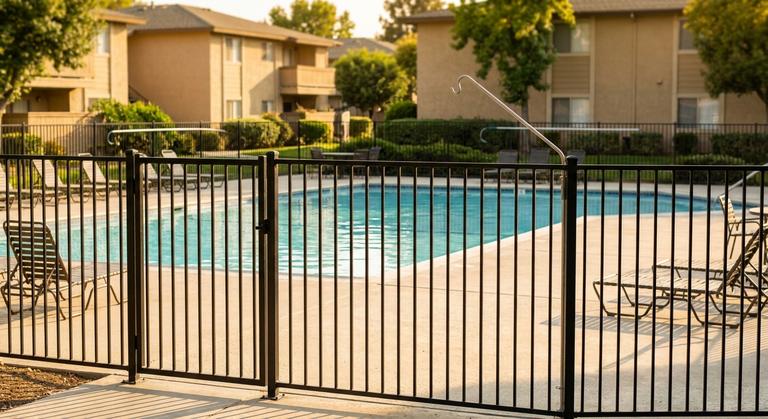
A swimming pool turns a rental into a premium listing and a liability magnet on the same afternoon. Rental property pool requirements in the United States are not one rule but three overlapping layers: a federal statute that governs drain covers and suction entrapment, a state or local barrier code that governs fencing and gates, and a county health department permit that governs everything from disinfectant levels to the depth markings painted on your deck. Most owners satisfy one layer, assume they have satisfied all three, and find the gap during an inspection or a claim.
Public Pool or Private Pool? That Answer Picks Your Rulebook
The federal line is the one owners get wrong most often. The Virginia Graeme Baker Pool and Spa Safety Act, usually shortened to the VGB Act, applies to public pools and spas, and its definition of public is far broader than a municipal aquatic center. A pool open only to residents of an apartment complex, condominium building, HOA community, or other multi-family development counts as a public pool under the VGB Act. So does a pool at a hotel, motel, or membership club.
A pool behind a single-family rental house, used by the tenant household and their guests, is generally treated as residential and sits outside the VGB Act's federal reach. That does not make it unregulated. State barrier statutes, adopted building codes, and your insurance carrier all still apply, and in practice the carrier is the party most likely to enforce something with real teeth.
Classify every pool in your portfolio before you do anything else. Which covers you need, whether you need a health permit, whether a certified operator has to sign a daily log: all of it flows from that one determination.
The VGB Act Governs Drains, Not Fences
The VGB Act exists because of suction entrapment, a hazard category that covers body entrapment, limb entrapment, hair entanglement, mechanical entrapment, and evisceration. The Consumer Product Safety Commission enforces it.
What compliance actually looks like
For a covered pool or spa, two things have to be true:
- Every main drain and submerged suction outlet is fitted with a cover certified to the current ANSI/APSP-16 anti-entrapment standard. Anything older, unmarked, or improvised fails.
- If the pool has a single main drain that is not an unblockable drain, it also needs a secondary anti-entrapment system. Accepted options include a safety vacuum release system (SVRS), a suction-limiting vent system, a gravity drainage system, an automatic pump shut-off system, or permanent disablement of the drain.
Pools built with two properly spaced main drains, or with a genuinely unblockable outlet, do not need the secondary system. Older pools with one small drain at the deep end almost always do, and that retrofit is the most commonly deferred item on rental property pool requirements checklists because it means opening up the equipment pad rather than swapping a part.
The date stamped on the cover
Certified drain covers are not permanent. Each one carries a manufacturer service life, and it is printed or molded onto the cover itself. Once that life expires the cover is no longer compliant, even if it looks fine. Sun, chlorine, and freeze cycles make the plastic brittle long before it looks broken.
Have your pool tech photograph every cover with the markings legible, then put replacement dates straight into your maintenance calendar instead of trusting someone to notice a problem eight feet underwater. A missing, cracked, or loose cover is grounds for immediate closure in most jurisdictions, and it should be grounds for immediate closure under your own operating policy regardless of what the local inspector says.
Rental Property Pool Requirements for Barriers and Fencing
Fencing is where state and local law does the heavy lifting. Most states have adopted some version of the International Swimming Pool and Spa Code (ISPSC) or a residential barrier appendix, and the recurring specifications look like this:
- A minimum barrier height, commonly 48 inches for residential pools measured from the outside grade, with community and public pools often required to run higher under state health codes.
- No opening anywhere in the barrier that allows a 4-inch sphere to pass through.
- Limited ground clearance beneath the barrier, measured on the side facing away from the water.
- No external handholds or footholds a child can climb, which is why horizontal rails frequently have to sit on the pool side.
- Gates that are self-closing, self-latching, and swing outward away from the pool, with the latch release set high or shielded so a child cannot reach through and open it.
- Any door leading directly from a dwelling into the pool enclosure fitted with an alarm or an approved self-closing device.
Treat that as the shape of the rule, not the rule itself. Verify the code and edition actually adopted in your city or county, because local amendments are common and two editions can differ on details that decide a citation.
Gates fail more often than fences
Across turnover inspections, the fence panel is almost never the problem. The gate is. Hinges sag, self-closing tension weakens, latches get propped with a rock, and a tech zip-ties the gate open for a week of deck resurfacing that nobody undoes. Test every gate by hand at each inspection: release it from the fully open position and confirm it swings shut and latches without help. Write down the result and the date. That log is the difference between an ordinary defense and a painful one if something goes wrong.
State Layers Worth Checking
State law is where rental property pool requirements diverge most sharply. California requires new residential pools and permitted remodels to carry multiple approved drowning prevention safety features. Florida's residential pool safety law requires at least one approved feature from a defined list. Arizona has a statewide barrier statute with cities layering stricter ordinances on top. New York requires pool alarms on residential pools installed after a set date.
Separately, if a pool serves a hotel, resort, or another place of public accommodation, ADA accessibility standards require an accessible means of entry such as a lift or sloped entry. Multi-family housing carries its own overlay under fair housing rules. Ask counsel rather than guessing, because retrofitting entry equipment mid-season is expensive and visible.
The Paperwork Layer Nobody Budgets For
The administrative side of rental property pool requirements catches new managers off guard. Community and multi-family pools are usually regulated as public bathing facilities by the county or state health department, which typically means:
- An annual operating permit plus a pre-season opening inspection.
- Daily disinfectant and pH readings, recorded and retained for a set period.
- A certified pool operator credential (CPO or AFO) held by whoever manages water quality.
- Required deck equipment: shepherd's hook, ring buoy or rescue tube, and a working emergency phone.
- Posted signage covering occupancy load, no lifeguard on duty, no diving, and depth markings at the waterline and on the deck.
Budget this as an operating line item rather than a surprise. A single community pool can carry more annual compliance cost than an entire building's HVAC service contract, which is exactly the sort of asset-level math worth working through at Construction Arbitrage before you underwrite your next multi-family deal with an amenity pool attached.
Getting the Right Trades On Site
Pool work splits into two distinct trades, and hiring the wrong one wastes a season. Barrier work is fencing and carpentry, judged on code compliance and gate hardware. Drain cover and SVRS work is licensed pool service and plumbing, and whoever does it should be comfortable naming the standard and handing you documentation afterward. Pool service is also a fast-consolidating industry, so expect vendor churn as smaller operators sell to roll-ups and your familiar tech disappears mid-season.
Line up both trades before April rather than during the first heat wave, when every crew is booked six weeks out. Platforms like PlanaJob let property managers post the job once and compare quotes from vetted contractors instead of chasing callbacks, and you can find pool fence installers and certified pool techs in the marketplace alongside the rest of your trades. If you run a portfolio, the tools built for property managers are designed for exactly this kind of recurring seasonal compliance work, and you can create an account and have quotes in hand well before opening day. More seasonal compliance guides live on the PlanaJob blog.
Handle the classification, the covers, the barrier, and the logs, and rental property pool requirements stop being the thing that keeps you awake in July.
FAQ
Does the VGB Act apply to a single-family rental with a private pool?
Generally no. The federal statute targets public pools and spas, and a pool used only by one tenant household usually falls outside that definition. Your state barrier law, local building code, and insurance policy still apply, and many carriers require a compliant fence and self-latching gate as a condition of coverage. If the property operates as a short-term rental or a resort-style unit, the classification can shift, so confirm it rather than assuming.
How high does a pool fence need to be at a rental property?
Forty-eight inches is the most common minimum for residential barriers under codes derived from the ISPSC, but community and public pools frequently require more under state health regulations, and individual cities amend the number. Height alone is not compliance either: gaps, ground clearance, climbable horizontal rails, and gate hardware all get cited. Pull the adopted code edition for your jurisdiction and have the installer confirm in writing that the build meets it.
Who is liable if a tenant's guest is injured in the pool?
It depends on the state, the lease language, and the facts, but owners rarely escape exposure by pointing at the tenant. Pools are often treated as an attractive nuisance where children are involved, which raises the duty of care even toward trespassers. Documented inspections, functioning barriers, current drain covers, and posted signage are what actually reduce risk. Keep the records, because the records are the defense.