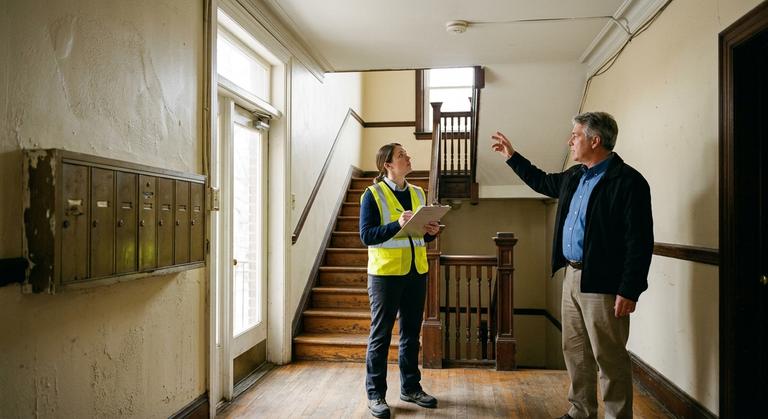
A property manager running 40 doors across three municipalities can be fully compliant in one and 90 days from a citation in the next. Rental inspection requirements by city are not one national framework with local flavor. They are hundreds of separate ordinances, written by separate councils, enforced by separate departments, on separate renewal clocks. There is no federal rental license, and only a handful of states impose one from the top down. So the operative question is never "what does the law say." It is "what does this specific jurisdiction require, who enforces it, and when does my license expire."
This guide covers the models cities actually use, which places are most likely to have a program, what inspectors write up, and how to run renewals across a scattered portfolio without discovering a lapsed license in the middle of a lease-up.
Why rental inspection requirements by city vary so widely
Rental licensing lives at the municipal level because code enforcement is a municipal function. A council responds to habitability complaints in its own housing stock, funds enforcement through per-unit fees, and writes an ordinance scoped to the problem it sees. Two adjacent suburbs can land in completely different places.
State law sits on top of that. Some legislatures have preempted or narrowed local rental registries, so a program that existed a few years ago may have been scaled back or rewritten. Others layer statewide obligations over multifamily housing regardless of what the city does. Never assume the program you learned in one market transfers to the one next door.
Three practical consequences:
- The trigger varies. Some ordinances apply to every non-owner-occupied unit. Others exempt one- and two-family homes, owner-occupied duplexes, or units already inspected under another program.
- The clock varies. Registration is often annual while the physical inspection runs on a three-, four-, or five-year cycle. Missing the registration and missing the inspection are separate violations.
- The penalty varies. Some cities issue a fine. Others withhold a certificate of occupancy, block your ability to file an eviction, or attach the unpaid fees to the property.
The five models of local rental inspection programs
1. Registration only
You file owner and agent contact details, unit counts, and a fee. No routine inspection. New York City's annual registration for multiple dwellings works this way. Inspection risk arrives through complaints and separate unit-level compliance filings rather than a license cycle.
2. License plus cyclical proactive inspection
The city inspects on a rotation whether or not anyone complains. Los Angeles runs one of the largest through its Systematic Code Enforcement Program, which covers multifamily rental units on a recurring cycle and bills the fee through the property tax roll. Boston pairs annual rental registration with periodic inspection.
3. Risk-tiered licensing
Your license class depends on your record. Minneapolis is the reference implementation: properties are tiered on violation and enforcement history, and a worse tier means a shorter license term, more frequent inspections, and higher fees. Austin's Repeat Offender Program applies similar logic to multifamily with a violation history.
4. Third-party inspector or self-certification
The city accepts a report from a qualified private inspector instead of sending its own. Denver's residential rental license requires a passing inspection at issuance and renewal. Baltimore's rental license likewise runs on a licensed private inspection. Seattle's registration and inspection ordinance allows a qualified private inspector to certify a sample of units.
5. Point-of-sale or change-of-occupancy inspection
The trigger is a transaction, not a calendar. Many New Jersey municipalities require a continuing certificate of occupancy inspection at every tenant turnover, on top of the state's cyclical inspection of multiple dwellings. Parts of the Midwest and Northeast do the same. In those markets the inspection sits on the critical path of every turn, not on your annual compliance list.
Cities that require rental licenses or inspections
Programs get amended, expanded, and occasionally preempted, so treat this as a starting map and confirm current terms with the department before you budget:
- Los Angeles, CA - Systematic Code Enforcement Program: per-unit annual fee, cyclical inspection of covered rental units.
- Sacramento, CA - rental housing inspection program covering registered rental properties.
- Seattle, WA - Rental Registration and Inspection Ordinance: register the property, renew on a multi-year term, inspect a sample of units via the city or a qualified private inspector.
- Denver, CO - citywide residential rental license, including single-family rentals, with a passing inspection required.
- Minneapolis and St. Paul, MN - Minneapolis licenses by tier; St. Paul operates a certificate of occupancy program for rental property.
- Boston, MA - annual rental registration with periodic inspection, with exemptions for certain owner-occupied small properties.
- Philadelphia, PA - rental license from Licenses and Inspections, a certificate of rental suitability for each new tenant, plus lead certification duties in older housing.
- Baltimore, MD - rental license conditioned on a licensed inspection, alongside separate state lead registration for pre-1978 rentals.
- Washington, DC - business license for rental housing, registration with the rent administrator or a filed exemption, and a housing inspection.
- Detroit, MI - certificate of compliance requiring registration, inspection, and lead clearance in pre-1978 stock.
- Kansas City, MO - healthy homes rental registration and inspection requirements.
- Chicago, IL and New York City, NY - no general rental license, but dense ordinance duties: tenant disclosure summaries, heat requirements, multiple dwelling registration, and unit-level filings that carry their own penalties.
- New Jersey (statewide) - the state inspects multiple dwellings on a multi-year cycle, independent of any municipal turnover inspection.
What inspectors actually write up
Across programs, the punch lists rhyme. The repeat offenders:
- Missing, expired, or badly located smoke and carbon monoxide alarms
- Blocked or non-conforming egress, especially basement bedrooms with undersized windows
- Missing GFCI protection at kitchens, baths, laundry, and exteriors
- Loose or absent handrails and guardrails on stairs, landings, and decks
- Deteriorated paint in pre-1978 housing and unaddressed lead hazards
- No heat source capable of holding the code minimum, or a water heater with no discharge line on the relief valve
- Active plumbing leaks, unvented dryers, damaged screens, and inoperable windows
- Failed window locks and missing deadbolts on entry doors
- Unpermitted work: finished basements, converted attics, added units
- Exterior items: address numbers not visible, downspouts discharging at the foundation, unsecured trash storage
Unpermitted work is the one that turns a two-hour fix into a six-month project, because the remedy is a permit application and sometimes partial demolition rather than a repair. If a unit came to you with a suspiciously finished basement, pull the permit history before your first inspection cycle, not after.
Building a portfolio-wide compliance calendar
- Inventory by jurisdiction, not by owner. Group every unit under the authority that regulates it. One owner's four properties may sit under three different regimes.
- Call each department once. Ask four questions: does my property type need a license, what triggers an inspection, what is the renewal term, and who is authorized to inspect.
- Back-date your reminders from the renewal. 120 days out for the pre-inspection walk, 90 days for repairs, 45 days for the filing. Permit-dependent work needs the longest runway.
- Self-inspect with the city's own checklist. Most departments publish theirs. Walking a unit with the same form the inspector uses removes almost all the surprises.
- Keep an evidence file per unit. Alarm install dates and photos, lead documentation, permits, prior reports, contractor invoices. Inspectors accept documentation; they do not accept recollection.
- Track vendor depth per jurisdiction. Contractor benches churn constantly, and owners regularly retire or sell the business outright, which is why marketplaces like ContractorExit exist. Assume your best electrician in a given market will be unavailable during your busiest renewal month, and have a second name ready.
One budgeting note: repair labor pricing moves with regional construction demand, not with your license calendar. If you want the macro view on why trade capacity and pricing swing the way they do, Construction Arbitrage covers that side of the business well. More operational walkthroughs for US portfolios live on the PlanaJob blog.
Clearing the punch list before your license renewal
The gap between knowing your rental inspection requirements by city and actually passing is execution: eight units, four trades, one hard deadline. Scope the list room by room, then split it by trade rather than by unit so an electrician handles every GFCI and alarm circuit in one visit instead of four. Book permit-dependent work first. Photograph each completed item against the checklist line it satisfies.
Platforms like PlanaJob let property managers post a punch list once and compare quotes from vetted contractors, so a 20-item list across a building turns into a handful of scheduled visits rather than three weeks of phone tag. If you manage across several jurisdictions with staggered renewals, the property manager tools are built for exactly that pattern, or you can create an account and load your next renewal punch list before the inspector books the date.
FAQ
Does every US city require a rental license?
No. Rental licensing is the exception rather than the rule nationally, though it is common in larger cities and in older housing markets. Some jurisdictions require registration without inspection, some require both, and some regulate rentals entirely through complaint-driven code enforcement. Because rental inspection requirements by city differ even between neighboring suburbs, verify each municipality individually rather than assuming a county-wide or statewide standard.
What happens if my rental license lapses?
It depends on the ordinance, but consequences commonly go beyond a fine. Cities may refuse to issue a certificate of occupancy for a new tenant, bar you from filing an eviction while unlicensed, add escalating penalties per unit per day, or attach unpaid fees to the property. Some also treat operating without a license as grounds for rent to be withheld or refunded. Fix a lapse before your next turnover, not after.
Do Section 8 inspections satisfy city rental inspection requirements?
Usually not. A housing authority inspection under HUD's NSPIRE standard covers the assisted unit for voucher purposes; a municipal license covers the property under local code. They are separate authorities with separate checklists and separate deadlines, though a few cities grant partial credit or an exemption for recently inspected assisted units. Ask the licensing department directly whether they accept an outside report, and get the answer in writing.