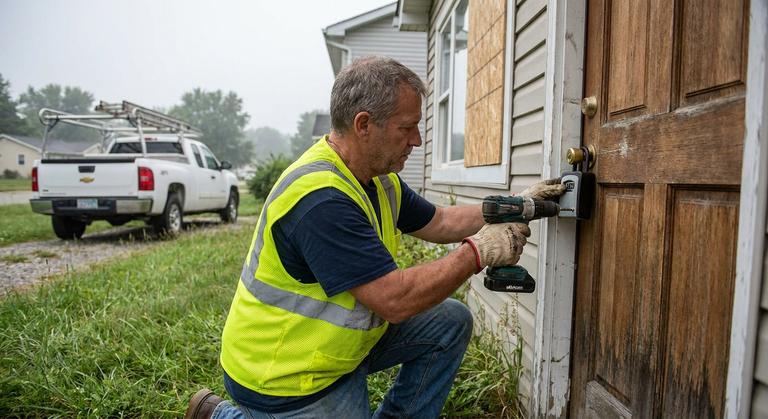
Foreclosure cleanouts, winterizations, lockbox installs, biweekly grass cuts - most of that work in the United States flows through a handful of national field service networks before it ever reaches a local crew. Lessen, MCS and Cyprexx sit near the top of that funnel, and each gates entry through a property preservation vendor application that checks your insurance, coverage area and paperwork discipline before you ever see a work order. This guide breaks down how the three networks differ, what their applications actually screen for, and how to decide whether network volume or direct property manager relationships deserve more of your week.
How Preservation Work Orders Flow Downhill
The industry runs on a subcontracting pyramid. Banks, mortgage servicers and single-family rental operators hire national field service companies to keep vacant and defaulted properties secured, maintained and marketable. Those nationals then push individual work orders down to local vendors: an initial secure with lock changes and a lockbox, a winterization ahead of heating season, debris removal priced by the cubic yard, recurring grass cuts through the growing season.
Two things follow from that structure. Pricing is usually anchored to investor allowables, the task-by-task caps that HUD, Fannie Mae and other investors publish, with the network paying you a discount off those figures. And documentation is the product: every work order lives or dies on date-stamped, geotagged before, during and after photos. If the photos do not prove the work, the network treats the work as not done, and that is where chargebacks are born.
Lessen, MCS and Cyprexx: Who Assigns What
Lessen
Lessen absorbed SMS Assist and its affiliate network, and it leans toward single-family rental and commercial maintenance at national scale: turns, recurring maintenance, renovation punch lists and preservation-adjacent work for institutional owners. Dispatch is app-driven, response windows are tight, and vendors are scored continuously. If your crew is built for rental turns and punch lists rather than pure foreclosure work, Lessen is usually the most natural fit of the three.
MCS
MCS, short for Mortgage Contracting Services, is a classic mortgage field services national: property inspections, preservation for loan servicers, REO maintenance, and increasingly single-family rental and commercial facilities work. Coverage is organized by county, so a rural vendor willing to drive is often worth more to MCS than another crew in a saturated metro. Expect strict investor guidelines and unforgiving photo standards.
Cyprexx
Cyprexx Services, headquartered in Florida, concentrates on REO: securing, maintenance, repairs, estimates and inspections for banks, GSEs and asset management companies. The work skews toward making foreclosed homes marketable - sales cleans, small repairs, ongoing yard care - so crews with light remodeling skills alongside preservation basics tend to do well there.
All three recruit through vendor pages on their own websites, and all three approve by coverage gap. If they need your counties, your property preservation vendor application moves fast; if they are already saturated, it sits. Apply to all three and let their coverage needs decide which relationship develops first.
What a Property Preservation Vendor Application Actually Screens For
The forms differ, but the screening is the same everywhere. Have this ready before you start, because half-finished applications rarely get a follow-up email:
- A real business entity. An LLC or corporation with an EIN and a W-9 ready to upload. Networks issue 1099s and prefer vendors that look like companies rather than a person with a truck.
- Insurance certificates. General liability at minimum, usually with the network named as additional insured. More on this in the table below.
- Background checks. Servicer and REO work generally requires a current background check for every person who enters a property, commonly run through Aspen Grove's ABC system. Budget for the whole crew, not just yourself.
- A defined coverage area. Counties or zip codes you can genuinely reach within required response times. Overpromising coverage is the fastest route to a bad scorecard.
- Equipment and trade capability. Winterization gear, mowers, board-up materials, hauling capacity for debris, plus any licensed trades you carry in-house.
- A photo workflow. Whatever app you use, your process must produce complete, date-stamped, geotagged before, during and after photo sets on every order, every time.
- References. Prior preservation work helps, but rental turns, insurance restoration and general maintenance references count too.
Treat the application like a bid package. Vendor managers tend to reject incomplete submissions silently, so a file missing a certificate of insurance or an unsigned W-9 usually just dies in the queue.
Insurance Requirements by Network (As of August 2026)
Exact minimums live in each network's current onboarding packet and they change, so verify the figures on the day you apply rather than trusting any blog post, this one included. As of August 2026, these are the coverage categories each network asks vendors to document:
| Network | Coverage typically required | Notes |
|---|---|---|
| Lessen | General liability; workers' comp per your state's law; commercial auto for crews on the road | Network named as additional insured; certificate kept current in the vendor portal |
| MCS | General liability; workers' comp or a valid state exemption; errors and omissions if performing inspections | Inspection-only vendors face different requirements than preservation crews |
| Cyprexx | General liability; workers' comp per state law | Certificate holder details are provided during onboarding; a lapsed certificate pauses dispatch |
Do not buy a policy ahead of a property preservation vendor application. Get the network's current stated limits first, then have your agent quote those limits plus the additional insured endorsement, which sometimes costs extra and which every network wants to see on the certificate.
The Margin Math Nobody Puts in the Welcome Packet
Working under a national means working under its margin. You are paid a discount off allowables, you carry the fuel, labor, dump fees and insurance, and quality control can claw money back through chargebacks when photos are incomplete or a follow-up inspection disputes the result. Payment runs on a net cycle after QC approval, so rework resets the clock.
None of that makes network work bad; it makes per-order math mandatory. Know your fully loaded cost for a grass cut, a winterization and a cubic yard of debris before you accept a coverage area, and build dense routes so windshield time does not eat the discount. For deeper thinking on pricing and on knowing which work to walk away from, the strategy pieces at Construction Arbitrage are aimed squarely at contractors running exactly these numbers.
Owning the Client vs Renting the Volume
The real trade-off with Lessen, MCS and Cyprexx is not the discount - it is that the client relationship belongs to the network. The servicer never learns your name, you cannot raise prices without losing dispatch, and if the network loses the account, your volume vanishes with it.
Direct property manager work orders are the other lane. Platforms like PlanaJob let property managers post maintenance jobs and compare quotes from vetted contractors, so you bid in your own name, at your own price, and a PM who likes your work comes back to you rather than to a dispatch queue. That difference compounds into repeat orders, referrals and pricing power no vendor portal will ever give you. It also matters if you ever sell up: a book of direct clients is transferable goodwill, while a network vendor ID is not. If a sale is somewhere in your future, Contractor Exit, a marketplace for buying and selling trade businesses, is worth a look at how client relationships shape what a business is worth to a buyer.
The sensible play is both. Submit a property preservation vendor application or two so network volume fills the gaps, and build the direct side in parallel - create a free PlanaJob profile so local PM work orders can reach you while the network paperwork sits in review. One distinction worth keeping straight: this guide covers national preservation networks, while winning recurring maintenance contracts directly with property management companies is a different playbook, and we cover it separately on the PlanaJob blog.
FAQ
Do I need preservation experience before applying to Lessen, MCS or Cyprexx?
No, but you need adjacent proof: rental turns, insurance restoration, handyman maintenance or landscaping references all count. Start by accepting the simple, high-volume orders - grass cuts, initial secures, winterizations - and let your scorecard build before you chase repair bids. A clean photo record on easy work is what unlocks better work.
How long does a property preservation vendor application take to approve?
It depends almost entirely on whether the network has a coverage gap where you operate. Complete paperwork in an undersupplied county can move in days, while a saturated metro can leave you in the queue for months. Follow up politely every week or two, and keep your insurance certificate current so an expired document does not restart the process.
Can I work for the networks and take direct PM jobs at the same time?
Yes, and most established vendors do. Read your vendor agreement first: non-solicitation clauses typically bar you from approaching the network's own clients directly, but they do not stop you from taking independent work orders from local property managers. Running both keeps your crews busy when either side goes quiet.