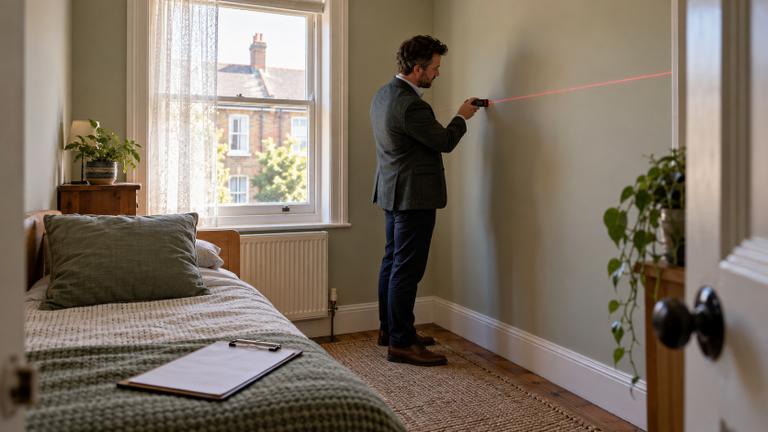
"How many people can legally live here?" sounds like a question with one number for an answer. It isn't. The overcrowding rules for a rented property come from at least three separate places: the statutory standards in Part X of the Housing Act 1985, HMO licensing conditions under the Housing Act 2004, and whatever your council has layered on top through additional or selective licensing. A three-bedroom terrace in one borough can lawfully house more people than an identical house a mile away. Get it wrong and you are not just risking a licensing penalty - you are risking a hazard notice, an insurer asking awkward questions, and a tenancy that is now very hard to unwind.
The two statutory tests every property must pass
Statutory overcrowding is the floor. It applies to every dwelling, licensed or not, and it is measured two ways. A property is legally overcrowded if it fails either test.
The room standard
The room standard is about who shares a bedroom, not how big it is. A property breaches it when two people of opposite sexes, aged 10 or over, who are not living together as a couple, have to sleep in the same room. Children under 10 are ignored for this test. In practice this is the test that catches the growing family: two children of different sexes sharing a box room is lawful until the older one turns 10, and then it isn't.
The space standard
The space standard is arithmetic. Part X sets out tables capping the permitted number of people by the number of rooms available as sleeping accommodation and by each room's floor area, whichever gives the lower figure. Two things catch people out:
- "Rooms available as sleeping accommodation" is not the same as "bedrooms". A living room usually counts. A kitchen may count depending on its size and layout. A property advertised as a two-bed with a separate reception is often assessed as three rooms.
- People are not counted as whole units. A child under one does not count at all, and a child aged one to under 10 counts as a half. A couple with a toddler and a newborn are two and a half people, not four.
Run both tests before you advertise and record the answer on the property file. It takes ten minutes once and settles an argument later.
Overcrowding rules in a rented property that is an HMO
Once the property is a house in multiple occupation, the licence overrides your own arithmetic. In England, mandatory HMO licensing bites where five or more people from two or more households share a kitchen, bathroom or toilet - the old storey rule was removed in 2018, so a two-storey flat is fully in scope. Scotland's threshold is lower, at three or more unrelated occupants; Wales licenses landlords and agents through Rent Smart Wales; Northern Ireland runs a single scheme administered by Belfast City Council for the whole region. If you manage across borders, do not assume the English numbers travel.
A mandatory licence in England also carries national minimum sleeping room sizes as a condition: broadly 6.51 sq m for one person over 10, 10.22 sq m for two people over 10, and 4.64 sq m for a child under 10, with anything smaller than 4.64 sq m unusable for sleeping at all. Your licence will state a maximum number of occupants for the property and for each named room, and that figure is the operative limit. Councils often set standards above the national minimum through additional licensing, so read the conditions attached to your actual licence rather than the general guidance.
What counts as a household
A household is a single person, a couple, or people related as family, including step-relations and certain carers. Three friends sharing are three households. A couple and their adult son are one. That single definition decides whether you are running a straightforward let or an HMO, so establish it at referencing stage, not at renewal.
A seven-point occupancy check
Applying the overcrowding rules to a rented property is a repeatable process. Run this before you agree a let, and again whenever a tenant asks to add someone:
- Measure and record every room's usable floor area, leaving out any part where the ceiling is too low to count under the regulations.
- Apply the room standard and the space standard, counting under-10s correctly.
- Establish how many households the occupiers form.
- Check the council's licensing register for mandatory, additional and selective schemes covering that postcode.
- Check for an Article 4 direction. In England a small HMO for three to six people normally falls in use class C4, and the change from C3 is permitted development unless Article 4 removes it. Seven or more occupants is sui generis and needs planning permission regardless.
- Confirm the fire precautions match the real occupancy: alarms on every storey, a carbon monoxide alarm in any room with a fixed combustion appliance, and fire doors where the licence or a risk assessment requires them.
- Write the permitted number into the tenancy agreement and the property record, then diary the date the youngest child turns 10.
Point seven matters more than it looks. Overcrowding is almost always a slow drift rather than an event.
When a property is already overcrowded
The overcrowding rules do not only bite at the start of a tenancy. If you inherit or discover an overcrowded let, you have a live compliance problem and a narrow set of moves.
Crowding and space is one of the hazards assessed under the Housing Health and Safety Rating System, so a council can serve an improvement notice whether or not the property is licensed, and whether or not the statutory standards are technically breached. Separately, Part X makes it an offence for an occupier to permit overcrowding and for a landlord to cause or permit it, subject to defences - including where the overcrowding arises only because a child has reached a relevant age and the tenant has applied to the authority for suitable alternative accommodation.
Your realistic options are to reconfigure the property, reduce occupancy by agreement, or support a rehousing application. Do not assume notice is the shortcut. With no-fault possession routes in the private rented sector far narrower than they were, a possession claim built on overcrowding is slow, contested, and unattractive if the council is already involved. Fixing the building is usually faster than fixing the tenancy.
The works that usually follow
Reconfiguration is where these cases get expensive: partition changes, a second means of escape, upgraded fire doors, extra bathroom capacity, and ventilation to deal with the condensation heavy occupancy produces. These are specialist jobs with licensing consequences if they are done badly, so the contractor matters as much as the price. Platforms like PlanaJob let property managers compare quotes from vetted contractors against the same scope instead of chasing three unrelated estimates by phone. For a view of how the trades themselves plan and price this work, Contractor Club is a useful window into UK contractor practice, and Construction Arbitrage is good on the commercial logic behind compliance-driven jobs.
Keep the evidence trail in one place
Overcrowding disputes are won on records: measured room sizes, licence conditions, the date you were told about a new occupier, inspection notes, works ordered and completed. If that lives across email threads and a shared drive, you will not find it under pressure.
That is the case for running a proper repairs desk rather than an inbox. PlanaJob works as your repairs desk CRM: every job raised against the property, every quote, every contractor visit and completion note tied to the address and the tenancy, so when an officer asks what you did and when, the answer is one click away. You can see how it works for property managers, create an account in a few minutes, or read more UK compliance guides on the PlanaJob blog.
FAQ
Does a newborn count towards the legal occupancy limit?
Not under the space standard. A child under one is not counted at all, and a child aged one to under 10 counts as half a person. They only count for the room standard once they reach 10. This is exactly why occupancy should be reviewed against birthdays rather than at renewal.
Can I just write "maximum four occupants" into the tenancy agreement?
You can and should, but a contractual cap does not override the law in either direction. It will not make a property lawful if the statutory standards or the licence permit fewer people, and a breach is a contractual matter you would have to enforce yourself. Treat the clause as your early-warning system and your evidence, not as your compliance.
Who is liable if a tenant moves extra people in without telling me?
Both sides can be exposed. The occupier commits an offence by permitting overcrowding, and the landlord commits one by causing or permitting it, which in practice means knowing or having reason to know and doing nothing. Agents are judged on whether they acted once they had grounds for concern, so log the report, inspect, write to the tenant, and record the outcome.