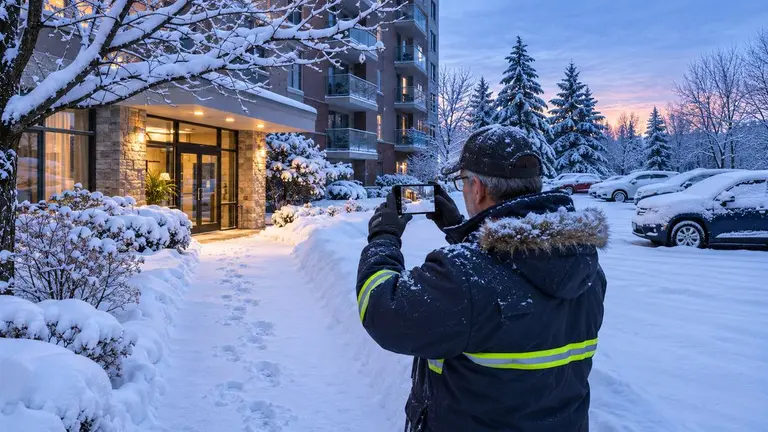
Missed snow clearing documentation is a short, dated record that shows what the contract required, what the weather did, what was seen on site and what happened next. Get that down within hours, not weeks, and most disputes about a skipped lot or an unsalted entrance settle on facts instead of memory. This guide is for Canadian property managers who need to show a visit did not happen, and for snow removal contractors who need to show it did, or explain why it was late.
Start with what the contract actually promised
You cannot document a missed visit until you know what a completed visit looks like. Pull the snow clearing agreement or work order and note the terms that define service.
- Trigger: the snowfall depth or conditions that start a visit, and whether it is measured on site or from a named weather source.
- Service window: how soon after the trigger, or after the snow stops, clearing must be finished. Many contracts also set a deadline before opening hours.
- Scope: which areas are included. Parking lots, drive aisles, sidewalks, entrances, stairs, ramps, fire routes, garbage enclosures and loading docks are often listed separately.
- Ice control: whether salting or sanding is included, on what trigger, and with what material.
- Reporting: whether the contractor must log visits, send photos or notify the site.
- Pricing basis: seasonal or per-visit pricing shapes what a missed visit means commercially, but that is a conversation for later.
If the contract is vague, record that too. A vague contract is a reason to fix the wording for next season, not to guess what it meant in the middle of a dispute.
Missed, late or partial
Be precise about which one you are documenting.
- Missed: no service at all within the window.
- Late: service happened, but after the agreed window.
- Partial: the crew came but skipped an area, left windrows blocking an entrance or did not salt.
Each needs slightly different evidence, and each tends to lead to a different conversation.
What to record, every time
Use the same list whether you are the site contact or the contractor. Consistency matters more than volume.
- Date and time of the observation, and who made it.
- Weather facts: start and end of the snowfall and approximate accumulation, from a named source such as Environment and Climate Change Canada historical data or the source named in the contract. Save a screenshot or note the station.
- Site condition: photos of each area in scope, taken from the same spots each time. Include a wide shot and a close shot. A tape measure in the snow helps show depth.
- What was missing: which areas were not cleared or treated, in plain words. 'North sidewalk not cleared, entrance B not salted' beats 'lot not done'.
- Notice given: when and how the contractor was told, and by whom. Keep the message.
- Response: when the contractor replied, what they said, and the proposed time for the return visit.
- Return visit: when it happened, with photos of the finished result.
- Interim action: anything done in the meantime, such as closing an entrance, putting out signage or calling a backup crew. Record who authorized it.
- Incidents or complaints: note any reported slip, fall or tenant complaint factually, and pass it to whoever handles insurance or claims for the property. Do not speculate about cause in the log.
Keep phone photos as originals. The file usually holds the time it was taken, which is harder to dispute than a caption typed later.
Who records what
The property manager or site contact
Your job is to observe and notify. Walk the site, or have a superintendent or caretaker do it, at a set time after the trigger. Send notice in writing through the channel the contract names. If you phone, follow up with a message that repeats what you said.
Stick to what you saw. 'No sign of plowing at 7:40 a.m.' is useful. 'They clearly never showed up' is not, because a crew might have plowed overnight and the lot drifted in again.
The snow removal contractor
Your job is to show what was done and when. Crews should log arrival and departure times and take before and after photos of each area. If a site was skipped because of equipment failure, a blocked lot or cars that would not move, record the reason at the time. A reason written three days later reads like an excuse.
If you subcontract routes, make sure your subcontractors send the same evidence to you, in the same format, so you can answer the client without chasing.
A simple timeline after a missed visit
Illustrative scenario: a condo corporation's contract requires clearing within a set number of hours after snowfall ends. An overnight storm stops at 4 a.m. At 7:30 a.m. the superintendent finds the parking lot and front walk uncleared.
- Within the hour: the superintendent takes photos, treats the front steps from the building's own supply if that is the corporation's practice, and messages the property manager.
- Same morning: the property manager sends written notice to the contractor, attaching photos and the snowfall timing, and asks for a return time.
- When the contractor replies: record the reply and the proposed time. If no reply arrives by a time you set, follow up and decide whether to call a backup.
- After the return visit: photograph the result and close the record.
- Within the week: review the record with the contractor. Agree what happened, what changes, and whether the contract terms for a missed visit apply.
This is a made-up example. Your own windows and steps come from your contract and your board or owner.
Decisions a person has to make
Documentation supports decisions. It does not make them. Someone with authority needs to decide:
- whether to call a backup contractor, and who pays for it
- whether the miss triggers a credit, deduction or warning under the contract
- whether repeated misses justify ending the agreement
- what to tell residents or tenants
- whether an incident needs to go to the insurer or a legal adviser
Responsibility for clearing sidewalks and private property varies by municipality and province. Check your local bylaw, and get advice from your insurer or a qualified lawyer in your province before you rely on the record for a claim. This guide does not replace that advice.
How Plan@Job fits this workflow
Plan@Job is AI-powered project and operations management for construction and property businesses. Snow clearing is one kind of recurring maintenance job it can hold, alongside the rest of a property manager's or contractor's work.
For a missed visit, the useful part is keeping everything in one place. Each visit or return visit sits as a job with its brief, dates, status and evidence, instead of being spread across texts and inboxes. In Plan@Job terms, the contractor running the work is the operator, meaning the business that manages clients, delivery, subcontractors and its own operatives. The client sees the agreed scope and the evidence shared with them. The operator's internal costs and the identity of any subcontractor stay internal.
Plan@Job's AI staff can help with the admin around it. Sophie Bennett, the AI Enquiries Coordinator, checks existing job briefs for missing information, such as which areas are in scope, and asks for clarification, handing over to a person if two attempts do not resolve it. Daniel Reed, the AI Operations Manager, follows up on proposed dates and includes open items in a morning brief. Neither decides whether a visit was missed, awards work, sets a price or applies a credit. Those calls stay with you. Read more on the AI staff page.
Plan@Job is live in the UK first. In Canada, property managers can register interest through the Canadian property managers page, and snow removal and maintenance contractors through the Canadian contractors page. Timing and features for Canada will be confirmed through that journey.
Make next season easier
Before the first storm, agree a shared checklist with each contractor: the trigger, the window, the areas in scope, the photo spots and the notice channel. Then the record for any missed visit is half written before it happens, and both sides know what evidence the other expects.
FAQ
How quickly should I report a missed snow clearing visit?
As soon as you confirm it, and in writing. Same-morning notice with photos gives the contractor a chance to return and gives you a clean record. Check your contract for any required notice period or channel.
Are photos enough on their own?
Rarely. Photos show condition but not context. Pair them with the snowfall timing, the contract window, the notice you sent and the contractor's reply. Together they tell a complete story.
Can a contractor dispute a missed visit if the lot looks uncleared?
Yes, and sometimes fairly. Drifting, a second snowfall or vehicles parked in the lot can undo a completed visit. That is why contractors should keep their own before and after photos and visit times, and why both sides should review the full record before anyone decides on credits or next steps.