Every few months a managing agent forwards us the same cold-call email: a "legionella certificate" for a two-bed flat, fixed price, renewed annually, tenant sign-off included. It looks like compliance. Usually it is not. The legionella risk assessment landlords are told they must buy is one of the most misunderstood duties in UK lettings, and the confusion cuts both ways. Some portfolios pay every year for paperwork nobody asked for, while genuinely risky communal systems in older blocks go years without a proper look. Here is what the law actually requires, who can carry it out, and how to run it sensibly across a managed portfolio.
The legionella risk assessment landlords actually owe their tenants
There is no standalone "Legionella Act". The duty sits inside general health and safety law. The Health and Safety at Work etc. Act 1974 places duties on anyone running an undertaking to protect people who are not their employees, and the Control of Substances Hazardous to Health Regulations 2002 (COSHH) treat legionella bacteria as a biological hazard that has to be assessed and controlled. The HSE's Approved Code of Practice L8, with the practical detail in HSG274 Part 2, explains how that applies to hot and cold water systems.
In lettings terms the duty comes down to three things: identify and assess the risk of legionella in the water system, take reasonable steps to control it, and review the assessment when something changes. It applies to landlords letting residential property as part of a business, and in day-to-day practice the managing agent carries it out on the landlord's behalf.
There is no certificate and no fixed annual cycle
The HSE has been unusually blunt on this point. There is no such thing as a legionella "test certificate" for a domestic rented property, and there is no legal requirement to sample the water or to bring in a specialist for a typical low-risk home. Firms selling annual certificates for standard flats are selling reassurance, not compliance. Bundling low-value compliance products into recurring subscriptions is a well-worn commercial play, and worth understanding if you buy services at portfolio scale - Construction Arbitrage writes about that side of the trade.
Nor is there a statutory frequency. An assessment stays valid until the system or the occupancy changes.
When you can do the assessment in-house
For a mains-fed flat with a combi boiler, no stored water, no loft tank and no unusual outlets, the legionella risk assessment landlords need is genuinely a short, structured piece of work, and the HSE accepts that a competent landlord or agent can do it themselves. What it has to actually cover:
- Map the system. Where the mains enters, whether water is stored, what type of hot water you have (combi, unvented cylinder, vented cylinder with a loft tank), and every outlet including outside taps and en-suites.
- Check temperatures. HSE guidance points to storing hot water at around 60°C, hot reaching roughly 50°C at the outlet within about a minute, and cold staying below 20°C. Legionella multiplies in the 20°C to 45°C band, so lukewarm is the problem, not hot.
- Hunt for stagnation. Dead legs left from a removed appliance, capped pipework after a refit, a second bathroom nobody uses, an outside tap that runs once a summer.
- List aerosol sources. Showers, spray taps, garden hoses, spa baths. Inhalation of fine droplets is the transmission route, so these matter far more than a kitchen tap.
- Note occupant vulnerability. Older tenants, smokers, and people with chronic respiratory conditions or suppressed immune systems raise the consequence side of the risk.
- Inspect condition. Tank lids and insulation, debris or scale, perished shower hoses, furred showerheads.
- Write it down. Findings, actions taken, date, and who carried it out. A single page is fine if it is honest and specific to that property.
What "competent" actually means
Competence here is not a certificate. It means the person understands the water system in front of them, knows what L8 and HSG274 expect, and can recognise a risk when they see one. Plenty of agencies train their inspectors to that level and fold the assessment into the inventory or the periodic visit. If your inspectors could not confidently explain what a dead leg is, you do not have competence yet - that is a training gap, not a reason to start buying certificates.
When you genuinely need a specialist
The picture changes as soon as water is stored, shared or complicated. Bring in a water hygiene specialist when the property involves:
- Communal or shared water systems in blocks of flats, including landlord-supplied hot water, boosted cold water sets and communal storage
- HMOs with shared bathrooms, long pipe runs or stored hot water serving multiple lets
- Loft or roof tanks feeding several dwellings, particularly in converted or older buildings
- Spa baths, hot tubs, pools, or any cooling tower or evaporative condenser (which also has to be notified to the local authority under the 1992 notification regulations)
- Supported or sheltered housing, care settings, or lets where occupants are clinically vulnerable
- Extended voids, phased refurbishments, or a block standing partly empty
For these systems the assessment is only the start. Where a foreseeable risk is identified, L8 expects a written scheme of control: a named duty holder and responsible person, defined control measures, monitoring frequencies, temperature logs, tank inspections and a review cycle. That is a documented ongoing regime, not a one-off visit, and it is the part cheap providers quietly leave out.
Look for providers registered with the Legionella Control Association, ask to see the scope of that registration, and check any sampling goes to a UKAS-accredited laboratory. Sampling is the exception rather than the rule, and a proposal that leads with water tests for ordinary domestic stock deserves a hard question. Platforms like PlanaJob let property managers put the job out and compare quotes from vetted contractors side by side, which makes it far easier to spot when a price is out of step with the actual scope. Contractors moving into water hygiene work usually get there through LCA registration and structured training, a route discussed openly in UK trade communities such as Contractor Club.
The control measures that do the real work
An assessment that never changes anything is just paper. The controls that reduce risk in real housing stock are unglamorous:
- Keep hot water hot and cold water cold, and resist tenants or contractors turning cylinder thermostats down to save energy
- Remove redundant pipework and dead legs while you are already doing plumbing work, rather than logging them forever
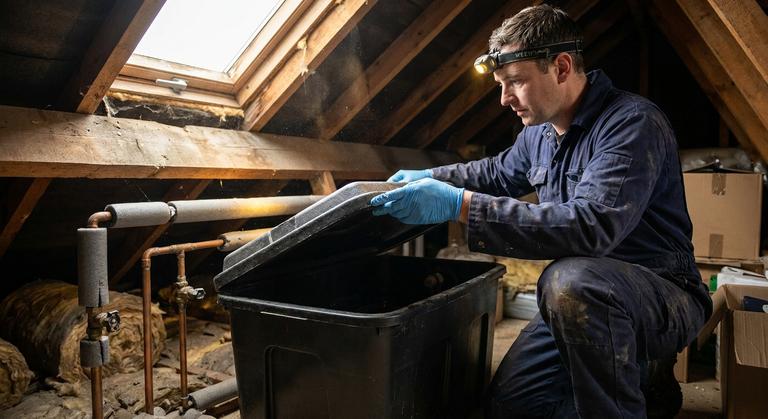
- Keep cold water storage tanks lidded, insulated, screened against vermin and free of debris
- Descale and disinfect showerheads, and replace tired shower hoses on a sensible cycle
- Flush infrequently used outlets long enough to draw genuinely fresh water through
- Fit and service thermostatic mixing valves where scalding is a real concern, remembering that a TMV creates a warm blended section which needs its own attention
Voids, re-lets and refurbishments
Voids are where most residential legionella risk is created. A flat standing empty for weeks with warm, stagnant water sitting in the cylinder and pipework is the textbook growth condition, and the next tenant's first act is usually to take a hot shower.
Build flushing into the void process: run all outlets weekly during the void where access allows, and always flush thoroughly before check-in, starting with the shower with the head removed or bagged to limit spray. After a refurbishment, flush again and, where the system has been extensively altered or left full and unused, arrange disinfection before handover. Record all of it. If a case is ever investigated, the void log is the document that matters.
What to tell tenants
Tenants run the system day to day, so brief them at check-in and put it in writing:
- Do not turn the hot water thermostat below the setting we have left it at
- After a holiday, run taps and showers for a few minutes with the room ventilated, standing clear of the spray
- Descale the showerhead periodically, or tell us and we will arrange it
- Report discoloured water, debris, or hot water that never gets properly hot
Booking assessments without the cold-call premium
The practical answer for a managed portfolio is to split the stock. Simple mains-fed homes get a competent in-house assessment recorded on file. Anything with storage, sharing or vulnerable occupants gets a specialist and a written scheme of control. That single split usually strips out most of the recurring spend while improving the assessments that genuinely count.
When you do need a specialist, put the job out properly. You can create a PlanaJob account and raise a legionella risk assessment as a job in minutes, attaching building type, system details and access arrangements so the quotes come back comparable rather than caveated. If you manage across several sites, our property manager guide covers batching compliance work into single contractor visits, and there is more on UK lettings compliance across the PlanaJob blog.
FAQ
Is a legionella certificate a legal requirement for UK landlords?
No. The legal duty is to assess and control the risk, not to hold a certificate. The HSE has confirmed there is no recognised legionella test certificate for domestic rented property. A dated, property-specific written risk assessment plus evidence that you acted on its findings is what demonstrates compliance.
How often should a legionella risk assessment be reviewed?
There is no statutory interval. Review it when something changes: a new cylinder or boiler, altered pipework, a long void, a change in who occupies the property, or any fault suggesting the controls are not holding. Many agents diary a light-touch review alongside the annual gas safety visit simply because someone competent is already on site.
Do I need to test the water for legionella in a rental property?
Rarely. Sampling is not required in typical domestic lets and the HSE does not expect it. It is justified in higher-risk settings: communal systems where control measures are not being met, buildings serving clinically vulnerable occupants, or following a suspected case. If a provider recommends sampling, ask why, and check the laboratory is UKAS accredited.