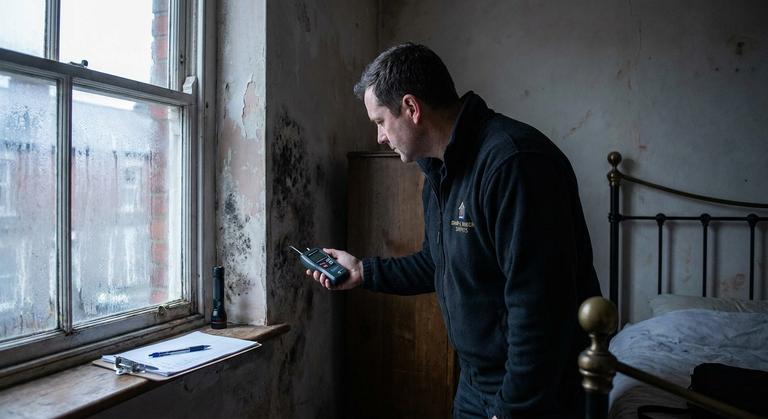
Damp and mould has stopped being a seasonal grumble and become one of the sharpest compliance risks in UK lettings. Landlord responsibility for damp and mould now rests on four overlapping regimes - repairing covenants, fitness for human habitation, HHSRS hazard ratings and a new set of statutory response timescales - and every one of them assumes you can prove what you did and when. Sending someone to wipe down a bedroom wall and hoping the complaint goes quiet is no longer defensible. You need a diagnosis, a dated record, and a repair that removes the cause rather than the stain.
Landlord Responsibility: Damp and Mould Duties in 2026
There is no single "damp law". Four separate regimes bite at once, and a well-run managing agent tracks all of them.
The repairing obligation
Section 11 of the Landlord and Tenant Act 1985 puts the structure and exterior of the property, plus the installations for water, gas, electricity, sanitation, space heating and water heating, squarely on the landlord. Penetrating damp from a blocked gutter, cracked render, perished pointing or a failed window seal is straightforward disrepair, as is damp from a leaking waste pipe. The historic gap was pure condensation: where there was no underlying disrepair, section 11 often did not reach it. That gap is what the next regime closed.
Fitness for human habitation
The Homes (Fitness for Human Habitation) Act 2018 implies a term into tenancies in England that the dwelling is fit for human habitation at the start of the term and throughout it. Freedom from damp is one of the listed matters. Crucially, the tenant can bring a claim directly for works and damages without waiting for the council to act, and the duty reaches condensation-driven mould caused by the design or condition of the building.
HHSRS and local authority enforcement
Under the Housing Act 2004, environmental health officers assess hazards using the Housing Health and Safety Rating System, and damp and mould growth is a prescribed hazard. Where the assessment produces a Category 1 hazard, the council has a duty to act: improvement notice, hazard awareness notice, prohibition order or emergency remedial action. Notices carry appeal rights, but they also carry consequences - civil penalties, prosecution, exposure to rent repayment orders, and restrictions on serving certain possession notices while a notice is live.
Awaab's Law and the timescale regime
The Social Housing (Regulation) Act 2023 introduced Awaab's Law for social landlords, phased in from late 2025. It converts a vague duty to repair into a clock: report received, investigation within a defined window, written findings issued to the resident, works begun within a set period, emergency hazards handled far faster, and alternative accommodation where a home cannot be made safe in time. The Renters' Rights Act 2025 provides the power to extend equivalent duties to the private rented sector, with the detailed timescales set by regulations and introduced in phases. If you manage private stock, the sensible planning assumption for 2026 is that a comparable clock is coming, and that adopting it early costs far less than retrofitting it under enforcement.
The devolved picture
Landlord responsibility for damp and mould is not uniform across the UK, and agents managing across borders get caught out here:
- England - section 11, the 2018 fitness Act, HHSRS enforcement, and the Awaab's Law and Renters' Rights framework above.
- Wales - the Renting Homes (Wales) Act 2016 governs occupation contracts with contract-holders rather than tenants, with fitness for human habitation regulations setting the standard.
- Scotland - the Repairing Standard under the Housing (Scotland) Act 2006 applies from the start of the tenancy and throughout, enforced by the First-tier Tribunal (Housing and Property Chamber) via a Repairing Standard Enforcement Order.
- Northern Ireland - the fitness standard sits in Northern Ireland housing legislation, updated by the Private Tenancies Act (Northern Ireland) 2022.
Check the regime for the property's jurisdiction, not the one your head office sits in.
The "tenant lifestyle" defence is finished
Government guidance for landlords is unambiguous that damp and mould should not be treated as the occupier's fault by default, and ombudsman decisions have repeatedly criticised landlords who answered a mould report with a leaflet about opening windows. Occupant behaviour can contribute - washing dried on radiators, taped-over trickle vents, a wardrobe pressed against a cold external wall - but the building's ability to cope with normal occupation is the landlord's problem. If the bathroom extract is a token unit from the 1970s, if there is no background ventilation, or if heating is so expensive the household rations it, the property is failing, not the tenant. Give advice alongside the works, never instead of them, and never in writing that reads as blame. Those letters get quoted back at you.
Diagnose before you dispatch
Most repeat callouts happen because someone treated the symptom. Train your team to categorise before instructing:
- Condensation and surface mould - black speckling in corners, on window reveals and behind furniture on cold external walls, worse in winter, concentrated in bathrooms and bedrooms.
- Penetrating damp - a localised patch that maps to an external defect and worsens after heavy rain. Check gutters, downpipes, flashing, render cracks, pointing and window seals.
- Rising damp - a tide mark roughly a metre up a ground floor wall with salt deposits. Far rarer than the firms selling chemical injection suggest.
- Escape of water - sudden onset with no seasonal pattern, often a slow leak beneath a bath, shower tray or concealed pipe.
- Retrofit or construction moisture - new builds still drying, or interstitial condensation after insulation was added without addressing ventilation and thermal bridging.
Where the cause is not obvious, commission an independent damp survey rather than a free inspection from a company whose revenue depends on finding rising damp. Meter readings, thermal imaging and a data logger left in place across a fortnight of normal occupation produce evidence that holds up later.
A repeatable response process
- Log the report the moment it lands: date, time, channel and the tenant's own words, with their photos attached.
- Triage for vulnerability and severity. Infants, older residents and anyone with respiratory or immune conditions escalate the urgency immediately.
- Inspect within a fixed internal window rather than waiting until someone is "in the area".
- Diagnose the cause. "Mould present" is not a diagnosis and will not defend you.
- Write to the tenant with the findings, the planned works and the dates, then file the letter.
- Instruct works in the right order: fix the cause, make good, then treat and redecorate.
- Verify on completion with a return visit, fresh readings, photographs and tenant confirmation.
- Diarise a check during the following heating season, because that is when a failed fix reappears.
Building this into your standard operating procedure is the highest-value change most agencies can make, and it is how we frame compliance workflows for property managers.
Scoping works that actually hold
Damp remediation sits awkwardly across trades. A proper job may need a roofer, a plasterer, an electrician for a continuous-running extract fan or positive input ventilation unit, and a decorator, sequenced so internal finishes go on after the fabric has dried. Contractors who specialise in this work swap specification detail in trade communities such as Contractor Club, and the commercial side of pricing remedial packages properly gets picked over on Construction Arbitrage. The cheapest damp quote is often the most expensive, because a mould wash and a coat of anti-condensation paint buys you a few months. Platforms like PlanaJob let property managers put a properly scoped damp job in front of vetted contractors and compare quotes side by side, which makes it easier to tell the quote that has priced the cause from the one that has priced the paint.
Evidence repair timelines in PlanaJob
Whether the challenge arrives as a disrepair claim, an improvement notice, an ombudsman complaint or a future Awaab's Law-style investigation, the defence is identical: an unbroken, dated chain from first report to verified fix. Reconstructing that from inboxes, WhatsApp threads and a spreadsheet two years after the event is where good landlords lose winnable cases. Raising damp and mould jobs through a platform timestamps each stage automatically - when the job was raised, when a contractor accepted, when they attended, the site photos, the invoice and the follow-up - so your repair timeline is a record rather than a recollection. To get that audit trail from your next job onwards, set up an account and route damp reports through it as standard. More compliance walkthroughs for UK agents sit on the PlanaJob blog.
FAQ
Is damp and mould always the landlord's responsibility?
Not automatically, but the presumption runs that way. Where damp stems from disrepair, from the design or condition of the building, or from inadequate ventilation, heating or insulation, landlord responsibility for damp and mould is clear. Where genuine tenant-caused damage is the sole cause, such as a deliberately disconnected extract fan, the position differs - but you would need dated evidence of the cause and of the advice you gave. Assume the duty is yours until a properly evidenced survey says otherwise.
Do Awaab's Law timescales apply to private landlords in 2026?
Awaab's Law began in the social rented sector under the Social Housing (Regulation) Act 2023. The Renters' Rights Act 2025 provides the mechanism to extend equivalent duties to the private rented sector, with the specific timescales and phasing set out in regulations. Rather than waiting on commencement dates, adopt fixed internal service levels now for investigation, written findings and starting works.
What records should I keep to defend a damp and mould complaint?
The original report with its date and the tenant's own wording, your triage and vulnerability assessment, inspection notes and photographs, the diagnosis or survey, the letter to the tenant setting out findings and dates, the contractor instruction and scope, evidence of attendance and completion, and a post-works verification plus a follow-up in the next heating season. Keep them attached to the job, not scattered across individual mailboxes.