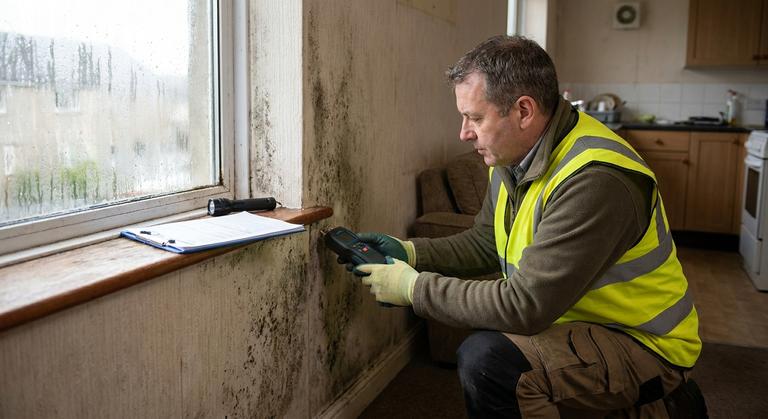
A tenant emails you a photo of black spotting creeping up the bedroom wall behind a dresser, and suddenly you are not looking at a routine maintenance ticket - you are looking at a potential habitability claim. Landlord mold laws in the United States are a patchwork: there is no single federal standard, only a handful of states have mold-specific statutes, and everywhere else liability flows through the implied warranty of habitability and ordinary negligence. That patchwork is exactly why mold catches experienced property managers off guard. This guide walks through what the law actually requires, where liability really comes from, and how to run a remediation that holds up if the dispute ever reaches a courtroom.
Why There Is No Federal Mold Standard
Start with the fact that surprises most owners: no federal law sets a permissible level of mold in residential housing. The EPA publishes guidance on mold cleanup and moisture control, and OSHA addresses workplace exposure, but neither creates an enforceable standard for rental units. There is no federal number a property can pass or fail.
The practical consequence is that mold disputes are decided by state statutes, local housing codes, and court decisions - not by a lab report alone. A test showing spores in the air proves very little by itself, because mold spores exist in virtually every building. What matters legally is visible growth, active moisture, the tenant's complaints, and how you responded. Keep that framing in mind, because it shapes every decision that follows.
How Landlord Mold Laws Vary by State
Because there is no federal baseline, landlord mold laws differ meaningfully depending on where your portfolio sits. Broadly, state approaches fall into three buckets, and a single property can be covered by all three at once.
Disclosure requirements
Some states require landlords to disclose known mold conditions to prospective tenants, with California being the best-known example. Where disclosure rules apply, the danger zone is a unit with a mold history that gets re-rented without a word. If you remediated properly and can document it, disclosure is usually straightforward - it is the undocumented paint-over that turns into a misrepresentation claim.
Licensing for mold professionals
A number of states, including Texas, Florida, Louisiana, and New York, license mold assessors and remediators, and several of them separate the two roles so the company that finds the problem is not the company paid to fix it. If your state licenses these trades, hiring an unlicensed handyman for a significant job can undercut your legal position even if the work itself was decent. Always check current licensing rules for the state where the property sits before awarding the work.
Habitability everywhere else
Even in states with no mold-specific statute, nearly every state recognizes an implied warranty of habitability. Mold caused by a leaking roof, failed plumbing, or chronic building moisture can render a unit legally uninhabitable. Depending on the state, tenants may be able to repair and deduct, withhold rent, break the lease under a constructive eviction theory, or raise the condition as a defense to eviction. Cities layer on their own rules too - New York City, for example, has indoor allergen requirements that put affirmative inspection and remediation duties on residential landlords. Local code always deserves a check before you assume state law is the whole story.
Where Landlord Liability Actually Comes From
Here is the part that should genuinely change how you run your maintenance desk: under most landlord mold laws and the case law around them, liability rarely turns on the mold itself. It turns on notice and response. The classic negligence claim is that you knew, or reasonably should have known, about a moisture problem and failed to act within a reasonable time.
The fact patterns that show up again and again in mold disputes look like this:
- A tenant reports a leak under the kitchen sink, the ticket sits for weeks, and mold blooms inside the cabinet.
- Recurring condensation complaints get dismissed as a "lifestyle issue" with no inspection, no dehumidifier, no ventilation check.
- Maintenance paints over visible growth without fixing the water source, and the stain returns within a month - now with a paper trail proving you knew.
- Text messages and portal tickets document a slow, dismissive response, which becomes the exhibit list in the tenant's demand letter.
Tenant-caused moisture is a real defense - drying laundry indoors, blocking vents, never running the bathroom fan - but it only works if your lease spells out ventilation and reporting duties and you can show the building side of the equation was sound. In practice, the landlords who lose mold cases are almost never the ones with mold; they are the ones with mold and a documented history of ignoring it.
Remediation Requirements: What a Defensible Response Looks Like
Most states do not prescribe a step-by-step remediation protocol for rentals, so the standard you will be judged against is reasonableness plus any licensing rules that apply. A defensible response runs like this:
- Acknowledge in writing within 24-48 hours. Speed of acknowledgment is the cheapest liability protection available to you.
- Inspect for the moisture source, not just the stain. Mold is a symptom. Roof, plumbing, grading, gutters, HVAC condensate, and ventilation are the disease.
- Stop the water first. Remediating growth while the leak continues guarantees a repeat complaint and makes the first invoice look like negligence.
- Size the job honestly. EPA guidance suggests that areas beyond roughly ten square feet warrant professional remediation rather than a wipe-down by maintenance staff. Small, contained patches on non-porous surfaces are a different animal from growth inside wall cavities.
- Use qualified pros for anything significant. Look for state licensing where required, and for credentials tied to recognized industry standards such as the IICRC S520 for mold remediation.
- Insist on containment and proper disposal. Cutting out moldy drywall without containment spreads spores through the HVAC system and can turn one bad room into a whole-unit problem.
- Get post-remediation verification. In licensing states this may need to come from an independent assessor. Everywhere else, a written clearance report is still the document that ends arguments.
Relocating the tenant during work is not automatically required in most places, but for multi-day jobs involving containment it is often the pragmatic call - a few nights of hotel cost is cheap compared to a claim that you left a family living inside a containment zone.
If you are on the contractor side of this trade rather than the property side, pricing and structuring remediation work profitably is its own discipline - the construction business strategy pieces at Construction Arbitrage are worth a read before you bid your next restoration job.
Documentation That Protects You
When a mold dispute escalates, the file wins or loses the case. For every complaint, keep:
- Date-stamped photos of the affected area before and after work
- Moisture meter readings, if your team or contractor takes them
- Every written communication with the tenant, including acknowledgment times
- Contractor credentials, scope of work, and invoices
- The clearance or post-remediation report
This is also where choosing contractors carefully pays off twice: once in the quality of the work, and again in the quality of the paperwork. Platforms like PlanaJob let property managers compare quotes from vetted contractors and keep the job history in one place, which is exactly the kind of record a habitability dispute demands. There are more compliance walkthroughs like this one on the PlanaJob blog, and a rundown of how the platform works for portfolios at our property managers page.
The honest summary of landlord mold laws is this: the law forgives buildings that get wet, because all buildings eventually do. It does not forgive slow, undocumented responses. Build the response system before the next complaint lands - create a free PlanaJob account and connect with certified mold remediation pros now, so the gap between a tenant's photo and a professional on site is measured in days, not weeks. That gap is usually the difference between a maintenance invoice and a lawsuit.
FAQ
Is a landlord always liable when mold appears in a rental?
No. Liability generally requires that the landlord knew or should have known about the moisture problem and failed to respond reasonably. Mold caused by tenant behavior, promptly reported and promptly fixed, rarely creates liability. The danger is delay: the longer a documented complaint sits, the stronger the tenant's claim becomes under most landlord mold laws.
Do I have to hire a licensed mold remediation company?
It depends on the state. Texas, Florida, Louisiana, New York, and others license mold assessors and remediators, and some require the assessment and remediation to be done by separate firms. In states without licensing, you are judged on reasonableness - which in practice means using contractors who follow recognized standards and provide written clearance documentation.
Can a tenant withhold rent because of mold?
In many states, yes, if the mold is serious enough to breach the implied warranty of habitability and the tenant has followed that state's notice procedure. Remedies such as rent withholding, repair and deduct, and lease termination vary significantly by state, so check the specific rules where the property is located rather than assuming one state's playbook applies everywhere.