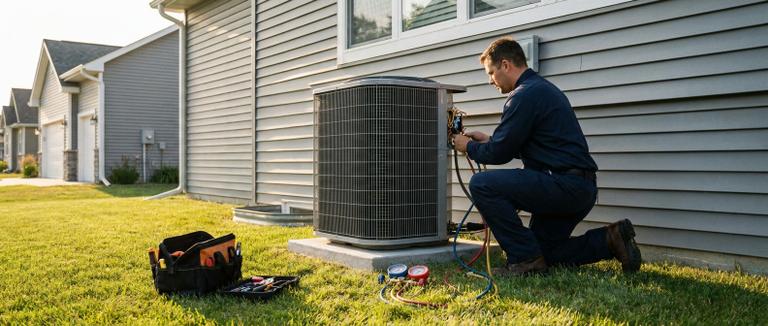
A full system replacement is one of the largest single checks a property manager approves, and 2026 is a tricky year to write it. The refrigerant transition that began in 2025 pushed equipment prices up, skilled labor is still tight in most metros, and bids for the same job can differ by thousands of dollars. This guide breaks down HVAC replacement cost in the United States for 2026: realistic planning ranges, the factors that genuinely move the number, when a repair still makes sense on a rental, and how to collect quotes you can defend to an owner.
What Does HVAC Replacement Cost in 2026?
There is no single national HVAC replacement cost, but widely published cost surveys converge on useful planning ranges. Treat these as budgeting anchors, not promises - your market, the building, and the scope will move them in both directions.
- Full system replacement (condenser plus furnace or air handler): roughly $5,000 to $12,500 for a typical single-family home, with high-efficiency equipment or awkward installs running well past that.
- Central air conditioner only: commonly $4,000 to $8,000 installed.
- Gas furnace only: often $3,000 to $7,500, depending on efficiency tier and venting requirements.
- Air-source heat pump: frequently $4,500 to $10,000, with cold-climate models at the top of the range or above it.
- Ductless mini-split: a few thousand dollars for a single zone, well past $10,000 for multi-zone setups.
- Ductwork replacement or major repair: can add several thousand dollars and push a whole-project total beyond $15,000.
Multi-family is its own world. Packaged rooftop units, PTACs, and shared systems price differently, and portfolio volume gives you negotiating leverage no single homeowner has. More on using that leverage below.
Why 2026 bids are higher than your last replacement
Two structural changes explain most of the sticker shock. First, newly manufactured residential air conditioners and heat pumps now use lower-global-warming-potential refrigerants such as R-454B and R-32 instead of R-410A, a transition that took effect in 2025. Manufacturers redesigned entire product lines and raised list prices along the way. Second, the SEER2 efficiency standards that took effect in 2023 lifted the minimum efficiency floor, removing the cheapest builder-grade equipment from the market. Add ordinary labor and materials inflation and you get the biggest jump in HVAC replacement cost most property managers have seen in a decade.
The Cost Drivers That Actually Move the Number
Two nearly identical houses can come back with wildly different bids. These are the variables doing the work.
System type and fuel
A like-for-like swap of a gas furnace and AC is usually the cheapest path. Converting to a heat pump, switching fuel types, or adding zones means electrical work, sometimes a panel upgrade, and more labor hours.
Sizing and the Manual J load calculation
Good contractors size equipment with a Manual J load calculation based on the building envelope, not by copying the nameplate on the dying unit. Oversized systems short-cycle and die early; undersized ones run flat out and never quite cool. If a bidder quotes tonnage without asking about insulation, windows, or square footage, treat the number with suspicion.
Ductwork condition
Leaky, crushed, or undersized ducts quietly destroy the efficiency you are paying for. Duct problems are the most common source of surprise cost on older rentals, so ask every bidder to inspect and price the ductwork explicitly rather than discovering it on install day.
Labor, access, and region
Attic air handlers, crawl-space furnaces, rooftop condensers that need a crane - access drives hours, and hours drive cost. Dense coastal metros typically price well above rural markets for identical scope, and permit fees vary by municipality.
Efficiency tier and features
Every step above the SEER2 minimum - variable-speed compressors, communicating thermostats, cold-climate heat pump performance - adds cost. For rentals, mid-tier equipment usually hits the sweet spot: real utility savings for tenants without paying for features nobody asked for.
Repair or Replace: The Math for Rental Properties
The old industry rule of thumb still works as a first filter: multiply the age of the system in years by the repair estimate in dollars, and if the result tops $5,000, replacement usually wins. A $600 repair on a 12-year-old condenser fails that test. The same repair on a 5-year-old unit passes easily.
Two 2026-specific factors tilt the math further toward replacement on older systems. R-410A is being phased down, so refrigerant-related repairs on existing equipment keep getting more expensive. And a system in its mid-teens will probably fail again in peak season, when emergency rates apply and tenants have the least patience.
That tenant dimension matters more for you than for a homeowner. Nearly every state treats working heat as a basic habitability requirement for rentals, and a growing number of cities now treat cooling the same way in summer. A dead system is not just an expense, it is a compliance clock. When a repair bill approaches half of the likely HVAC replacement cost, experienced managers stop patching.
How Property Managers Get Better HVAC Replacement Quotes
The spread between the highest and lowest bid on the same job is often wider than the price of any equipment upgrade you are debating, which makes the quote process itself your highest-leverage move.
- Get at least three bids, every time. A single quote tells you nothing. On a five-figure job, the spread routinely repays the time spent collecting comparisons many times over.
- Require a Manual J load calculation. If the sizing is guessed, everything downstream of it is guessed too.
- Demand an itemized scope: exact equipment model numbers, refrigerant type, permit costs, old-unit disposal, thermostat, labor and parts warranty terms, and who files any rebate paperwork.
- Time the work if you can. A planned shoulder-season replacement in spring or fall gets sharper pricing and better scheduling than a July emergency ever will.
- Confirm who stands behind the warranty. HVAC has consolidated fast and local firms change hands regularly - there is an entire marketplace at Contractor Exit for buying and selling trade businesses. Make sure the company on your quote is the one doing the install and honoring the warranty in year five.
- Understand how the bid was built. Overhead and margin structures differ enormously between a two-van shop and a private-equity-backed brand, which is why identical scopes come back thousands of dollars apart. Construction Arbitrage covers how contractor businesses price their work, if you want to see the other side of the table.
Across a portfolio, the bigger win is planning. Track system ages, schedule replacements before they become emergencies, and bundle jobs across properties to negotiate volume pricing. Handled that way, HVAC replacement cost turns from a series of nasty surprises into a predictable capital line. Platforms like PlanaJob make the comparison step easier too: post the job once and compare quotes from vetted HVAC contractors side by side instead of chasing callbacks - here is how it works for property managers.
Before you sign anything this year, slow the process down by a week. Collect three itemized bids, check the Manual J, and compare quotes from vetted HVAC contractors on PlanaJob rather than taking the first number that lands in your inbox - posting a job is free. If you are budgeting the rest of the year, the PlanaJob blog has more US cost guides in this series.
FAQ
How long does a full HVAC replacement take?
A straightforward like-for-like swap usually takes one to three days on site. Ductwork replacement, an electrical panel upgrade, or a fuel conversion can stretch the job to a week or more. Get the schedule in writing so you can give tenants proper notice of entry under your state's rules.
Can I replace the air conditioner and keep the existing furnace?
Sometimes, but it is getting harder. The indoor coil and outdoor condenser must be matched for the lower-GWP refrigerants introduced in 2025, so pairing a new condenser with an aging coil is often impossible or voids the manufacturer warranty. If the furnace is close to the condenser in age, replacing both in one visit is usually cheaper than paying for two separate labor events a few years apart.
Are there rebates or tax credits for HVAC replacement in 2026?
The long-running federal energy-efficiency tax credit many owners used for heat pumps expired for equipment placed in service after the end of 2025, so do not build a budget around it without checking current rules. Utility rebates and state-level programs still exist and vary widely - ask each bidder what applies locally, since good contractors handle that paperwork routinely.