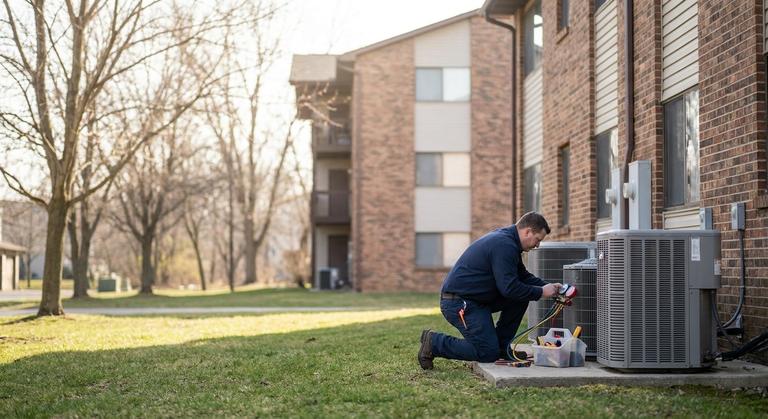
The two most expensive HVAC calls a property manager takes are the one on the first 95-degree afternoon in July and the one on the first hard freeze in January. Most of them were preventable. A real HVAC preventive maintenance checklist, run twice a year in spring before the cooling season and in fall before the heating season, catches the weak capacitor, the sludged condensate line and the cracked heat exchanger while there is still time to book a normal repair instead of paying emergency pricing with a tenant on the phone. Below is what actually belongs on that list, when to schedule each visit, and how to keep the program running across a portfolio without chasing vendors every quarter.
Why Two Visits, Not One
Most residential and light commercial systems do two different jobs with two different failure modes. Cooling stresses the compressor, the run capacitor, the condenser coil and the condensate drain. Heating stresses the heat exchanger, the ignitor, the flame sensor and the venting. A single annual tune-up always lands in one season and leaves the other half of the equipment unverified for another twelve months. That is why a two-visit HVAC preventive maintenance checklist beats one long visit, even if the total labor hours are similar.
There is a paperwork reason too. Manufacturers commonly require documented annual maintenance to honor parts warranties on compressors and heat exchangers. When a five-year-old compressor fails and you are trying to get the part covered, a dated service report with actual readings is the difference between a parts claim and a full system quote.
Heat pumps make the case stronger. They run in both seasons, so reversing valves, defrost boards and auxiliary heat strips need eyes on them twice a year regardless of climate zone.
The Spring HVAC Preventive Maintenance Checklist
The goal of the spring visit is simple: the system delivers full capacity on the hottest day, drains water where it is supposed to, and does not trip a breaker at 4pm.
Outdoor condenser or heat pump
- Wash the condenser coil from the inside out with a proper coil cleaner, not a pressure washer that folds the fins flat
- Comb bent fins and restore the clearance the manufacturer calls for around the unit, which landscaping usually swallows over a summer
- Inspect the contactor for pitting and burning; it is a cheap part that strands a unit during the worst week of the year
- Test the run capacitor against its rated microfarads and replace anything drifting out of tolerance rather than waiting for it to fail
- Measure compressor and condenser fan amp draw against the nameplate
- Verify refrigerant charge by superheat or subcooling, not by touch
- Check the disconnect, whip, service valves and equipment pad for corrosion, settling and rodent damage
Indoor air handler and evaporator
- Inspect the evaporator coil for dust mat and biofilm; a dirty coil mimics low charge and gets misdiagnosed constantly
- Flush the condensate line, clean the pan, and confirm the trap holds water
- Lift the float switch to test it, because if the unit does not shut down, the next clog becomes a drywall claim
- Replace the filter and record the size and MERV rating in the service report
- Check blower wheel cleanliness, and belt condition on belt-driven equipment
- Measure total external static pressure; high static quietly destroys blower motors and coils
Controls and thermostats
- Verify thermostat calibration and correct staging
- Replace thermostat batteries as routine, not on request
- Confirm smart thermostat schedules and setpoint limits survived the last tenant
One habit worth enforcing across a portfolio: have the technician log the supply air temperature split (return minus supply) on every unit, every spring. On a properly charged system it typically sits in the high teens to low twenties Fahrenheit. Watching that number narrow year over year is the cheapest early warning you will ever get, and it flags problems months before anyone calls in a complaint.
The Fall Half: Heating Season Prep
The fall side of your HVAC preventive maintenance checklist is where the safety items live. Treat it as non-negotiable.
Gas-fired furnaces
- Inspect the heat exchanger visually and confirm with a combustion analyzer or CO test in the supply stream
- Clean the burners and flame sensor, and check ignitor resistance
- Verify manifold gas pressure against the rating plate
- Inspect the flue, vent connectors and combustion air openings for blockage, disconnection or back-drafting
- Test the inducer motor, pressure switch, limit switch and rollout switches
- Clear the condensate drain and check the neutralizer on high-efficiency condensing furnaces
Heat pumps and electric heat
- Operate the reversing valve in both modes and listen for a valve that is slow or stuck mid-shift
- Verify defrost initiation and termination rather than assuming the board is fine
- Confirm auxiliary heat strips energize in stages and lock out correctly; check sequencers and relays
- Measure amp draw on each strip, because a dead element shows up as a January utility bill dispute, not a no-heat call
- Check that the outdoor unit sits above grade with drainage; a heat pump standing in an ice puddle will fail
Life safety
- Test CO alarms in any unit with fuel-burning appliances; requirements vary by state and locality, and battery-only units get disabled by tenants
- Confirm smoke alarm placement was not compromised by recent duct or vent work
- Check gas shutoff valve access and the condition of appliance connectors
Anyone opening a refrigerant circuit needs EPA Section 608 certification, and HVAC licensing rules vary by state and sometimes by city. Verify both before a technician touches your equipment, and keep copies on file. It also pays to note which of your systems still run older refrigerant, since the industry transition to A2L refrigerants is changing what a service call looks like on aging equipment. That belongs in your capital plan, not in a panic email in August.
Timing: Book Off-Peak or Don't Bother
The scheduling window matters more than most property managers expect. Complete spring visits between late February and mid-April, and fall visits between mid-September and the end of October. Once the first heat wave or cold snap hits, every competent contractor in your market is running emergency calls, and your scheduled maintenance turns into a two-week wait. Off-peak booking also gets you better pricing and, frankly, better technicians, because the company is not triaging.
Spread the HVAC preventive maintenance checklist across your turnover calendar as well. If a unit turns in March, fold the spring service into the turn while it is vacant. No tenant coordination, no access refusals, no one home. Vacant-unit service is the fastest and cheapest visit you will ever buy.
Getting the Program Contracted Properly
Attach the checklist to the agreement as an exhibit. Vague scope is how you end up paying twice for the same visit. Require the following:
- A written task list per visit, per equipment type, that matches the seasonal scope above
- A clear split between included consumables (filters, belts, batteries) and billable parts
- A per-unit report with actual readings, not a line that says "serviced, OK"
- Photos of coil condition, filter condition and any deficiency found
- Named response time commitments and a published after-hours rate schedule
- Proof of state license, EPA 608 certification, general liability and workers compensation
- A repair approval threshold, so small fixes happen on the spot instead of generating a second trip charge
When you re-tender the work, compare like-for-like scopes rather than raw hourly rates. Platforms like PlanaJob let property managers compare quotes from vetted contractors against the same defined scope, so you can see what is genuinely included instead of guessing. If you manage multiple sites, keeping properties, quotes and service history in one place is the point of tools built for US property managers.
One more practical note: HVAC service companies change hands more often than owners realize, and there is an active market for buying and selling trade businesses. Anchor your program to documentation you own rather than a relationship with one owner, so a sale does not reset your maintenance history to zero.
Make It Recurring, Not Remembered
The failure point of most maintenance programs is not the checklist, it is the calendar. An excellent HVAC preventive maintenance checklist that nobody schedules in February is worth nothing in July. Put the two visits on a recurring cycle tied to each property, with a named owner and a deadline that lands before the season starts.
Set biannual HVAC tune-ups on autopilot with PlanaJob's recurring bookings: define the scope once, set your spring and fall windows per property, and the job goes out to vetted contractors on schedule without anyone having to remember. Create an account and load your properties, then work through the seasonal playbooks on the blog for the rest of your maintenance calendar. If you want a sense of how contractors actually price recurring maintenance work, the analysis at Construction Arbitrage is a useful view from the other side of the table.
FAQ
How often should HVAC preventive maintenance be done on rental properties?
Twice a year for anything that both heats and cools: once in spring for the cooling side and once in fall for the heating side. Heat pumps and any gas-fired equipment should never go longer, because both seasons stress different components. Rooftop units on commercial buildings and systems in coastal or high-dust environments often justify quarterly filter service between the two full visits.
Can maintenance staff handle any of this in-house?
Yes, and they should. Filter changes, condensate line flushing with a shop vac, clearing landscaping from around condensers, replacing thermostat batteries and visual checks of drain pans are all reasonable in-house tasks that reduce emergency calls. Anything involving refrigerant, gas pressure, combustion, heat exchangers or electrical diagnosis needs a licensed technician with EPA 608 certification.
Is a maintenance agreement cheaper than paying per visit?
It depends less on the headline price than on the terms. The real value in an agreement is usually priority scheduling during peak season, a discounted repair rate and consistent documentation for warranty claims. Compare the annual agreement price against two off-peak per-visit calls, then weigh what the priority response is worth to you in the middle of a heat wave. For a small portfolio, per-visit pricing booked early often wins; for anything with fuel-burning equipment across multiple sites, the documentation and response terms usually justify the agreement.