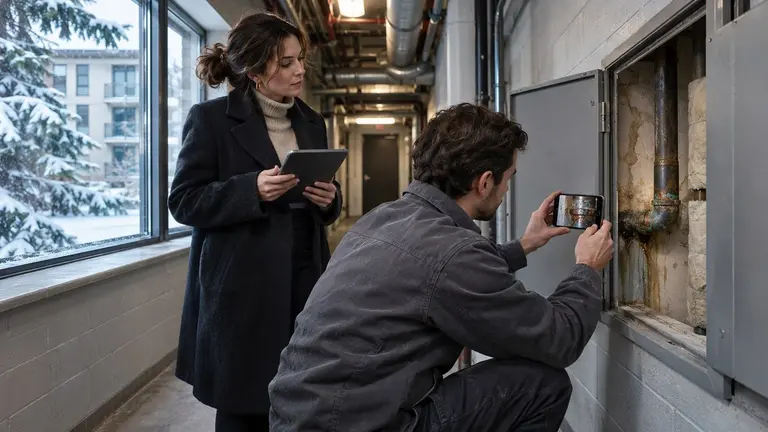
Recurring condo repair faults get fixed for good when every visit is recorded against one fault record, with the same location, the same symptom wording and dated evidence each time. If each callback sits in its own work order, nobody sees the pattern. The fourth plumber starts from zero, and the board pays for the same patch again.
The method is simple. Create one record per fault, link every visit to it, capture the same details each time, and review the open records on a schedule. The rest of this guide shows how to do that in a condo building, where a fault can cross units, common elements and several contractors.
What counts as a recurring fault
A fault is recurring when the same problem comes back after a repair that was meant to fix it. In a condo, that usually looks like one of these:
- The same symptom in the same place, such as a ceiling stain that returns in one unit.
- The same symptom in a vertical stack, such as leaks in the 04 units on several floors.
- The same equipment failing in different ways, such as a garage door that jams, then trips, then will not close.
- A seasonal return, such as ice build-up at one entrance every winter or a balcony door that leaks in driving rain.
The last two are the easiest to miss. The symptom changes or the gap between visits is long, so each call looks new.
Decide your own trigger and write it down. Many teams treat a second callback for the same symptom in the same location as the point to open a fault record. There is no universal number. What matters is that everyone uses the same rule.
Set up one fault record, not a pile of work orders
Work orders record visits. A fault record records the problem. You need both, and each work order should point to the fault it belongs to.
Fix the location first
Vague locations hide patterns. A note that says 12th floor leak cannot be matched to anything.
Record the location in a fixed format every time:
- Building and floor.
- Unit number, or the named common element, such as the P1 garage ramp or the east stairwell.
- Room and surface, such as main bathroom ceiling above the tub.
- The riser, stack or equipment tag if you know it.
In a condo, the stack matters as much as the unit. Water faults travel down. Heating and ventilation faults often follow a riser. If your records hold the stack, a search shows every related call in seconds.
Describe the symptom, not the guess
Write what was seen, heard or measured. Keep the suspected cause in a separate field.
Brown stain, about 30 cm across, damp to touch, is a symptom. Leaking shower upstairs is a guess. If the guess goes in the symptom field, the next contractor inherits the assumption and may repeat the same failed repair.
Link every visit to the fault
Give the fault record a reference and put it on every related work order, quote and invoice. If your system has no fault reference, use a consistent tag in the job title. A plain spreadsheet works if the team keeps it up.
What to capture at every visit
Ask the contractor or in-house operative to record the same items each time. A short, fixed list gets filled in. A long form does not.
- Date, time and who attended.
- Who reported it and what they said, in their words.
- Conditions at the time, such as heavy rain, a cold snap, or the unit above being occupied or empty.
- What was found, with photos taken from the same position as last time.
- What was tested and the result, including tests that ruled something out.
- What was done, with parts replaced and where.
- What was not done and why, such as no access to the unit above.
- The contractor's view on cause, marked as confirmed or suspected.
- Cost of the visit.
- What should happen next and who needs to decide it.
Items 5 and 7 are the ones most often skipped. They are also the ones that stop the next visit from repeating the last one.
Keep a running total of cost and visits on the fault record. The board will ask for it.
Illustrative example: a stain that keeps coming back
This example is fictional. It shows how the record works, not a real building or result.
A property manager gets a call about a ceiling stain in the bathroom of unit 704. A plumber attends, reseals the tub in unit 804 and closes the job. Three months later, unit 704 calls again. A different plumber attends, finds the seal intact and replaces a drain fitting.
On the second call, the manager opens a fault record. Both visits are linked. The location is logged as the 04 stack, main bathroom. The manager searches older jobs and finds a similar stain reported in unit 604 the year before.
The record now shows three reports in one stack, two repairs that did not hold, and two causes ruled out. It also shows that both recent calls followed heavy use of the unit above, not rain. That is enough to stop patching and ask for an investigation of the stack itself.
No single work order showed that. The fault record did.
Who decides what
A good record supports decisions. It does not make them. Be clear about who owns each one.
- The contractor reports findings and recommends a repair. They should say plainly when a repair is a patch and the cause is still unknown.
- The property manager decides when callbacks become a fault record, keeps it current and brings it to the board with options.
- The board decides on spending for common element repairs, within its own approval rules. The name of the body differs across Canada. It is a condominium corporation in most provinces, a strata corporation in British Columbia and a syndicate of co-owners in Quebec.
- An engineer or other specialist may be needed where the cause is in the building envelope, structure or a central system. Bringing one in is a decision for the manager and board.
One decision needs extra care. Whether a repair falls to the unit owner or the corporation depends on the corporation's governing documents and the condominium legislation in your province. Do not settle that from a work order. Record the facts, then check the documents or ask the corporation's lawyer. The same applies to insurance questions.
Review open faults on a schedule
A record nobody reads is just storage. Set a regular review, monthly for most buildings, and go through every open fault.
For each one, ask three questions. Has it come back since the last repair? Is the next step agreed and assigned? Does the board need to see it?
Close a fault only after it has stayed quiet through the conditions that used to trigger it. A roof leak is not proven fixed until it has been through heavy rain or a thaw.
Where Plan@Job fits
Plan@Job is AI-powered project and operations management for construction and property businesses. Property maintenance is one of its main uses. The UK is its live market. In Canada, property managers can check the current position on the Canada availability page, and maintenance contractors can use the contractor page for Canada.
Where it is live, two parts of the workflow are relevant to repeat faults.
First, job briefs. Sophie Bennett, the AI Enquiries Coordinator, checks existing job briefs for missing information and asks for clarification. If two attempts do not get an answer, the brief is handed to a person. That supports the habit this guide depends on, which is a complete location and symptom before anyone attends.
Second, the lasting repair. Fixing a repeat fault properly is often a staged job, such as investigate, open up, repair and make good. A project plan splits a job into internal stages with scope, dates, status and costs, for subcontracted or in-house delivery. The client sees the overall agreed scope and price and the evidence shared with them. Internal stage costs and subcontractor identity stay internal.
People still make the calls. Deciding that a fault is recurring, choosing the repair, approving the price and awarding the work all stay with you and your board.
Your next step: set your trigger rule this week, open a fault record for the one problem in your building that keeps coming back, and check the Canada availability page if you want to follow Plan@Job's progress in your market.
FAQ
How many callbacks make a fault recurring?
There is no fixed number. Set your own rule and apply it the same way every time. A second callback for the same symptom in the same location is a sensible point to open a fault record, because that is when a pattern first becomes visible.
Should each visit still have its own work order?
Yes. Each visit needs its own record of attendance, findings and cost. The fix is to link them, not merge them. Put the fault reference on every work order, quote and invoice so the full history can be pulled up in one view.
Who pays when a condo fault keeps coming back?
It depends on where the cause sits, what the corporation's governing documents say and the condominium legislation in your province. A clear fault record helps by showing the location, the confirmed cause and the repair history. It does not answer the question on its own. Check the documents and take legal advice where responsibility is disputed.