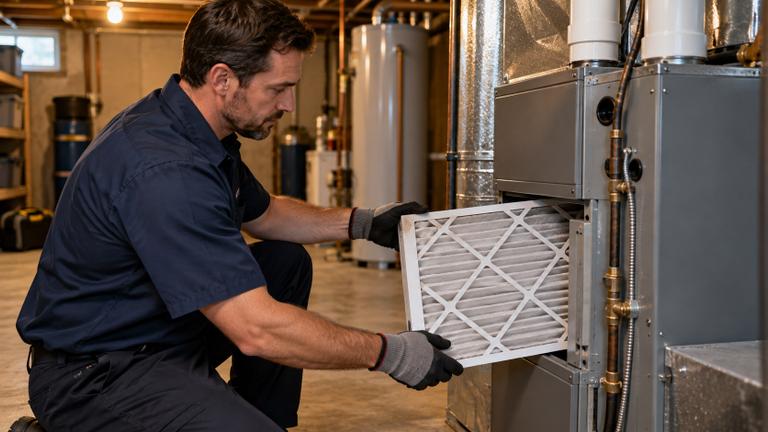
A blower motor that dies in February is almost never a blower motor problem. It is a filter problem nobody caught eight months earlier. That is why a furnace filter MERV rating guide belongs in your maintenance playbook and not in a drawer: the filter is the cheapest component in the entire HVAC system, it is the only part a tenant ever touches, and a clogged one is behind a huge share of the no-heat calls you end up paying overtime to answer. Getting the rating, the schedule, and the lease language right takes one afternoon and buys you years of quieter winters.
A practical furnace filter MERV rating guide
MERV stands for Minimum Efficiency Reporting Value, defined by ASHRAE Standard 52.2. It measures how well a filter captures particles between roughly 0.3 and 10 microns. The scale runs 1 to 16 for anything you will actually buy for a residential furnace. Higher number, smaller particles trapped. That is the whole idea.
The bands that matter in rental housing
- MERV 1 to 4. Flat fiberglass panels. They protect the blower wheel from lint and hair and do essentially nothing for air quality. Very low resistance, very low value.
- MERV 5 to 7. Light pleated media. Catches larger dust, lint, and mold spores. A step up, still not much.
- MERV 8. The workhorse. Pollen, dust, standard household debris, some pet dander. This is the sensible default across most older residential portfolios.
- MERV 11. Finer pet dander, smog particles, fine dust. Worth specifying in pet-friendly buildings or units where you get repeat allergy complaints.
- MERV 13. Smoke particles, bacteria, and the fine aerosols people care about. ASHRAE points to MERV 13 or better for infectious aerosol mitigation where the equipment can handle it. This is also the wildfire-smoke upgrade in the West.
- MERV 14 and up. Commercial territory. Do not put one in a thirty-year-old split system and expect it to survive the season.
MPR and FPR are marketing scales, not MERV
3M prints MPR on its boxes. Home Depot prints FPR. Neither is ASHRAE-defined, and they exist mostly to make comparison shopping harder. Manufacturers publish rough crosswalks, but for your own sanity, write the MERV number on the work order and the purchase spec. A furnace filter MERV rating guide only holds up if everyone in your chain, from the maintenance tech to the supply house, is speaking the same language.
Higher MERV is not automatically better
Every filter creates resistance, and denser media creates more of it. Many residential furnaces are rated for about half an inch of water column of total external static pressure, and a surprising number of real systems already exceed that on ductwork alone before a filter goes in. Drop a dense filter into an undersized return and you get predictable failures:
- Reduced airflow across the heat exchanger, which trips the high limit switch and short cycles the furnace
- Frozen evaporator coil once cooling season arrives
- PSC blower motors quietly losing airflow, and ECM motors ramping up and burning extra watts to compensate
- Dirty coils, because low airflow and bypass air around a poorly seated filter carry dust straight past it
Before you standardize a portfolio on MERV 11 or 13, have a tech measure total external static pressure with a manometer on a representative unit in each building type. That one measurement is worth more than any general recommendation, including this one.
Filter depth changes the math
A one-inch pleated filter has very little media area, so it loads up fast and restricts airflow as it does. A four-inch or five-inch media cabinet folds far more surface into the same face opening, which means a four-inch MERV 13 can breathe better and last longer than a one-inch MERV 11. If you hold the asset long term, converting to a media cabinet at the next furnace replacement is one of the better small capital decisions available to you.
Three details that cause avoidable callbacks: nominal sizes are not actual sizes, so a 16x25x1 measures closer to 15.5 by 24.5 by 0.75. The airflow arrow on the frame points toward the furnace. And if a unit has both a return grille filter and a cabinet filter, run one, not both.
Replacement schedules that survive real tenants
Manufacturer guidance is the starting point, not the answer:
- One-inch fiberglass: roughly monthly
- One-inch pleated, MERV 8 to 11: every 60 to 90 days
- Four-inch or five-inch media, MERV 11 to 13: every 6 to 12 months
- Washable electrostatic: rinse monthly and let it dry completely before reinstalling, since a damp filter feeds mold growth
Shorten every one of those intervals for pets, indoor smoking, high occupancy, nearby construction, heavy pollen or wildfire seasons, dusty climates, and any unit where the thermostat fan is left in the ON position instead of AUTO. Lengthen nothing based on optimism.
What works at portfolio scale is boring and repeatable:
- Inventory filter sizes per building and standardize wherever the equipment allows.
- Set a portfolio default rating: MERV 8 on older or high-static systems, MERV 11 where static pressure has been verified, MERV 13 only on confirmed-capable equipment.
- Buy in case quantities by size so nobody improvises at a hardware store.
- Write the install date on the filter frame in marker at every change.
- Anchor changes to something already on the calendar, like seasonal HVAC service or annual unit inspections.
- Require a photo of the dated filter attached to the closed work order.
Tenant responsibilities: what a lease can actually shift
Nearly every state recognizes an implied warranty of habitability, and functioning heat sits squarely inside it. You can usually assign routine filter changes to a residential tenant, but the clause only holds up when the basics are true: the lease names the duty specifically, the filter is reachable without tools or entry to a locked mechanical room, you specify the size and MERV or supply the filters outright, and your state and local law permit shifting that maintenance obligation. Some jurisdictions limit how much upkeep you can push onto a residential tenant, and some require the landlord to keep HVAC operational no matter what the lease says. Check your state landlord-tenant act before you rely on a chargeback, and note that HUD-assisted units inspected under NSPIRE will be evaluated on whether heating actually works, not on whose turn it was.
Lease language that holds
Spell out the filter size and minimum MERV, the change frequency, who supplies the filters, the right of entry with proper notice to inspect or replace, and the consequence if neglect causes damage, worded to stay inside your state's rules on deposit deductions. Ordinary wear and tear is never chargeable. Documented negligence sometimes is.
Why tenant-only plans fail
Tenants move mid-cycle, buy the wrong size, install the filter backward, or slide a new one in front of the old one. Filter delivery subscriptions help with supply but verify nothing about installation. Treat the lease clause as a backstop and put the actual reliability somewhere you control.
Make filters part of the vendor scope
The cheapest fix is contractual. Add a single line to every HVAC scope of work: replace the return air filter, record size and MERV, photograph the dated frame. Contractors price recurring maintenance work on route density and predictability, a dynamic covered well over at Construction Arbitrage, so bundling filter changes into a seasonal service agreement usually costs far less than dispatching anyone separately. When you are comparing bids, platforms like PlanaJob let property managers post the job once and compare quotes from vetted contractors side by side instead of chasing three voicemails, and you can see how that works for US property managers.
PlanaJob techs replace the filter on every service call, so it stops being one more thing to chase tenants about. If you want the filter question handled quietly in the background of work you are already booking, create a free account and put it in the scope. More maintenance playbooks like this one live on the PlanaJob blog.
FAQ
Can I charge a tenant for a frozen coil caused by a dirty filter?
Sometimes, and only with documentation. You need a lease clause assigning the change, proof you supplied or specified the filter, dated records showing the change was missed, and a technician note tying the failure to airflow restriction. Even then, state law governs what you can deduct from a deposit and how you must itemize it. Without that paper trail, most operators eat the repair.
Is MERV 13 safe for an older furnace?
Only if the system has been measured. On a tight duct system with a one-inch filter slot, MERV 13 can push static pressure past what the blower is rated for, which costs you airflow, comfort, and eventually the motor. If a tenant needs better filtration and the equipment cannot support it, a four-inch media cabinet or a portable air cleaner in the bedroom is the safer path.
How often should filters be changed in a vacant unit?
If the system is off, the filter is not loading, so time alone is not the trigger. What matters is turnover work: drywall dust, sanding, and paint overspray will destroy a filter in days. Change it at the end of any renovation and again immediately before move-in, and note the date on the frame so the new tenant's cycle starts clean.