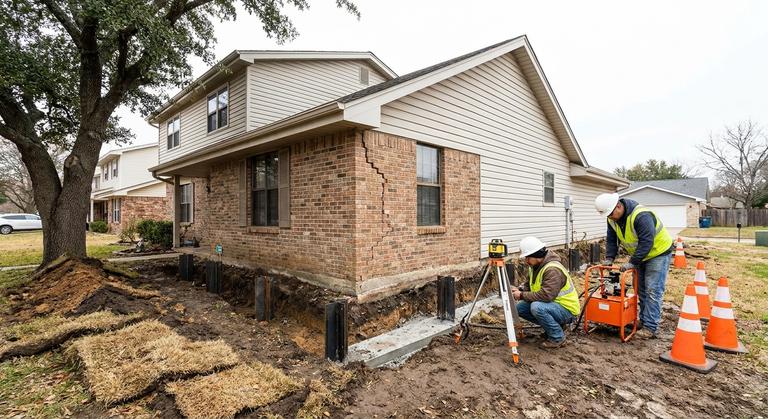
A stair-step crack in the brick over a garage door is not a masonry problem, and once you accept that, the next question is what the foundation repair cost is going to be. There is no useful national average to quote you. The same 1,600 square foot rental gets a completely different scope in Plano than it does in Denver or Tampa, because the soil is doing something different in each place: expansive clay swelling and shrinking with moisture, frost heave pushing on shallow footings, or limestone dissolving under a slab. What you can control as a property manager is knowing how each method is priced, which variables actually move the number, and how to line up three bids that look nothing alike on paper.
What Really Drives Foundation Repair Cost
Every quote you get is built from a unit of measure plus an access penalty. Get both straight and most of the confusion disappears.
- Piers are priced per pier, and the price changes with pier type and depth to load-bearing soil.
- Slabjacking and foam lifting are priced per injection hole, per square foot of lifted slab, or by material pumped.
- Crack repair is priced per linear foot of crack, or per crack for injection work.
- Drainage corrections are priced per linear foot of trench or per downspout run.
The access penalty is where budgets break. Driving a pier along an open exterior wall with a driveway to stage from is the cheap version. The same pier under an interior load-bearing wall means jackhammering finished slab, pulling flooring, protecting the unit and patching afterward, or tunneling in from outside, which is hand-dug labor by the foot. Ask every bidder to split interior and exterior pier counts. Two bids with identical pier totals can be very different jobs.
Two other drivers deserve a direct question. Post-tension slabs, common in newer Texas, Nevada and Arizona construction, mean cables must be located before anyone cuts. And in slab-on-grade markets, a pre-repair hydrostatic test tells you whether a leaking sewer line caused the movement, while a post-repair test tells you whether the lift broke something. Leave both out of scope and a finished foundation job becomes an emergency plumbing call two weeks later.
Piers: Push, Helical, and Pressed Pilings
Underpinning is the biggest single driver of foundation repair cost and the fix you are most likely to be sold. Four systems dominate US residential and small commercial work.
Steel push piers
Driven hydraulically in sections, using the weight of the structure as reaction, until they reach refusal or load-bearing strata. Best under heavy structures like masonry and multi-story buildings. Depth varies, which is why per-pier pricing often includes a depth allowance with a per-foot adder beyond it. Read that clause before you sign.
Helical piers
Screwed into the ground, with capacity verified by installation torque rather than structure weight. That makes them the right answer under lighter loads: additions, stoops, decks and porches. Often a little more per unit, but they load immediately and install in tight access.
Concrete pressed pilings
Short precast cylinders pressed into the soil, very common in Texas residential work and usually the reason one bid is dramatically cheaper. They generally do not reach the depth a steel system does and rely more on friction in the clay, so movement can return in a dry summer. Not automatically wrong, but know what you are buying.
Drilled and bell-bottom piers
Poured in place with a belled base, sized by an engineer, with cure time before load transfer. The most engineered option, and the slowest and most disruptive to the site.
Slabjacking, Mudjacking, and Foam Lifting
Slabjacking solves a different problem. It re-levels a sunken slab where the soil beneath consolidated or washed out. It does not support a structure.
- Mudjacking pumps a cement and soil slurry through roughly one to two inch holes. Cheap material, larger patch scars, and it adds weight to soil that already failed once.
- Polyurethane foam goes through much smaller holes, expands to lift, cures in minutes and weighs a fraction of slurry. It costs more but usually returns a walkway, driveway or garage bay to service the same day.
For a managed portfolio, foam usually wins on tenant disruption and trip-hazard liability, especially on accessible routes. Mudjacking wins on material price across big flatwork like parking aprons.
Crack Repair: Cosmetic, Structural, and Water
The cheapest category and the most misdiagnosed. Match the product to the failure mode.
- Epoxy injection structurally welds a dormant crack in poured concrete and restores tensile strength. Inject a moving crack and the concrete simply cracks again beside your repair.
- Polyurethane injection stays flexible and stops water. This is the right call for an active basement leak.
- Hydraulic cement and surface patching is cosmetic. It hides a symptom.
- Carbon fiber straps stabilize a bowing basement wall within tolerance, priced per strap.
- Wall anchors and helical tiebacks resist lateral soil pressure and can recover a wall over time, priced per anchor.
Crack repair, slab lifting and piering sit in roughly that order from least to most expensive, and they address genuinely different failures. A cheap fix aimed at the wrong failure is not a saving.
How to Normalize Three Foundation Bids
Foundation repair cost comparisons only work when the scopes match. Send every bidder the same document and demand the same line items.
- One independent engineer's plan, with pier locations and an elevation survey, so bids price a single scope instead of three sales opinions.
- Pier count, type and depth allowance, with the per-foot adder stated.
- Interior versus exterior pier split.
- Who pulls and pays for the permit, and who supplies the closeout engineer's letter.
- Cosmetic restoration. After a lift, doors stick, drywall cracks and tile can fail. Put in writing who repairs what.
- Landscaping, flatwork and irrigation restoration.
- Pre and post hydrostatic plumbing tests, included or excluded.
- Post-repair elevation survey proving the lift was achieved, plus warranty terms in full.
Marketplaces like PlanaJob let you put one scope in front of vetted contractors and compare quotes side by side instead of chasing three companies that each measured something different. If you want to understand why two bids on an identical scope still land far apart, the pricing and risk-margin writing at Construction Arbitrage is a useful look at how contractors actually build a number.
Warranties, Permits, and the Paperwork That Protects the Owner
A lifetime transferable warranty is the industry's standard phrase, and it needs three follow-up questions: what is covered (usually re-driving the specific piers installed, rarely cosmetic damage and never the rest of the foundation), who administers it, and what voids it. Drainage changes, new irrigation and added construction are common exclusions. A warranty that quietly fails in year eight becomes a second foundation repair cost the owner never budgeted for. Foundation companies are also bought and sold like any other trade business, with an active market for exactly that at Contractor Exit, so confirm who would actually honor the paper.
Most jurisdictions also require a permit for underpinning, and many require a sealed engineer's letter at completion. Missing paperwork surfaces at resale or refinance, and the owner will ask you why.
Fix the water before you buy piers
In clay markets, much of the movement is a moisture problem: downspouts dumping at the wall, negative grading, a leaking supply or sewer line, or a mature tree pulling moisture from under one corner. Gutter extensions, regrading, root barriers and a consistent perimeter watering program cost a fraction of underpinning and sometimes stabilize things on their own. Any contractor who will not discuss drainage before selling piers is selling piers.
Get a Real Assessment Before You Approve a Number
Foundation repair cost only becomes predictable once the scope stops moving. The route there is one engineered plan, several real bids against it, and contractors whose license, insurance and prior work you can verify before anyone cuts a slab. PlanaJob is built for US property managers who need that comparison quickly: post the scope once, get structural assessments from vetted foundation specialists, and keep the documentation in one place for the owner. Create an account and put your next assessment out to bid, or read more cost guides on the PlanaJob blog first.
FAQ
Does insurance cover foundation repair cost?
Usually not. Standard property policies exclude earth movement, settling and soil expansion. Coverage generally appears only when a covered peril caused the damage, such as a burst supply line washing out soil, or when you carry a specific endorsement. Florida policies treat catastrophic ground cover collapse and sinkhole coverage as separate items, so read the declarations page rather than assuming. If a plumbing leak is involved, file anyway and keep the test results.
How long does the work take, and do tenants need to move out?
Exterior piering on a typical single-family rental is often a few days of work plus cleanup. Interior piers and tunneling take considerably longer and are genuinely disruptive: concrete cutting, dust, noise and rooms out of use. Plan for tenants to be out during interior slab work, budget the vacancy in, and give notice under your state's requirements and the lease.
Should I hire an engineer or use the contractor's free inspection?
Free inspections are sales calls performed by the company that profits from the recommendation. For anything beyond cosmetic crack repair, pay a licensed professional engineer with no financial interest in the outcome to produce a report with an elevation survey and a recommended scope. It costs a fraction of the job and it is the best tool you have for keeping three bids honest.