Fire safety is the one compliance area where a missed detail can cost lives rather than just money. The fire safety regulations for rented property in the UK have tightened steadily over the past decade, and in 2026 property managers are juggling duties spread across several pieces of legislation rather than one tidy Act. Alarms, escape routes, fire doors, furnishings, gas and electrics each carry their own rules, inspection cycles and paperwork. This checklist pulls them into one working document: what to check, how often, who is qualified to do the work, and what evidence you need on file when the council, your insurer or a tribunal comes asking.
Why fire safety regulations for rented property are a patchwork
There is no single landlord fire safety act. In England, the fire safety regulations for rented property that matter day to day sit across several regimes:
- The smoke and carbon monoxide alarm rules for private rented homes, which require a working smoke alarm on every storey used as living accommodation, and a carbon monoxide alarm in any room with a fixed combustion appliance (gas cookers are the exception).
- The Regulatory Reform (Fire Safety) Order 2005, which applies to the common parts of HMOs and blocks of flats and requires the Responsible Person to carry out and maintain a fire risk assessment.
- The Fire Safety (England) Regulations 2022, which added practical duties around fire doors and building information in multi-occupied residential buildings.
- The Housing Act 2004, under which councils assess fire hazards in individual homes and attach fire safety conditions to HMO licences.
- The Furniture and Furnishings (Fire) (Safety) Regulations 1988, which apply to anything upholstered that you supply in a furnished let.
Layer the gas and electrical safety regimes on top - both exist partly to control ignition sources - and it is obvious why an ad hoc approach fails. Work through the checklist below in order; it follows the sequence most portfolios need.
The 2026 checklist
1. Alarms: fitted, tested, recorded
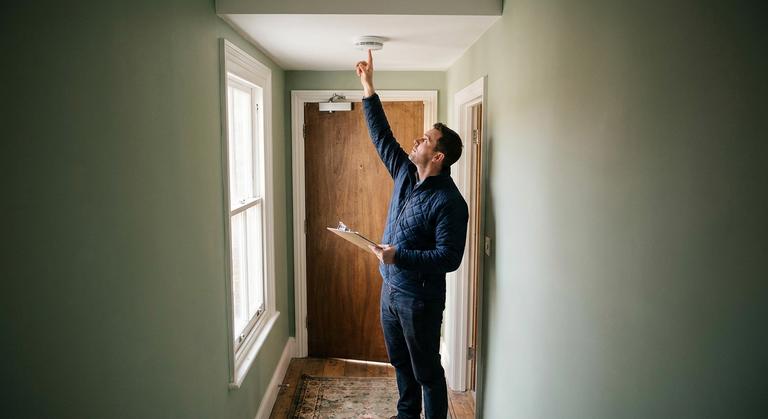
Confirm a working smoke alarm on every storey with living accommodation and a carbon monoxide alarm in every room with a fixed combustion appliance. Test each alarm on the day a tenancy starts and record the test on the check-in inventory with date-stamped photographs. When a tenant reports a fault, current rules in England require the landlord to repair or replace the alarm as soon as reasonably practicable - treat it with the same urgency as a gas leak. Where budgets allow, fit interlinked alarms even when not strictly required; they are already the standard in Scotland and they buy escape time in larger houses.
2. Escape routes you could use in the dark
Walk the route from every bedroom to the final exit and ask one question: could a stranger get out in smoke, at night, without a key? That means thumb-turn locks rather than keyed deadlocks on final exits, no bikes or buggies stored in communal hallways, and no self-closing doors wedged open with fire extinguishers - a depressingly common sight. In HMOs, protected escape routes are usually a licence condition, and obstructed routes are among the most common enforcement findings on inspection.
3. Fire doors and compartmentation
Check every fire door: does the closer shut it fully from any angle, are the intumescent strips and smoke seals intact, are the gaps around the leaf consistent and small, and is the door free of damage and unauthorised alterations such as cat flaps or replacement letterplates? In multi-occupied residential buildings over 11 metres, current rules require quarterly checks of fire doors in communal areas and annual checks of flat entrance doors - and running the same routine in smaller blocks is cheap insurance. Repairs need a contractor who genuinely understands fire door standards, because a smart-looking replacement door that is not fire rated leaves you worse off than the scruffy original.
4. Furniture and furnishings in furnished lets
Every upholstered item you supply - sofas, beds, headboards, padded chairs - must meet the fire resistance requirements of the furniture regulations. Check for the permanent label on each item during inventory visits, and if the label is missing, replace the item rather than debate its provenance. Inherited portfolios are where this goes wrong: nobody knows where the sofa came from, and nobody has looked underneath it in years.
5. Ignition sources: gas and electrical checks
Fires need ignition, so the gas and electrical regimes are part of fire safety even though they live in separate legislation. Book the annual gas safety check with a Gas Safe registered engineer and give tenants the record within the required timescales. Keep the electrical installation condition report current - England requires one at least every five years for private tenancies - and act on any remedial codes rather than filing them. Portable appliance testing on anything you supply is good practice everywhere and a licence condition in many HMOs.
HMOs and blocks of flats: where duties step up
Shared buildings are where fire safety regulations for rented property bite hardest. If you manage the common parts of an HMO or a block of flats, someone must be identified as the Responsible Person under the Fire Safety Order, and that person must have a suitable and sufficient fire risk assessment in place - reviewed regularly, and again after anything material changes, from a kitchen fire to a loft conversion to a change in who lives there. HMO licences then add council-specific conditions on top: fire doors to bedrooms, emergency lighting, fire blankets in kitchens, signage. Read the licence for each property rather than assuming conditions are uniform, because neighbouring councils frequently require different measures for near-identical houses.
Scotland and Wales: do not copy-paste your England checklist
Fire safety regulations for rented property are partly devolved, and the differences are not cosmetic. Scotland requires interlinked smoke alarms in the living room and circulation spaces plus a heat alarm in the kitchen, with carbon monoxide detection where there is a fuel-burning appliance - a higher baseline than England's storey-by-storey rule. Wales ties alarm duties into the fitness for human habitation requirements under its renting homes legislation and expects hardwired, interlinked smoke alarms. If your portfolio crosses a border, run a separate checklist per nation rather than managing to the lowest common denominator.
Evidence: if it is not recorded, it did not happen
Enforcement officers, insurers and tribunals all start from the paperwork, and a compliant property with no records looks identical to a neglected one. Keep, per property:
- Alarm test entries on every check-in inventory, with photographs.
- The current fire risk assessment for common parts, plus the action log showing items closed off.
- Fire door check logs with dates and defects found.
- Gas safety records and electrical installation condition reports, with proof they were served on tenants.
- Furniture label photographs for furnished lets.
- Contractor certificates and competence evidence for any fire safety work carried out.
Store them centrally and searchably. The manager who can produce a complete file within an hour of a council request has usually already won the argument.
Getting fire safety work done without the runaround
The gap between knowing what the fire safety regulations for rented property require and actually getting things fixed is where most compliance programmes stall. Fire door adjustments, alarm upgrades and emergency lighting repairs are small jobs individually, which makes them easy to deprioritise and hard to price. Two habits help. First, batch the work: one visit to fix every door closer in a block costs less and disrupts tenants less than five separate call-outs. Second, use contractors who can show competence in fire-rated work specifically - communities like Contractor Club are where serious UK trades compare notes on standards and accreditation, and that diligence shows in the quality of their work.
Platforms like PlanaJob make the comparison part straightforward: raise the job once and compare quotes from vetted contractors instead of chasing three firms by phone. The tools for property managers are built for exactly this kind of recurring compliance work - raise your fire safety jobs, attach the fire risk assessment actions, and keep the completion certificates filed against each property. If you are not on the platform yet, signing up takes a few minutes, and you will find more compliance guides like this one on the PlanaJob blog.
FAQ
Who is responsible for fire safety - the landlord or the managing agent?
The legal duties sit with whoever has control of the relevant part of the building. For individual dwellings that is normally the landlord, but a managing agent with control of common parts can be the Responsible Person under the Fire Safety Order. Management agreements should state explicitly who does what, because enforcement follows control, not job titles.
How often should a fire risk assessment be reviewed?
The law requires the assessment to be kept up to date rather than setting a universal interval. Review it after any material change - building works, a fire or near miss, a change in occupancy - and on a regular cycle in between. Many managers settle on an annual review for HMOs and busier blocks because it lines up neatly with other compliance renewals.
Do I need to provide fire extinguishers in a single-let house?
There is no general requirement to provide extinguishers in a standard single-household let in England, and an unserviced extinguisher can be worse than none. HMO licences, by contrast, frequently require fire blankets or extinguishers as a condition. Check the licence and the fire risk assessment for each property, and service anything you do provide.