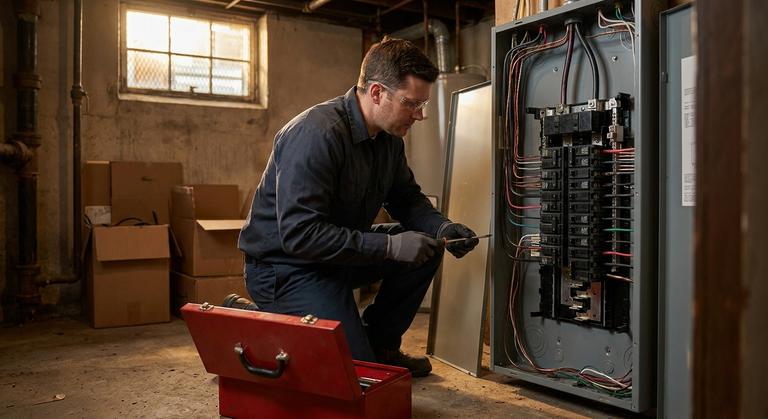
An aging 100-amp panel is the kind of rental property problem that stays invisible right up until it isn't. A tenant plugs in a space heater, a breaker trips for the third time in a week, and suddenly you're fielding electrician quotes you have no way to evaluate. Electrical panel upgrade cost is one of the harder line items for property managers to budget because the honest range is wide: two buildings on the same street can come back with numbers thousands of dollars apart, and both can be fair. Here's what actually drives the price, when a rental genuinely needs 200-amp service, and how to tell a sharp quote from a padded one.
What Determines Electrical Panel Upgrade Cost
The biggest source of confusion around electrical panel upgrade cost is that two very different jobs share the same name.
A panel swap is not a service upgrade
A like-for-like replacement keeps your existing service size. The electrician removes the old load center, installs a new one with new breakers, and you still have 100-amp service when the lights come back on. A service upgrade to 200 amps is a different animal: it usually touches everything between the utility's conductors and your branch circuits - the meter base, the service entrance cable, sometimes the mast and weatherhead, the grounding electrode system, and the panel itself. It also pulls the utility company into the schedule, because someone has to disconnect and reconnect the service. More parties, more parts, more money.
The line items behind the quote
When you get a bid, it should break down roughly like this:
- Equipment - the panel, breakers, and surge protection. Breaker brand and copper prices move this more than most PMs expect.
- Labor - usually the largest share. A clean swap is typically a one-day job for a small crew; a full service upgrade can stretch longer.
- Permit and inspection fees - set by your city or county and wildly inconsistent between jurisdictions.
- Utility coordination - the disconnect and reconnect, sometimes with a fee attached, always with scheduling friction.
- Service entrance work - new meter base, new conductors, mast repairs. Only relevant on a true upgrade, but it's the section that separates a modest bill from a serious one.
- Code-triggered extras - depending on which National Electrical Code edition your state has adopted, the inspector may require updated grounding and bonding, whole-panel surge protection, or arc-fault and ground-fault breakers on certain circuits. These aren't upsells; they're the cost of pulling a permit in your jurisdiction.
- Making good - drywall patching, exterior sealing, or relocating a panel that current code no longer allows in its old spot.
When a Rental Actually Needs 200-Amp Service
Not every tired panel needs to become a 200-amp panel. A small unit with gas heat, a gas range, and a gas water heater can live comfortably on 100-amp service for years. The real triggers look like this:
- A tenant asks about EV charging. A Level 2 charger is a large continuous load, and it's the single most common reason a load calculation comes back tight.
- The property is electrifying. Heat pumps, heat pump water heaters, induction ranges, and electric dryers each claim a slice of capacity, and they tend to arrive together during renovations.
- You're adding an ADU or splitting a unit. New dwelling space almost always means a fresh look at service capacity.
- Chronic nuisance tripping plus a tight load calculation. Tripping alone can be one bad circuit; tripping plus a calculation showing the service near its limit is a capacity problem.
- The panel is being replaced anyway. If hazardous or obsolete equipment has to come out regardless, the incremental cost of stepping up to 200 amps during that visit is far lower than paying for a second project in five years.
The honest answer always starts with a load calculation - the NEC method, on paper, not a glance and a shrug. If the calculation shows real headroom, a like-for-like swap at the existing amperage may serve the property fine and save you a meaningful chunk of the bill.
Panels That Should Jump the Maintenance Queue
Some equipment changes the conversation from 'when budget allows' to 'this cycle':
- Federal Pacific (Stab-Lok) and Zinsco panels have a well-documented history of breakers failing to trip. Many insurers will refuse to write or renew coverage on properties that still have them, or will surcharge until they're gone.
- Fuse boxes are not inherently dangerous, but they invite tenant improvisation - an oversized fuse screwed in to stop the blowing is a fire risk you can't monitor.
- Split-bus panels lack a single main disconnect, which first responders and electricians both dislike for good reason.
- Visible distress - scorching, rust streaks, buzzing, warm breaker faces, or 'double-tapped breakers' showing up on inspection reports.
There's also a compliance angle. HUD's NSPIRE inspection standards treat electrical hazards as serious deficiencies, so a known-problem panel in a voucher unit can cost you far more than the replacement would. And insurance renewal questionnaires increasingly ask for panel brand and amperage by name. Replacing on your own schedule is nearly always cheaper than replacing on an insurer's or inspector's deadline.
What It Runs: Ranges and Why Quotes Vary
Treat the following as orientation, not a quote - regional labor rates and utility requirements swing electrical panel upgrade cost hard. In most US markets, a straightforward like-for-like panel replacement tends to land somewhere in the $1,500 to $4,000 range. A full 100-amp to 200-amp service upgrade - new panel, meter base, service entrance conductors, permits, and the code-triggered extras that ride along - commonly starts around $2,500 and can run well past $5,000 where access is difficult, the service is underground, or the local utility's requirements are demanding.
Why do two bids for the same building differ by thousands? Usually one of these: one electrician priced the unknowns (aluminum branch wiring, a corroded service entrance cable, a panel that has to move to meet current working-clearance rules) and the other didn't; one included permit fees and utility coordination while the other left them as extras; or one shop is simply busier and pricing accordingly. If you want to understand how contractors build these numbers from the other side of the table - overhead, licensing costs, callback risk - the pricing breakdowns at Construction Arbitrage are a worthwhile read.
One rule holds everywhere: the cheapest bid that excludes the permit is not the cheapest bid. It's a deferred bill with interest.
Keeping Electrical Panel Upgrade Cost Under Control
You can't negotiate copper prices, but you can control how the project is scoped and bought:
- Get the load calculation first, in writing, before anyone talks amperage. It's the document that stops both under-building and over-selling.
- Bid an identical scope to every electrician - amperage, surge protection, AFCI and GFCI expectations, patching, permit and utility fees included. Three bids on three different scopes tell you nothing.
- Bundle across the portfolio. If four units in a building share the same 1970s panels, one mobilization beats four service calls, and electricians price accordingly.
- Plan the outage properly. A panel change means most of a working day without power. Written tenant notice, a mild-weather date, and a check for tenants with medical equipment or remote-work needs will save you the complaint calls.
- Never accept unpermitted panel work. It surfaces at sale, at insurance claim time, and at every future inspection.
On the bidding itself, platforms like PlanaJob let property managers put one clear scope in front of multiple vetted electricians and compare like-for-like quotes instead of chasing callbacks. Every electrician on PlanaJob is license-verified for panel work in your state, which matters more on service upgrades than almost any other trade job - this is not the project for a handyman with a multimeter. If panel replacements are on your capital plan this year, create a free account or see how PlanaJob works for property managers. You'll find more cost guides on our blog.
FAQ
Will tenants lose power during an electrical panel upgrade?
Yes - plan on most of a working day for a swap, and potentially longer for a full service upgrade if the utility's reconnect slips. Give written notice, schedule around extreme weather, and check whether any tenant relies on powered medical equipment before you book the date.
Can I replace the panel without going to 200-amp service?
Absolutely. If the load calculation shows adequate capacity, a like-for-like replacement addresses safety and insurability at a lower electrical panel upgrade cost. Ask the electrician to price both options - the difference is often smaller than expected when the panel is coming out anyway.
Do I need a permit to upgrade an electrical panel?
In virtually every US jurisdiction, yes - panel and service work requires a permit and inspection, and the utility generally won't reconnect an unpermitted service upgrade. A licensed electrician should pull the permit as part of the job; treat any suggestion to skip it as a reason to choose a different contractor.