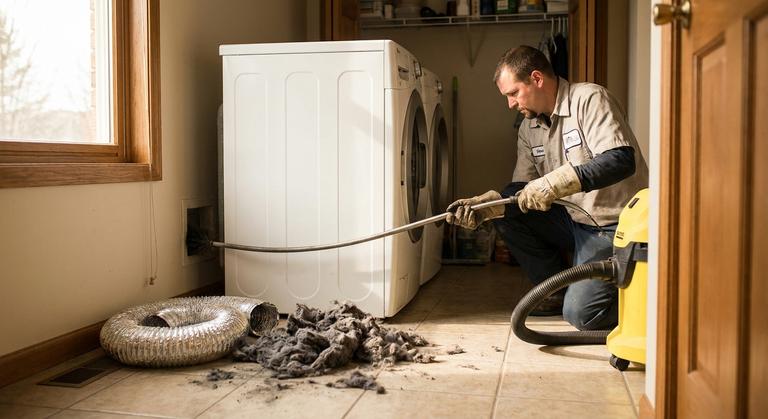
A clothes dryer is the only appliance in most rental units that combines high heat, continuous airflow, and a steady supply of finely divided fuel inside a duct you cannot see. That is why dryer vent cleaning sits at the top of the preventable fire list for property managers. Fire authorities including the NFPA have consistently identified failure to clean as the leading contributing factor in home clothes dryer fires, ahead of mechanical or electrical failure. The lint was in the duct the whole time. Nobody pulled it out. Unlike wiring faults or tenant behavior, this one is fully inside your control and costs a scheduled visit.
Why a lint-packed duct turns into a fire
Lint is nearly ideal fuel
Lint is cellulose and synthetic fiber shredded into a low-density mat that holds a lot of air. It ignites far more readily than the garment it came off, and once it catches inside a duct it has a chimney to travel through. The lint trap catches only a portion of what comes off a load. The rest goes downstream and settles wherever the airflow slows: at elbows, at crushed sections, at the termination cap, and in the cavity behind the machine.
Restriction is what turns fuel into ignition
A partially blocked duct means the dryer cannot exhaust heat and moisture. Cycle times stretch, the element or gas burner runs longer per load, the high-limit thermostat and thermal cutoff cycle more often, and temperatures inside the drum and duct climb. Long run times plus elevated temperature plus a duct lined with fuel is the entire failure sequence. Tenants usually notice the first symptom, two cycles to dry one load, months before anything dangerous happens, and they almost never report it because they assume the machine is just old.
The US code details that decide whether a vent is safe
Requirements vary by jurisdiction, so verify against your locally adopted code and any state amendments. In most places the mechanical provisions follow the International Residential Code, and the recurring failures are the same ones:
- Duct material. Rigid or semi-rigid metal with a smooth interior. Vinyl and thin foil concealed inside walls are not acceptable. Joints should run in the direction of airflow and be sealed with foil tape, not fastened with screws that project into the duct and snag lint.
- Developed length. IRC-based codes commonly cap total developed length at 35 feet, with deductions for each bend, typically 5 feet per 90-degree elbow and 2.5 feet per 45, unless the manufacturer instructions or a listed booster fan permit more. Long runs in mid-rise and podium buildings often exceed this quietly after a remodel moved a machine.
- Transition duct. The flexible connector behind the machine must be a listed transition duct, kept short, never concealed in a wall or ceiling, and never extended by joining two lengths together.
- Termination. Exhaust must terminate outdoors with a backdraft damper and no screen. Terminating into an attic, crawl space, garage, or soffit cavity is both a fire problem and a moisture problem.
- Ventless units. Condensing and heat pump dryers common in retrofits have no duct, but they still have filters, a condenser coil, and a drain that clog. Give them their own maintenance line rather than assuming there is nothing to service.
How often to schedule dryer vent cleaning across a portfolio
Annual is the sensible baseline for a standard in-unit dryer, and it matches general fire safety guidance to have vents inspected and cleaned once a year by a qualified professional. Adjust up from there based on how hard the vent works:
- Standard in-unit dryer, short exterior run: once a year.
- Stacked or closet units with long or bendy runs: once a year, plus a check at every turnover.
- Shared or common-area laundry rooms: every three to six months. These machines run all day and produce lint at a completely different rate.
- Student housing, corporate rentals, high-occupancy units: twice a year.
- Any unit where a tenant reports long dry times: immediately, as a diagnostic call rather than a routine one.
Also fold dryer vent cleaning into your turnover checklist for any unit with in-unit laundry. The unit is empty, access is free, and you are already sending techs there.
What a competent dryer vent cleaning visit includes
Plenty of contractors will run a brush in from the exterior cap for ten minutes and call it done. Specify the scope in the work order so you are comparing like for like:
- Pull the machine and disconnect the transition duct, then clean from both ends.
- Use a rotary brush on a drive rod with vacuum capture, not just compressed air blown toward the outside.
- Clean the transition duct, the lint trap housing, the cavity under and behind the machine, and the floor pan.
- Inspect the full duct run for crushed sections, non-compliant material, disconnected joints inside walls, and screws penetrating the duct. Report and quote any repairs separately.
- Service the exterior termination: verify the damper opens and closes freely, remove any screen or bird nest, and confirm the cap is not painted shut.
- Verify airflow after the work and document it. A before-and-after reading, or at minimum a timed dry test with photos, turns the invoice into evidence.
- Deliver a per-unit written record with photos, filed against the unit, not one line item covering the whole building.
That last point matters more than it sounds. If a fire does happen, the difference between a defensible position and a negligence claim is a dated per-unit record showing the vent was serviced and the duct was inspected. Your insurance carrier will ask for it. So will opposing counsel.
Signs your turnover techs should be trained to flag
- Loads that need two cycles, or clothes still damp on a normal setting.
- The dryer cabinet or the laundry closet running noticeably hot.
- A burning or scorched smell during operation.
- Humidity, condensation, or a musty odor in the laundry closet, which suggests a leaking or disconnected duct inside the wall.
- A termination cap where the damper does not open while the dryer runs, or where you can feel almost no air.
- Lint accumulating around the exterior cap or on the ground beneath it.
- Tenant reports that the dryer shuts off mid-cycle, which usually means the thermal cutoff is doing its job.
Train these into the same walkthrough you use for smoke alarm checks. The marginal time cost is close to zero and the catch rate is high.
Run it as a program, not a stream of work orders
The reason dryer vent cleaning gets skipped is not that managers think it is unimportant. It is that it is a small job spread across many addresses, which is exactly the shape of work that falls through a reactive maintenance queue. Handle it the way you handle fire extinguisher servicing: one annual scope, one schedule, one vendor, one document trail.
Batching also fixes your pricing. A single vent cleaning is an expensive callout because travel dominates the labor, while forty units on one route is a completely different economic conversation and contractors will price it that way. If you want the underlying logic on why route density and scope bundling move trade pricing so sharply, Construction Arbitrage is a good read on how contractors actually build their numbers.
Sourcing is usually the bottleneck. Platforms like PlanaJob let property managers post one job and compare quotes from vetted contractors instead of chasing three voicemails, and our US property managers page walks through how that fits an existing maintenance calendar. You can schedule annual dryer vent cleaning across every unit in your portfolio as a single PlanaJob booking, then repeat it on the same date next year. Create an account and post the scope once. More maintenance playbooks like this one are on the PlanaJob blog.
FAQ
How often should dryer vent cleaning be done in a rental unit?
Once a year for a standard in-unit dryer with a short run, which aligns with general fire safety guidance to have vents inspected and cleaned annually by a qualified professional. Increase to every three to six months for shared laundry rooms and twice a year for high-occupancy units. Any report of long dry times should trigger a visit regardless of when the last one happened.
Is the landlord or the tenant responsible for dryer vent cleaning?
Where the owner supplies the dryer and the duct is part of the building, the duct is building infrastructure and the owner or manager is the practical responsible party. Leases sometimes assign lint trap cleaning to the tenant, which is reasonable. Assigning duct cleaning to a tenant is not, because they cannot access it. Check your state landlord-tenant statute and your insurance policy conditions, since carriers increasingly ask for maintenance records after a fire.
Does a short, straight dryer vent still need cleaning?
Yes. A short run clogs more slowly, but the termination cap and damper are still where lint collects, and a bird nest built in the cap in spring can block a four-foot duct just as completely as a thirty-foot one. Short runs are cheap and fast to service, so there is no good reason to exclude them from the annual schedule.