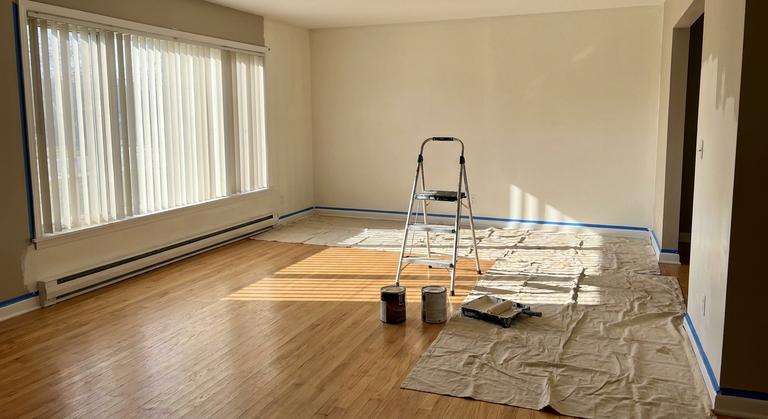
Ask three painters what it costs to repaint a vacant unit and you will get three numbers that are impossible to compare, because they are not pricing the same thing. One is quoting walls only. One is quoting walls, ceilings, trim, and doors. One is quoting per room and treating a 10-foot bedroom the same as a living room with a stairwell. The cost to paint apartment units is not really a market rate you can look up - it is a formula built from surface area, prep condition, and how many coats the color change demands. Once you can rebuild that formula yourself, bids stop being a guessing game and your make-ready budget becomes a line item you can defend to an owner.
Two Ways Painters Quote, and Why They Rarely Match
Most residential painters price interior work one of two ways, and the gap between those methods is where property managers quietly lose money.
Per-room pricing
A per-room price is a bundled estimate: a standard bedroom gets one number, a standard bath gets another. It is fast, easy to approve, and works well for repetitive turnover work in buildings where the floor plans repeat. The risk is that the word standard is carrying a lot of weight. Ask what the painter's standard room actually assumes - ceiling height, whether closet interiors are included, whether the ceiling gets painted, whether trim and door casings are in or out.
Per-square-foot pricing
A per-square-foot price sounds more precise but hides a bigger trap: which square footage. Some painters quote against floor area, the 750 sq ft on your rent roll. Others quote against wall and ceiling surface area, which for that same unit is two to three times larger. A bid that looks like half the price of its competitor is often just measured against a different denominator. Always ask, in writing: is that per square foot of floor area, or per square foot of painted surface?
Which one to ask for
For turnovers, flat per-unit or per-room pricing is easier to budget and easier to schedule against a lease start date. For a whole-building repaint, a renovation, or a unit with unusual geometry, per surface square foot is fairer to both sides.
Calculate the Square Footage Yourself Before You Read Any Bid
You do not need takeoff software. Five minutes with a laser measure gives you enough to sanity check any estimate.
- Wall area: add the length of all four walls (the perimeter) and multiply by ceiling height. A 12 by 14 bedroom has a 52-foot perimeter; at an 8-foot ceiling that is 416 square feet of wall.
- Openings: do not bother subtracting standard doors and windows. Cutting in around them takes back the time you saved on area. Subtract only for large openings such as sliders, wall-sized windows, or an open pass-through.
- Ceilings: ceiling area equals floor area. That same bedroom adds 168 square feet.
- Trim: measured in linear feet of baseboard, casing, and crown, not square feet. Doors are priced per door, and a door has two sides plus edges.
- Coverage: manufacturers generally rate a gallon at roughly 350 to 400 square feet per coat on smooth, primed drywall. Texture, raw drywall, and deep color changes eat considerably more.
Run that exercise across a whole unit and the painted surface usually lands somewhere between two and three times the floor area once interior partition walls and closets are counted. That number, not the rent roll number, is what the crew is actually rolling.
What Drives the Cost to Paint Apartment Units Up or Down
Two identical floor plans in the same building can differ by hundreds of dollars. These are the variables that move the number, roughly in order of impact:
- Prep condition. Patching nail pops, anchor holes, drywall dings, and damaged corner bead is labor, and labor is most of your invoice. A unit that needs skim coating in the hallway is not the same job as a unit that needs a wipe-down.
- Color change and coat count. The same off-white over the same off-white may cover in one coat. Bringing a tenant's navy accent wall back to your standard color means primer plus two coats on that wall at minimum.
- Stains and odors. Water stains, smoke, marker, and grease above the range need a stain-blocking or shellac-based primer. Another coat of latex will ghost through within weeks.
- Ceiling height and access. Anything above roughly 9 feet, plus stairwells and vaulted ceilings, means ladders, planks, or lifts and much slower production.
- Scope beyond the walls. Ceilings, trim, doors, and closet interiors each add. Ceilings alone can add meaningfully to the cost to paint an apartment because they are slow, awkward, and almost always need full coverage.
- Occupied versus vacant. An empty unit can be sprayed and back-rolled. An occupied unit means masking, moving furniture, and working around a resident's schedule.
- Texture. Knockdown, orange peel, and popcorn ceilings absorb far more paint per square foot than smooth drywall.
- Paint grade. Contractor-grade flat is cheaper per gallon but shows every scuff. A scrubbable eggshell costs more upfront and often survives an extra tenancy, which is the number that matters.
- Building logistics. Third-floor walk-up, no elevator reservation, no parking near the entrance, no dumpster access - all of it shows up in the hours.
If you want to understand why those variables matter so much from the crew's side, the margin math behind production rates is covered well on strategy blogs like Construction Arbitrage. Painters live or die by square feet per labor hour, not by the sticker price on the gallon.
Getting Bids You Can Actually Compare
The highest-leverage thing a property manager can do is send every painter the same scope sheet. Include:
- Unit number, floor plan, and rentable square footage.
- Ceiling height, plus a note on any vaulted or stairwell areas.
- Exactly what is in scope: walls, ceilings, trim, doors, closets, and anything explicitly excluded.
- Product and sheen by name, or a statement that you supply the paint.
- Number of coats, current color, and finished color.
- Prep expectations: patch and sand nail holes, spot prime, caulk gaps.
- Access window and whether the unit is occupied.
- Who handles final cleanup and trash-out.
- Payment terms and how the punch list gets closed.
Then ask for the bid split into labor, materials, and prep so you can see where the difference actually lives. Bids that are far apart almost always differ on coats or ceilings, not on hourly rate. Platforms like PlanaJob let you post the scope once and compare quotes from vetted contractors side by side, so you are comparing price rather than interpretation. There is more on running maintenance procurement this way on our property managers page.
Lead Paint and Product Rules You Cannot Skip
If the building was built before 1978, federal lead-safe rules apply to work that disturbs painted surfaces, and that covers a lot of routine sanding and scraping. Firms doing that work in pre-1978 housing generally need EPA Lead-Safe certification and must follow contained work practices, and you have separate disclosure obligations to residents. Confirm the certification before the crew starts, not after an inspector asks. Several states and regional air districts also set tighter VOC limits than the federal baseline, which affects which products your painter can legally use. A good local contractor will already know their own market's rules.
Turnover Math That Saves Real Money
Standardize to one color and one sheen
Pick a single wall color and sheen across the portfolio and hold the line. Touch-up becomes possible instead of a full repaint, you can keep gallons on the shelf, and any crew can walk into any unit without a color match. This is the single biggest structural lever on turnover painting cost, and it costs nothing to implement.
Touch-up versus full repaint
Touch-up genuinely works on flat paint, in the same color, from a reasonably fresh batch, on an otherwise clean wall. It rarely works on eggshell or satin, where the patch flashes in side light. Decide wall by wall rather than unit by unit: a full repaint in the hallway with touch-up in two bedrooms is a normal, defensible outcome.
Deposits and normal wear and tear
Faded paint and minor scuffs after a multi-year tenancy are almost always normal wear and tear, which you cannot charge back. Unapproved colors, crayon, holes beyond nail size, and smoke damage are a different category, and many states expect you to prorate against the remaining useful life of the paint rather than bill a full repaint. Landlord-tenant rules vary by state, so check your own statute, and document with time-stamped move-in and move-out photos either way.
Build the Budget Before the Unit Goes Vacant
The cost to paint an apartment stops being a surprise the moment you fix the scope, fix the color, and price it as a repeatable line item instead of a fresh negotiation every turn. Write the scope sheet once, price it per floor plan, and hold your painters to it. Book flat-rate turnover painting through PlanaJob and know your make-ready budget upfront - you can create an account in a couple of minutes and post your first turnover the same day. More breakdowns like this one live on the PlanaJob blog.
FAQ
How much does it cost to paint an apartment per square foot?
There is no single national rate, and any guide quoting one is guessing at your market. What you can control is the denominator. Measure the painted surface yourself (perimeter times ceiling height for walls, floor area for ceilings), then ask each painter for a rate against that same number. Once every bid uses the same surface area, the spread between them tells you something real about scope and prep rather than about measuring conventions.
Do I need to repaint the whole unit at every turnover?
No, and doing so is one of the most common make-ready overspends. Walk the unit with a flashlight before you decide. High-traffic surfaces such as hallways, the kitchen, and around switches usually need paint every turn; bedroom walls in good condition on a short tenancy often need spot repair and touch-up only. This only works if you have standardized your color and sheen, which is the whole argument for doing it.
Can I deduct the cost to paint an apartment from a tenant's security deposit?
Only for damage beyond normal wear and tear, and only to the extent your state allows. Routine fading and small scuffs are wear and tear in most jurisdictions. Painting over a color the tenant applied without permission, or priming out smoke damage, is usually chargeable, though many states require you to prorate the charge against the paint's remaining useful life. Check your state's landlord-tenant statute, keep the contractor's itemized invoice, and back it with dated move-in and move-out photos.