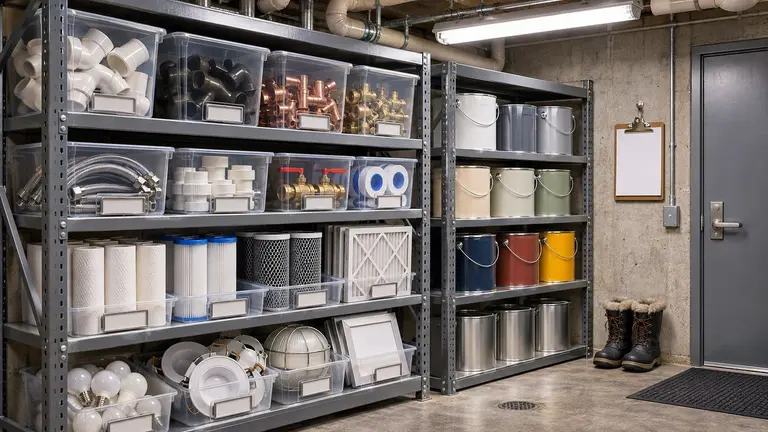
A condo maintenance stockroom inventory is a written list of the parts and materials your building keeps on site, with a minimum quantity for each item, a named person who controls it, and a simple rule for signing items out and reordering. That is the whole answer. The rest of this guide shows how to build one that a superintendent, a property manager and a maintenance contractor can all trust, without turning it into a second job.
Most condo stockrooms fail in the same way. Parts get bought for a repair, the leftovers go on a shelf, and nobody writes them down. A year later the room is full, but the one cartridge you need for a leaking suite tap is not there. A good inventory fixes that by deciding in advance what earns shelf space.
Decide what belongs in the stockroom
Not everything should be stocked. The test is simple. Keep an item on site if it is used often, if a delay would cause damage or a complaint, or if it is hard to get quickly. Everything else can be ordered per job.
Items most buildings keep
The exact list depends on your building, its equipment and its age. As a starting point, walk the building with your superintendent or maintenance contractor and look at these groups:
- Plumbing: common faucet cartridges for the fixtures actually installed in suites and amenity spaces, toilet flappers and fill valves, supply lines, shut-off valves, washers and plumber's tape.
- HVAC: filters in the sizes your fan coils, heat pumps or make-up air units use. Write down the size and grade, not just 'filters'.
- Electrical and lighting: lamps for corridors, stairwells, parkades and exterior fixtures, plus spare ballasts or drivers if you have older fittings.
- Doors and access: closers, hinges, strike plates, door sweeps and spare fob readers or cylinders if your access contractor approves holding them.
- Common-area finishes: touch-up paint in labelled colours, spare ceiling tiles, carpet tiles from the original batch and grout or caulk to match.
- Seasonal: ice melt, shovels and mats before winter, and hose bibs or irrigation parts before spring.
Items to think twice about
Some things need a person's decision before they go on a shelf. Specialist parts for fire, life safety, elevators or gas equipment are normally handled by the licensed contractor responsible for that system, and their service agreement may say how spares are kept. Check with that contractor and your management agreement before stocking them. Chemicals and fuels need proper storage and labelling, so confirm your current provincial and municipal requirements rather than guessing.
Build the inventory sheet
A spreadsheet is fine. What matters is that every line answers the same questions.
- Item and exact specification. Brand, model or part number, size and finish. 'Cartridge' is useless. 'Single-handle cartridge, model number as shown on the suite fixture' is useful.
- Where it is used. Suite type, floor, amenity room or system. This stops someone using the last parkade lamp in a lobby fixture.
- Shelf location. Bay and bin number. Label the bins to match.
- Minimum quantity (par level). The number at which you reorder.
- Reorder quantity. How many to buy when you hit the minimum.
- Supplier and lead time. Where it comes from and how long it usually takes.
- Unit cost in CAD. Use your latest invoice, not a guess.
- Last counted. Date and initials.
Setting par levels
Par levels come from your own history. Look back through the last year of work orders and invoices for each item. If you replaced a handful of a certain filter a month and the supplier takes a week, your minimum needs to cover at least that week plus a margin. If an item was used once in a year, it may not need a par level at all.
An illustrative example, not a real building: a 120-suite tower finds it replaced the same toilet fill valve in suites across several floors over the year, always with a few days' wait for parts. The manager sets a small minimum, keeps the reorder quantity modest, and notes the supplier's lead time on the sheet. The point is the reasoning, not the numbers.
Control the stockroom without slowing repairs
An inventory only stays accurate if items are signed out. Keep the rule short enough that people follow it.
A sign-out rule that sticks
- One person holds the key or controls access, usually the superintendent.
- Every item taken out is recorded against a job or work order number, the suite or area, and the quantity.
- Contractors who use building stock record it the same way. Agree in writing whether building stock is charged back on their invoice or supplied free to the job.
- Returns go back on the sheet. Damaged or opened items are marked as such.
Tying stock to a job number is the important part. It means that when the board asks why plumbing spend went up, you can show which suites and which repairs used the parts.
Counting
Do a quick count of fast-moving items monthly and a full count at least once a year, ideally before budget preparation. Compare the count with what the sign-out record says you should have. Small gaps are normal. Large or repeated gaps deserve a conversation.
Decide who approves spending
Stockroom purchases are still condo corporation money. Before you start, confirm three things in writing with the board and your management agreement:
- the spending limit the property manager or superintendent can approve without the board,
- which operating budget line stock purchases are charged to, and
- how items bought for a capital or reserve fund project are treated, since leftovers from that work may belong to that project's records.
Where a purchase is unusual, such as buying a larger quantity of discontinued corridor carpet tiles while they are still available, take it to the board. That is a judgement call about cost and future need, and it should not sit with one person.
Connecting the stockroom to your work orders
The inventory works best when the job record and the parts record talk to each other. Plan@Job does not run a stockroom or count bins for you. What it does is help keep the jobs themselves clear, which is where most parts problems start.
Plan@Job is AI-powered project and operations management for construction and property businesses. For a condo, the useful parts are these:
- Clearer job briefs. Sophie Bennett, the AI Enquiries Coordinator, checks existing job briefs for missing information and asks for clarification, such as the fixture model, a photo of the part or the suite number. If there is still no answer after two attempts, the job is handed to a person. A brief that names the part means the right item gets pulled from the shelf the first time.
- A morning brief. Daniel Reed, the AI Operations Manager, prepares a morning brief and follows up on quotes and proposed dates. That gives the superintendent an early view of the day's jobs so parts can be checked before anyone arrives on site.
- Staged work with internal costs. For larger work, the project plan splits a job into internal stages with scope, dates, status and costs, whether the work is done by a subcontractor or an in-house operative. Materials can be recorded against the stage. Internal stage costs stay internal; the client sees the agreed overall scope and price and the evidence you choose to share.
The decisions stay with people. Someone still decides what to stock, approves each purchase, chooses the contractor and signs off the invoice. No part of this awards work or spends money on its own.
If you are a maintenance contractor looking after several condo buildings, the same discipline applies to your van and your yard. Keep stock per building separate from your own stock, so you can show each corporation exactly what you supplied.
Your next step
Print your current stockroom list, or start one, and walk the room with your superintendent this week. Mark anything with no specification, no location or no minimum. That short list is your first job.
Plan@Job is live in the UK first. If you manage condos in Canada and want to see how clearer job briefs and staged project plans could support your maintenance work, check availability and join the list on the Plan@Job page for Canadian property managers. Maintenance contractors can do the same on the Canadian contractors page, and you can read how the AI staff handle job briefs and follow-ups.
FAQ
How often should a condo maintenance stockroom inventory be counted?
Count fast-moving items, such as filters and lamps, monthly. Do a full count at least once a year, ideally before the operating budget is prepared, so the board sees real figures.
Who owns the parts in a condo stockroom?
In most cases the condo corporation does, because it paid for them. If a contractor keeps its own stock on site, record that separately and agree in writing how it is charged. Check your management and service agreements for the specific terms.
Can software keep the stockroom stocked automatically?
Treat any automatic reordering with care, because it is still the corporation's money. Plan@Job does not manage stock levels. It helps keep job briefs complete and work organised, while purchases and approvals stay with the property manager, superintendent and board.