The most expensive sump pump failure is the one you discover in the second week of the melt, standing in a finished basement with a tenant on the phone. Across most of Canada the pump sits idle from November to March, then gets asked to run for days on end while the snowpack goes, the ground is still frozen, and a rain-on-snow event sends a season's worth of water at the weeping tile. Spring sump pump maintenance is the cheapest insurance a property manager can buy, and it takes well under an hour per pit if you do it before the thaw rather than during it. Here is how to test the whole system, and how to run it across a portfolio.
Why spring sump pump maintenance matters more in Canada
Canadian sump pumps deal with meltwater, and frozen soil cannot absorb it, so it moves sideways along the frost line into the gravel bed around the foundation and the weeping tile that feeds the pit. Add a March rainstorm on a heavy snowpack and inflow can go from nothing to continuous in an afternoon.
Three things make this worse for a pump that has sat all winter:
- Idle time. Seals dry out, impellers seize on debris and float switches stick. A pump that ran fine in October can hum without moving water in March.
- Frozen discharge lines. If the outside run froze in January and nobody noticed because nothing was pumping, the first real cycle pushes against a plug of ice.
- Power outages. Spring storms take down hydro lines. If the pump depends entirely on the wall receptacle, the busiest day of the year is the day it is most likely to lose power.
That is why sump pump maintenance in spring, done before the melt, needs to be a fixed date on the calendar rather than a reaction.
When to schedule it
Do the check while the ground is still frozen, so a pump that fails the test can be replaced before it is needed. Sump pump maintenance before spring is mostly about timing, and the window shifts by region. Coastal British Columbia sees water year-round, the Prairies tend to melt fast and late, and Ontario, Quebec and Atlantic Canada often get an early thaw followed by a refreeze, so late February to early March is the safer bet there.
A step-by-step spring sump pump maintenance check
Bring a flashlight, a bucket or a garden hose, a notepad and gloves.
1. Inspect before you test
Look at the pit, the lid, the cords and the receptacle. The pump should be on a GFCI-protected receptacle, with the cord in good condition and out of the water. Check the pit for silt, gravel, debris or a tenant's stored belongings.
2. Run a pour test
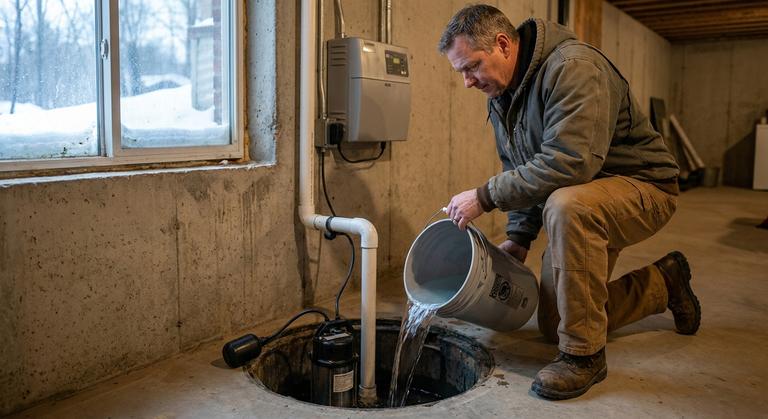
Pour water into the pit slowly until the float rises and the pump kicks in. Watch three things: the float lifts freely, the water level actually drops, and the pump switches off cleanly once the float falls. Note the cycle time. If the pump runs but the water does not drop, or it keeps running after the pit is empty, treat it as a fault.
3. Check the float switch
Float switches cause more spring failures than motors do. A tethered float snags on the pit wall, the discharge pipe or its own cord, and a vertical float sticks on mineral buildup. Move it by hand through its full travel.
4. Test the check valve
The check valve sits on the discharge pipe above the pump and stops water falling back into the pit. Listen at the end of a cycle. A loud clunk or a rush of water back into the pit means the valve is worn or installed backwards, and the arrow on the body should point away from the pump. Confirm there is a small weep hole in the pipe below the valve to prevent airlock.
5. Trace the discharge line outside
Follow the line to where it ends. It should discharge well away from the foundation, downhill, and not onto a neighbour's lot, a sidewalk or a driveway where it will refreeze into a hazard. Many Canadian municipalities prohibit connecting sump discharge to the sanitary sewer, so check your local bylaw. If the line is frozen, do not force the pump against it. A freeze-relief fitting near the wall gives water an escape route if the outside run ices up again.
6. Test the battery backup
If there is a battery backup, unplug the primary pump and run the pour test again so the backup does the work on its own. Check the charger light, the terminals for corrosion and the date on the battery. Batteries have a finite life regardless of use, and a backup that has never been tested is a hope, not a system. For a water-powered backup, confirm your municipality allows them and that a backflow preventer is fitted.
7. Clean, listen and log it
Scoop out silt and gravel and clear the intake screen, which is the most common reason a pump runs but moves little water. Reset the pump level so the float clears the walls. Grinding, rattling, humming without pumping or rapid on-off cycling all mean something is wrong. Write down the date, what you found, the cycle time and the battery date.
Signs it is time to replace rather than maintain
- It runs continuously or cycles every few seconds when inflow is modest.
- Rust on the housing, or a smell from the pit that persists after cleaning.
- It trips the breaker or the GFCI more than once.
- The motor is noticeably hot after a short run.
- Nobody has a record of when it was installed.
A pump that fails any of these is not worth a repair call in March. Replace it, and while the contractor is there, ask about a high-water alarm or a Wi-Fi monitor that texts you when the level rises. The whole point of spring sump pump maintenance is to find this out in February, not April.
Running spring sump pump maintenance across a portfolio
One basement is a chore. Thirty basements in a three-week window is a project, and it needs the same structure as any seasonal round.
- Keep one list. Every property with a sump pit, the pump type, whether there is a backup, the last test date and the last battery date. Update it during the visit.
- Brief your tenants. Tenants unplug pumps to use the receptacle. A short notice each winter explaining why the outlet must stay free saves a lot of grief.
- Check the rest of the drainage. Eavestroughs, downspout extensions and lot grading decide how much water reaches the weeping tile.
- Know your insurance position. Overland water and sewer backup coverage are typically optional endorsements in Canada, and some insurers ask whether a sump pump and backwater valve are in place. Keep the maintenance log with the policy documents.
- Get the work quoted early. Contractors are busiest once basements are already wet. Platforms like PlanaJob let property managers post the job once and compare quotes from vetted contractors, which helps when you have a dozen pits to check in the same two weeks.
If you manage rentals across several cities, the PlanaJob page for Canadian property managers explains how to run seasonal rounds without chasing individual trades, and there are more seasonal checklists on the PlanaJob Canada blog.
A note for contractors
If you are a plumber or waterproofing contractor, a spring sump pump maintenance round is the kind of recurring, predictable work the business strategy writers at Construction Arbitrage keep recommending, and a book of repeat seasonal clients is what buyers look at hardest when a trade business changes hands, a theme that comes up often on Contractor Exit.
What a professional visit should include
A good contractor visit covers the pump, the float switch, the check valve, the discharge line and the battery backup in one go, and leaves you with a written result per property. PlanaJob pros test pumps, float switches and battery backups in a single visit, so you are not booking a plumber for the pump, an electrician for the receptacle and someone else for the backup. Post the job on PlanaJob with your property list and the date you want the round finished, and let vetted local contractors quote against it.
FAQ
How often should a sump pump be tested?
At least twice a year: once before the spring melt and once in the fall before freeze-up. Properties with a finished basement or a history of water should get a quick pour test after the first heavy rain of spring as well.
Can the sump discharge go into a floor drain or the sanitary sewer?
In many Canadian municipalities, no. Sump water belongs on the ground surface or in the storm system, and sending it into the sanitary sewer can contribute to basement backups across the neighbourhood. Check your municipality's rules before changing where a line runs.
The pump runs but the pit is not draining. What is wrong?
Start with the simple causes: a clogged intake screen, a frozen or blocked discharge line, or a check valve installed backwards. If those are clear and the pump still moves little water, the impeller is likely worn and the pump should be replaced rather than repaired.